What this hypersexuality screener measures
This hypersexuality test targets distress and impairment themes clinicians discuss when sexual urges feel hard to manage. Six domains cover urge intensity, control difficulty, relationship impact, shame, escapist coping, and boundary respect. High libido alone is not the focus. Shame-reducing language matters because secrecy can delay help.
Urge intensity
Strength and persistence of sexual urges or preoccupying sexual thoughts.
Control difficulty
Difficulty stopping or limiting sexual behavior once started or when trying to cut back.
Relationship impact
Conflict, neglect, or concern from others tied to sexual habits or preoccupation.
Shame and distress
Shame, worry, hiding, or emotional pain about sexual thoughts or behaviors.
Escapist use
Using sex, porn, or fantasy primarily to escape stress, loneliness, or numb feelings.
Boundary respect
Honoring consent, agreements, and stopping when boundaries are crossed. Higher is healthier.
How it works
Three steps from first statement to concern index plus domain bars. Click Start Test to open the interactive quiz in a full-screen modal with session autosave.
Answer 22 statements
Rate agreement on a five-point scale about patterns over the past year. There is no timer and no auto-advance.
Items map to six domains
Your answers accumulate percentages for urges, control, relationships, shame, escapist use, and boundary respect.
View index and band
Results show concern index, boundary respect index, domain chart, signal flags, and one of three bands with support next steps.
Take the hypersexuality test
Rate 22 statements about urge intensity, control difficulty, relationship impact, shame, escapist coping, and boundary respect. Your answers produce a concern index plus a band label. This is not a diagnosis.
Opens in a focused modal. Adults only. Results stay on screen.
What your result means
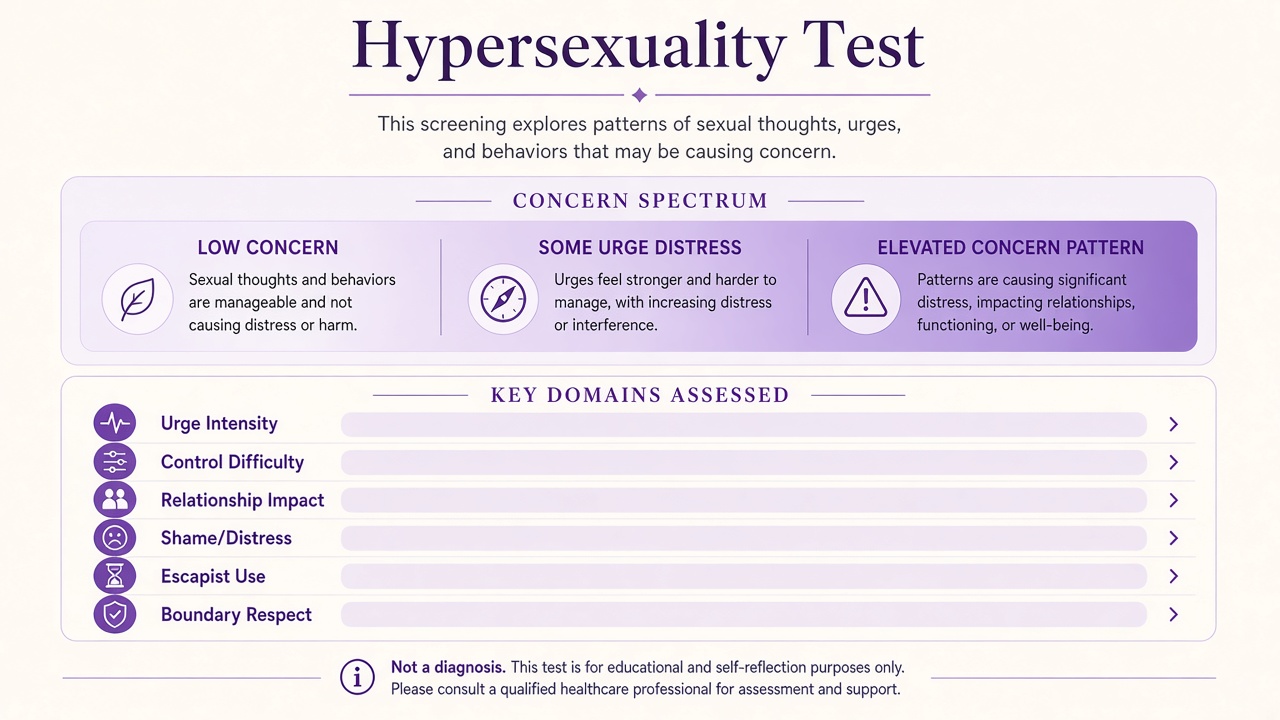
Your concern index (0 to 100) averages urge intensity, control difficulty, relationship impact, shame and distress, and escapist use domains. Boundary respect scores separately because healthy consent habits can coexist with distress. Band assignment uses the concern index only.
| Band | Score range | Plain-language reading |
|---|---|---|
| Low Concern | 0 to 34% | Limited distress or impairment themes on this screener |
| Some Urge Distress | 35 to 58% | Mixed distress signals worth monitoring without assuming diagnosis |
| Elevated Concern Pattern | 59 to 100% | Elevated distress themes; consider professional support |
Concern domains and the distress spectrum
The diagram below shows how six domains feed your concern index alongside boundary respect. High urge intensity with healthy boundary respect may still land in Some Urge Distress when shame or escapist use also score high.
What this test can and cannot tell you
Can tell you
- How your answers lean on distress and impairment themes today
- Which of six domain bars scored highest on this snapshot
- Whether boundary respect scored alongside control difficulty
- When to seek professional help based on elevated concern patterns
Cannot tell you
- Whether you have compulsive sexual behavior disorder or any DSM diagnosis
- Whether ADHD, bipolar disorder, mania, or trauma is present
- Whether high libido alone is pathological without distress
- What treatment you need without a licensed clinician assessment
Hypersexuality, distress, and getting support
Clinical discussions of compulsive sexual behavior emphasize distress or impairment, not moral judgment about desire level. The World Health Organization includes compulsive sexual behaviour disorder in the ICD-11 as a condition marked by persistent failure to control intense sexual impulses despite harm. The Quiz Hub does not administer that diagnosis. This screener educates about urge, control, shame, and relationship themes so adults can decide whether professional support would help.
Dr. Morgan Chen reviewed limits so this page never implies that every strong urge equals pathology. Our sex drive test measures trait libido separately. Our horny test captures state arousal. This hypersexuality test stays focused on distress and impairment. Pair all three when searches mix libido curiosity with worry about control.
| The Quiz Hub test | What it adds |
|---|---|
| Sex drive test | Trait-level libido without assuming distress or impairment |
| Horny test | State-level arousal versus long-term concern patterns here |
| This hypersexuality test | Concern index, boundary respect index, and six distress domain bars |
Sample item: agreeing that you use sex to escape stress raises escapist use without automatically meaning you lack boundary respect. Agreeing that you crossed a sexual boundary you knew was wrong raises concern on boundary items and should prompt professional conversation if true. If shame scores highest, support may help even before relationship conflict appears. Browse more on our kink and BDSM hub or read review standards in our editorial policy.
Hypersexuality test FAQ
What does this hypersexuality test measure?
This hypersexuality test screens distress and impairment themes across six domains: urge intensity, control difficulty, relationship impact, shame and distress, escapist sexual coping, and boundary respect. Results show a concern index, boundary respect index, domain bars, and one of three bands. It describes self-reported patterns on this screener, not a clinical diagnosis.
Is this hypersexuality test a diagnosis?
No. This quiz cannot diagnose compulsive sexual behavior disorder, hypersexuality, or any DSM condition. Dr. Morgan Chen reviewed clinical limits so the page states clearly that online screeners are educational only. Seek a licensed clinician if functioning feels impaired.
Does this test screen for ADHD, bipolar disorder, or mania?
No. This hypersexuality test does not screen for ADHD, bipolar disorder, mania, or any psychiatric condition. Increased sexual behavior can appear in several medical and mental health contexts. Only a qualified professional can evaluate those possibilities.
What is the difference between high libido and hypersexuality?
High libido on our sex drive test describes trait-level interest without assuming distress. Hypersexuality concern focuses on urge intensity plus control difficulty, shame, relationship harm, or escapist coping. Many people have strong drive without impairment.
Is compulsive sexual behavior treatable?
Yes. Compulsive sexual behavior and related distress patterns are treatable with therapy, support groups, and sometimes medical care when co-occurring conditions are present. This quiz encourages professional help in elevated concern bands without replacing clinical assessment.
Who reviewed this content?
Dr. Morgan Chen, PhD, reviewed the test framing and result explanations. See our editorial policy for review standards.
Reviewed by