What this love type test measures
The psychology types of love framework groups recurring attitudes toward romance, commitment, and care. Each style reflects a different pattern rather than a personality disorder or compatibility verdict.
Eros
Passionate, romantic love driven by chemistry and desire.
Ludus
Playful, exploratory love that keeps things light early on.
Storge
Friendship-first love built on trust and steady companionship.
Pragma
Practical love guided by compatibility and shared life plans.
Mania
Intense, preoccupied love with strong fear-of-loss undertones.
Agape
Generous, other-centered love that stays caring through difficulty.
How it works
Three steps from first scenario to your love style profile. Click Start Test to open the interactive quiz in a full-screen modal.
Answer 24 scenarios
Rate how much you agree with each relationship scenario on a five-point scale.
Items map to six styles
Your answers accumulate scores across Eros, Ludus, Storge, Pragma, Mania, and Agape. The highest score becomes your primary style.
View primary, secondary, and bars
Results show your top two styles, percent breakdown, partner tips, and growth notes.
Take the psychology types of love test
Rate 24 relationship scenarios on a five-point agree-disagree scale. Your answers reveal a likely primary love style plus a secondary influence with percent bars for all six categories.
Opens in a focused modal. No account required. Results stay on screen.
What your result means
Your primary love style is the category with the highest scenario score. Your secondary is the next highest. Percent bars show strength within each style, not a share of 100% across all six.
| Score pattern | Typical reading |
|---|---|
| One style clearly highest | Strong primary signal; secondary adds nuance |
| Two styles close together | You may blend patterns; read both profiles |
| Flat scores across styles | Many neutral answers or mixed preferences; retake when focused |
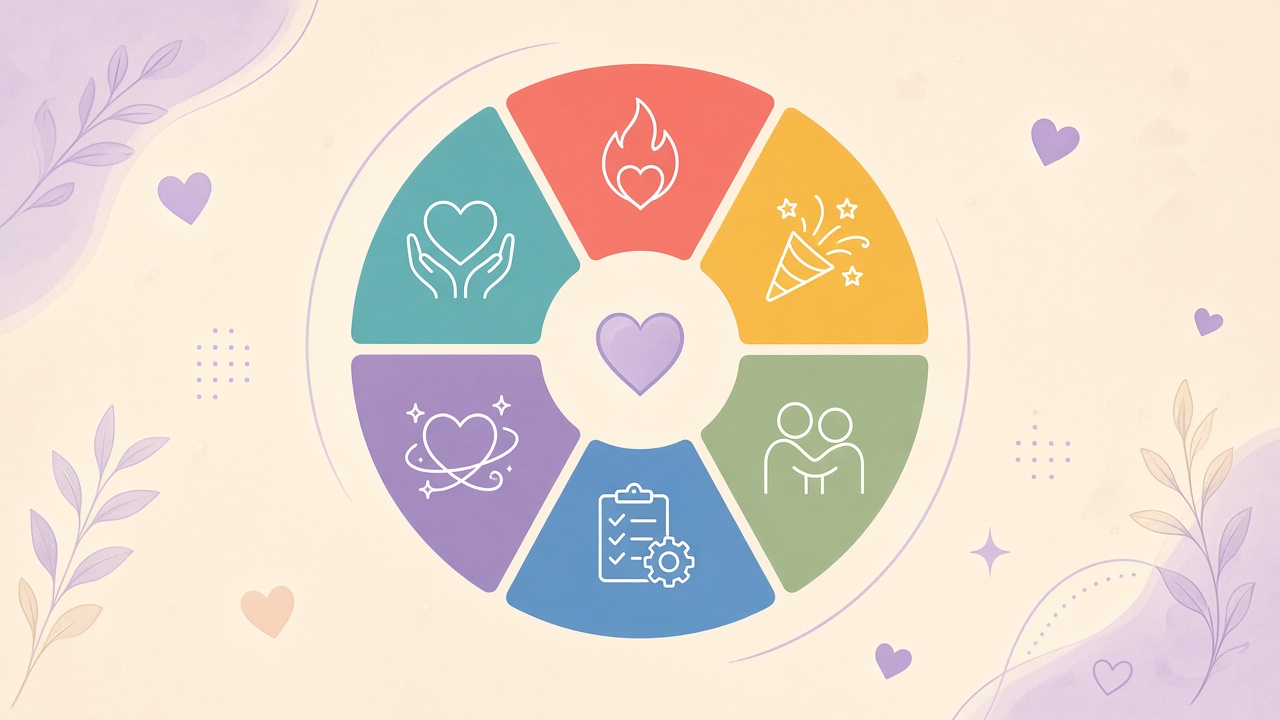
Lee's color wheel of love styles
John Alan Lee proposed six love styles in Colors of Love (1973), often drawn as a hexagon or color wheel in textbooks. The model helps name how people approach romance, not whether love is healthy or doomed.
What this test can and cannot tell you
Can tell you
- Your self-reported emphasis among six common love style attitudes
- A likely secondary style when two scores sit close together
- Plain-language partner tips and growth notes for reflection
- A vocabulary for discussing romance patterns with a partner or therapist
Cannot tell you
- Whether you or a partner are "meant to be" or compatible long term
- Official LSQ or Hendrick love attitudes scale scores
- Clinical attachment, personality, or mood disorder diagnoses
- Whether a relationship should continue or end
Understanding psychology types of love
John Alan Lee's love styles grew out of literary and classical models of romance. Eros echoes passionate Greek love poetry. Ludus treats courtship as a game. Storge grows from friendship. Pragma weighs practical fit. Mania blends desire with jealousy. Agape points toward selfless care. Later researchers such as Clyde and Susan Hendrick built the Love Attitudes Scale (LAS) to measure similar constructs with longer item sets.
The Quiz Hub uses a shortened 24-item scenario quiz with original wording, not the full published LAS. Pair your results with our love language test to compare care preferences with broader love attitudes. If you are sorting feelings toward someone specific, the am I in love quiz focuses on emotional intensity and attachment pull. For bond resonance with a current partner, try the soulmate test on the relationships and dating hub.
No online love type test replaces conversation or therapy. Styles can overlap, shift by life stage, and look different across cultures. Use your primary and secondary labels as hypotheses to explore together, especially when Mania or Pragma scores sit high and you want balance between intensity, security, and planning.
Psychology types of love FAQ
What are the psychology types of love?
John Alan Lee grouped common love patterns into six styles in his 1973 book Colors of Love: Eros (passionate romance), Ludus (playful love), Storge (friendship-based love), Pragma (practical love), Mania (obsessive love), and Agape (selfless love). The model is often shown as a color wheel for teaching, not as a clinical diagnosis tool.
How long does this love type test take?
Most people finish in about 6 minutes. There are 24 agree-disagree scenario items, four per love style. You can pause and return in the same browser session.
What is a primary and secondary love style?
Your primary love style is the category with the highest item score on this quiz. Your secondary is the next highest. Percent bars show how strongly each of the six styles scored relative to its own maximum, not as a share of 100% across all styles.
Is this the same as love languages?
No. Chapman love languages describe how you prefer to receive care. Lee love styles describe broader attitudes toward romance, commitment, and intensity. Many people take both quizzes and compare patterns on our love language test page.
Can my love style change over time?
Yes. Life experience, attachment healing, and relationship context can shift which items you endorse. Treat results as a snapshot for reflection, not a fixed identity label.
Who reviewed this content?
Dr. Priya Sharma, PhD, reviewed the test framing and result explanations. See our editorial policy for review standards.
Reviewed by