
What this pick me quiz measures
This pick me quiz estimates how much TikTok-era pick-me energy shows up in your dating and social habits. Twenty original agree-disagree statements group into four domains: validation chasing, competition mindset, self-minimizing, and boundary softening. Your pick-me energy index averages those patterns into a 0 to 100 score with plain-language bands. It reflects self-report about attention habits, not proof of how others see you.
Validation chasing
Checking replies, posting for reactions, and needing reassurance that you are still chosen.
Competition mindset
Comparing yourself to rivals, "not like other girls" framing, and ranking for romantic attention.
Self-minimizing
Apologizing for normal needs, hiding achievements, and performing easygoing likability.
Boundary softening
Tolerating disrespect, saying yes when you mean no, and ignoring red flags for approval.
How it works
Three steps from first question to your pick-me energy report. Click Start Quiz to open the interactive quiz in a full-screen modal.
Answer 20 agree-disagree items
Rate each statement from Strongly disagree to Strongly agree about dating and social habits. You click Next after each answer; nothing auto-advances.
Items map to four pick-me domains
Your answers accumulate percentages for validation chasing, competition mindset, self-minimizing, and boundary softening, plus an overall pick-me energy index.
View band and domain bars
Results show Secure Solo Energy, Mixed Pick-Me Vibes, or Peak Pick-Me Energy with domain bars and reflection prompts for group-chat sharing.
Take the pick me quiz
Rate 20 agree-disagree statements about validation chasing, rivalry, self-minimizing, and boundary softening in dating and social media. Your answers produce a pick-me energy index from 0 to 100, four domain scores, and a meme band label for entertainment reflection.
Opens in a focused modal. No account required. Results stay on screen.
What your result means
Your pick-me energy index is the normalized total across all 20 items on a 0 to 100 scale, with reverse scoring on healthy-boundary items so higher scores mean more pick-me patterns overall. Domain bars show endorsement rates so you can see whether validation chasing, rivalry, self-minimizing, or boundary softening drives your result most.
| Band | Index range | Typical reading |
|---|---|---|
| Secure Solo Energy | 0 to 35 | Fewer pick-me habits on this screener; normal crush nerves may still appear |
| Mixed Pick-Me Vibes | 36 to 65 | Blend of self-respect and approval chasing; worth noticing if persistent |
| Peak Pick-Me Energy | 66 to 100 | Frequent validation chasing, rivalry, or boundary softening; prompt for honest reflection |
What your pick me report looks like
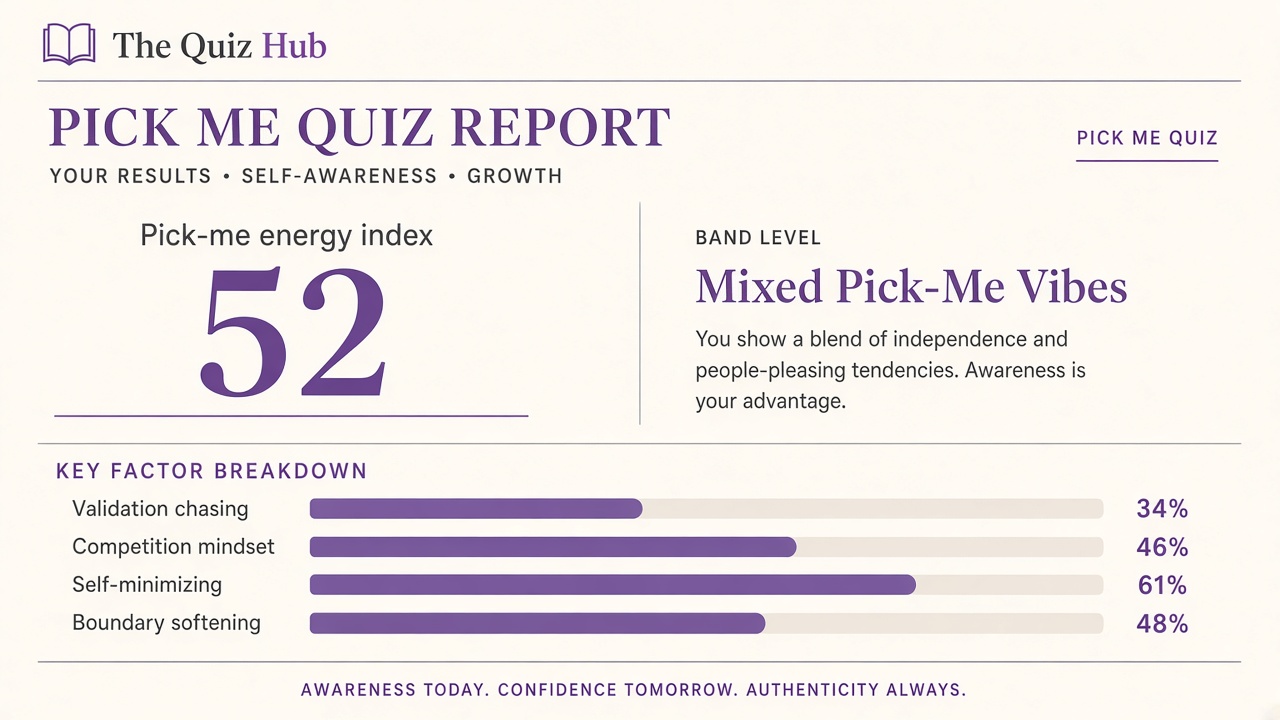
After all 20 items, you get a pick-me energy index from 0 to 100, a band label, and four domain bars for validation chasing, competition mindset, self-minimizing, and boundary softening. Percentages reflect habits you notice in dating and group chats, not a moral verdict about your character.
What this quiz can and cannot tell you
Can tell you
- How much pick-me flavored habits showed up in your self-report today
- A pick-me energy index and four domain bars for validation, rivalry, shrinking, and boundaries
- Which domain pattern feels strongest in your current dating or social habits
- A meme conversation starter for group chats or honest self-reflection
Cannot tell you
- Whether you are toxic, a bad partner, or morally inferior to others
- Whether you have a personality disorder or any clinical diagnosis
- How many people secretly judge you or whether your crush prefers someone else
- What treatment or relationship decision you need without your own judgment and support
Pick-me meme language and self-awareness
The phrase pick me girl spread through TikTok and Twitter/X in the early 2020s as meme shorthand for someone who performs likability, compares herself to other women, or softens boundaries to win romantic attention. Sociologist Eva Illouz wrote about emotional capitalism in Why Love Hurts (2012), describing how modern dating markets encourage self-branding and competitive visibility. Meme culture turned those observations into punchy labels rather than peer-reviewed scales. The Quiz Hub built this pick me quiz as an original agree-disagree screener inspired by that discourse, not a reproduction of any published instrument.
Readers often compare it to sibling tools on this site. Our am I a people pleaser quiz screens broad approval seeking across many relationships with frequency items. The am I insecure quiz maps self-worth and comparison habits in dating. The how many people have a crush on me quiz playfully screens incoming flirt attention with fictional crush-count bands rather than pick-me habits.
| The Quiz Hub test | What it adds |
|---|---|
| Am I a people pleaser quiz | Broad approval seeking and conflict avoidance, not dating rivalry meme language |
| Am I insecure quiz | Self-worth and comparison in relationships, not pick-me domain breakdown |
| How many people have a crush on me quiz | Fictional crush-count vibes from incoming attention, not validation chasing habits |
| Do I have a crush quiz | Your own crush butterflies and nervousness, not rivalry for someone else's attention |
| Bird test relationship | Partner bid responsiveness in viral relationship memes, not pick-me self-minimizing |
| This pick me quiz | Four-domain pick-me energy index for validation, rivalry, shrinking, and boundaries |
Sample item types include agree-disagree statements such as whether you refresh apps waiting for a crush's reply, or whether you would rather be alone than accept treatment below your standards. High validation chasing with high competition mindset often lands in Mixed or Peak Pick-Me Energy. New crushes, friend-group drama, and algorithm-heavy social seasons can spike scores temporarily. Read how we review quizzes in our editorial policy or browse more tools on our fun and novelty hub.
Pick me quiz FAQ
What does pick-me energy mean?
Pick-me energy is TikTok and Twitter meme language for habits that chase romantic validation, compare yourself to rivals, shrink your personality for approval, or soften boundaries to stay chosen. It is not a clinical label. This pick me quiz maps those self-reported patterns to a pick-me energy index from 0 to 100 with four domain bars for entertainment reflection.
What does this pick me quiz measure?
Twenty original agree-disagree statements group into validation chasing, competition mindset, self-minimizing, and boundary softening domains. Your answers produce a pick-me energy index from 0 to 100 and a band from Secure Solo Energy through Mixed Pick-Me Vibes to Peak Pick-Me Energy. It reflects habits you notice, not how others secretly judge you.
How is this different from the am I a people pleaser quiz?
The am I a people pleaser quiz screens broad approval seeking and conflict avoidance across many relationships using frequency items. This pick me quiz focuses on dating and social-media flavored pick-me habits with agree-disagree statements about rivals, DMs, and shrinking yourself for romantic attention.
Can this quiz label me toxic or diagnose a disorder?
No. Meme labels are conversation starters for self-awareness, not moral verdicts or clinical diagnoses. Only a licensed clinician can evaluate personality or relationship patterns through structured interviews. Online quizzes cannot prove you are a bad partner or friend.
How long does the pick me quiz take?
Most people finish in about four minutes. There are twenty agree-disagree statements on a five-point scale from Strongly disagree to Strongly agree. You click Next after each answer, and session autosave lets you pause in the same browser.
Who reviewed this content?
Dr. James Whitfield, PhD, reviewed the test framing and result explanations. See our editorial policy for review standards.
Reviewed by
