What the Healthy Friendship Quiz measures
This quiz does not diagnose personality disorders, replace couples or family therapy, or certify that someone must stay or leave a bond. It measures how much you agree with healthy friendship statements grouped four ways: reciprocity and support about balanced emotional labor and practical care; boundary respect habits about accepting nos and privacy; conflict repair without gossip about direct talk instead of alliance roasts; and quiz-not-toxic-label limits about playful captions and refusing viral exile cosplay. You rate 22 statements from strongly disagree to strongly agree, with reverse-worded traps so one loyalty meme cannot inflate every bar. Your answers also feed a second chart on closeness and trust habits. The total becomes an index from 0 to 100 where higher means more reported friendship literacy on this screener, not proof you are always right in every fight.
Reciprocity and support
Two-way care without scorecards.
Boundary respect habits
Nos, privacy, and pacing.
Conflict repair without gossip
Direct talk before rumor squads.
Quiz not toxic label
Habits not public exile orders.
How it works
Answer 22 agreement items
Rate each statement from Strongly disagree to Strongly agree. Tap Next after each answer.
Answers sort into four domains
Each answer feeds one of four healthy friendship groups, and every item also feeds a closeness and trust layer.
See your index and charts
You get a 0 to 100 index, a band, four domain bars, and a second chart for intimacy habits.
Take the Healthy Friendship Quiz
Answer 22 short statements to see your healthy friendship habits index, four domain bars, and a closeness and trust chart.
What your result means
Your index is the average of all 22 answers, scaled from 0 to 100, with reverse-worded items flipped first. Read boundary bars with repair bars together before you treat a high score as proof someone else is toxic. Licensed clinicians still own safety planning when fear persists.
| Band | Index range | Typical reading |
|---|---|---|
| Building healthy friendship habits | 0 to 35 | Fewer agreed habits on reciprocity, boundaries, repair, or toxic-label limit items. |
| Mixed healthy friendship habits | 36 to 65 | Solid support with boundary blur, gossip slips, or toxic-label corners. |
| Strong healthy friendship habits | 66 to 100 | Frequent agreement with reciprocity, boundaries, repair, and limits; still unofficial reflection only. |
Tips at a glance
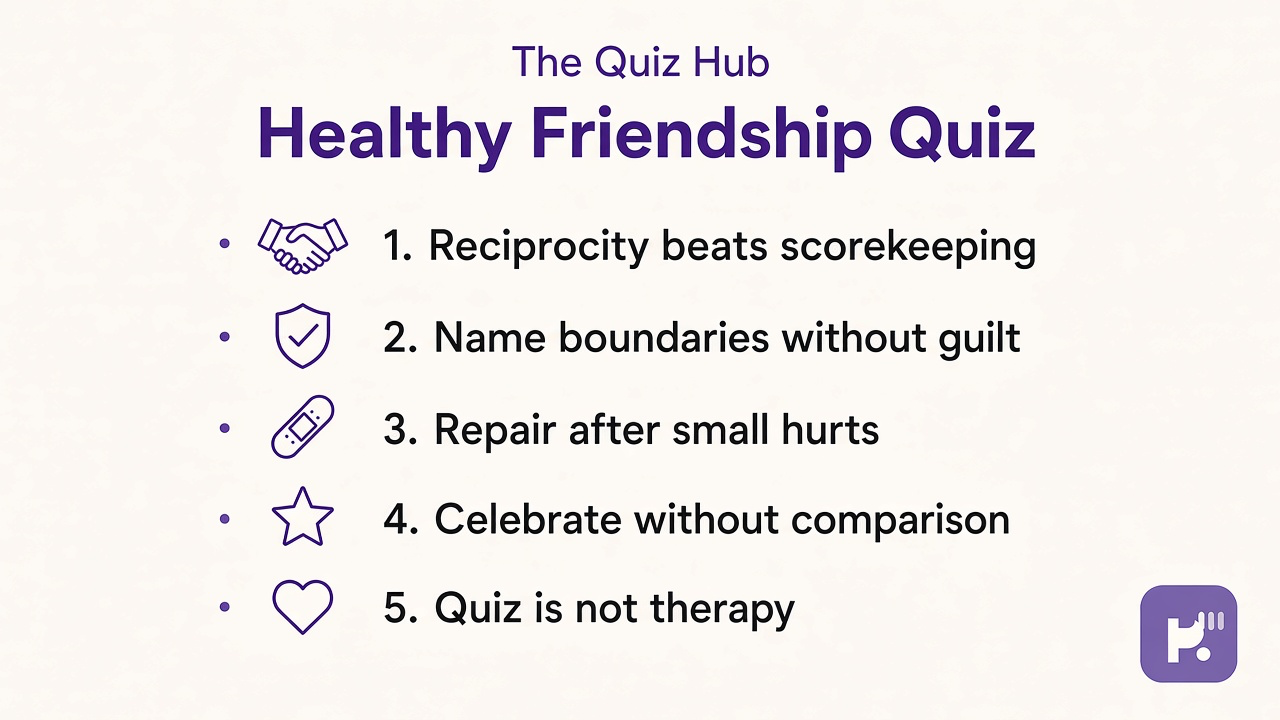
A quick takeaway graphic with topic tips (not your personal quiz scores). Start the quiz for your index, bands, and charts.
What this quiz can and cannot tell you
Can tell you
- Highlight reciprocity, boundary, and repair habits worth revisiting before tough talks
- Separate respectful reflection from rumor threads and public toxic labels
- Encourage direct repair without shame spirals about awkward seasons
- Spark better questions for therapists without claiming clinical authority
Cannot tell you
- Replace licensed therapy, abuse assessments, or safety planning with professionals
- Prove you may exile someone without conversation from bar height alone
- Diagnose narcissism, BPD, or other clinical labels from agree totals
- Predict whether a friendship must end forever from one couch session
Why healthy friendship quizzes need reciprocity context, boundary patience, repair habits, and toxic-label separation
Search traffic around healthy friendship quizzes often arrives from group-chat drama, boundary posts, or readers seeking fair language after rumor weeks, not from therapy portals or permission to exile someone from one bar screenshot. Those goals help when readers use reciprocity checks, respect nos, and keep agree bars away from public toxic labels. They hurt when couch scores become proof you may recruit a dunk squad. Friendship reflection works best when limit items sit beside original stems.
Dr. Priya Sharma reviews relationship screeners with a simple split: reward honest support agreement and honest limits on viral label myths at the same time. Reciprocity and support tracks two-way care without secret ledgers. Boundary respect habits tracks privacy and pacing without guilt-trip cosplay. Conflict repair without gossip tracks direct talk before alliance chats. Quiz-not-toxic-label limits keep screeners separate from exile orders.
Real readers mix bars. You might score high on support while keeping repair moderate, which often describes big heart yet occasional rumor slips during stress weeks. Reverse items catch overconfidence: rumor loyalty myths or instant toxic branding should not inflate habits meant to track everyday care.
Pair results with siblings instead of forcing one loyalty lecture. Our friendship quiz explores general trust and repair habits with separate stems. Our friend group quiz stays on circle roles rather than reciprocity depth here. Our frenemy quiz names competition and gossip patterns when trust feels mixed. Browse the relationships and dating hub for more reflection screeners. Share scores as private reflection with consent, not as orders to confront someone at lunch.
Drama feeds move faster than repair skills in group chat. A boundary bar might dip after one overshare week while reciprocity stays high until you retake calmly. When you share results, say unofficial friendship habit reflection, not therapist verdicts.
| Test | Focus |
|---|---|
| Friendship quiz | General trust and repair rather than healthy reciprocity depth on this page |
| Friend group quiz | Circle roles and cliques rather than boundary and gossip limits here |
| Frenemy quiz | Competition and trust mixed signals rather than healthy support stems on this screener |
Healthy Friendship Quiz FAQ
What does the Healthy Friendship Quiz measure?
It measures how much you agree with statements about reciprocity and support, boundary respect, repair without gossip, and quiz-not-toxic-label limits. You get an index from 0 to 100 plus four bars reflecting self-rated habits on this screener.
Can I use results to label someone toxic online?
No. Limit items reject viral toxic-label cosplay. Real safety concerns deserve direct support, advocates, or clinicians, not screenshot verdicts.
Is this a substitute for therapy?
No. Licensed therapists assess relationship patterns with interviews and safety planning. This page stays informal habit reflection only.
How is this different from the friendship quiz?
This page emphasizes healthy reciprocity, boundary respect, and gossip-free repair. The friendship sibling focuses broader trust language with separate stems.
Who reviewed this quiz?
Dr. Priya Sharma reviewed the relationship framing, boundary language, and result explanations. See our editorial policy for review standards.
Reviewed by