What the Friendship Quiz measures
This quiz does not diagnose personality disorders, rank your friend group, or declare who must stay or leave from one session. It measures how much you agree with general friendship habits grouped four ways: trust and vulnerability about confidences, honest pacing, white-lie awareness, and anti-vent-sharing traps; conflict repair habits about tone apologies, cool-down returns, curiosity before defense, mutual change requests, and anti-silent-treatment myths; reciprocity and boundaries about emotional labor balance, accepting help, kind nos, and clear borrow timelines without midnight-availability traps; and quiz not friend verdict about unofficial framing, refusal to label friends clinically from bars, consented sharing, and automatic cut-off myths. You rate 22 statements from strongly disagree to strongly agree, with reverse-worded traps so agreeable mood cannot hide boundary testing. Your answers also feed a second chart on closeness and trust habits, because everyday friendship stress sometimes tracks intimacy distance on the same week a fight happens. The total becomes an index from 0 to 100 where higher means more reported trust and repair habits on this screener, not proof every bond is healthy. Friend-group dynamics and decade milestone care live on separate siblings with different stems.
Trust and vulnerability
Vault secrets; honest words; paced openness.
Conflict repair habits
Apologize, listen, return after cool-down.
Reciprocity and boundaries
Give and receive; kind nos; clear timelines.
Quiz not friend verdict
Habit mirror; bars are not exile orders.
How it works
Answer 22 agreement items
Rate each statement from Strongly disagree to Strongly agree. Tap Next after each answer.
Answers sort into four domains
Each answer feeds one of four friendship habit groups, and every item also feeds a closeness and trust layer.
See your index and charts
You get a 0 to 100 index, a band, four domain bars, and a second chart for intimacy habits.
Take the Friendship Quiz
Answer 22 short statements to see your friendship trust and repair index, four domain bars, and a closeness and trust chart.
What your result means
Your index is the average of all 22 answers, scaled from 0 to 100, with reverse-worded items flipped first. Read verdict-limit bars together with repair scores before you treat a low total as proof you must cut someone off. Cozy reflection supports kinder friendship talk; licensed clinicians still own treatment when cycles hurt or feel unsafe.
| Band | Index range | Typical reading |
|---|---|---|
| Building friendship trust habits | 0 to 35 | Fewer agreed habits on trust, repair, reciprocity, or verdict framing on this screener. |
| Mixed friendship trust habits | 36 to 65 | Solid honesty with repair slips, reciprocity traps, silent treatment myths, or verdict framing gaps. |
| Strong friendship trust habits | 66 to 100 | Frequent agreement with trust, repair, reciprocity, and verdict limits; still not therapy. |
Tips at a glance
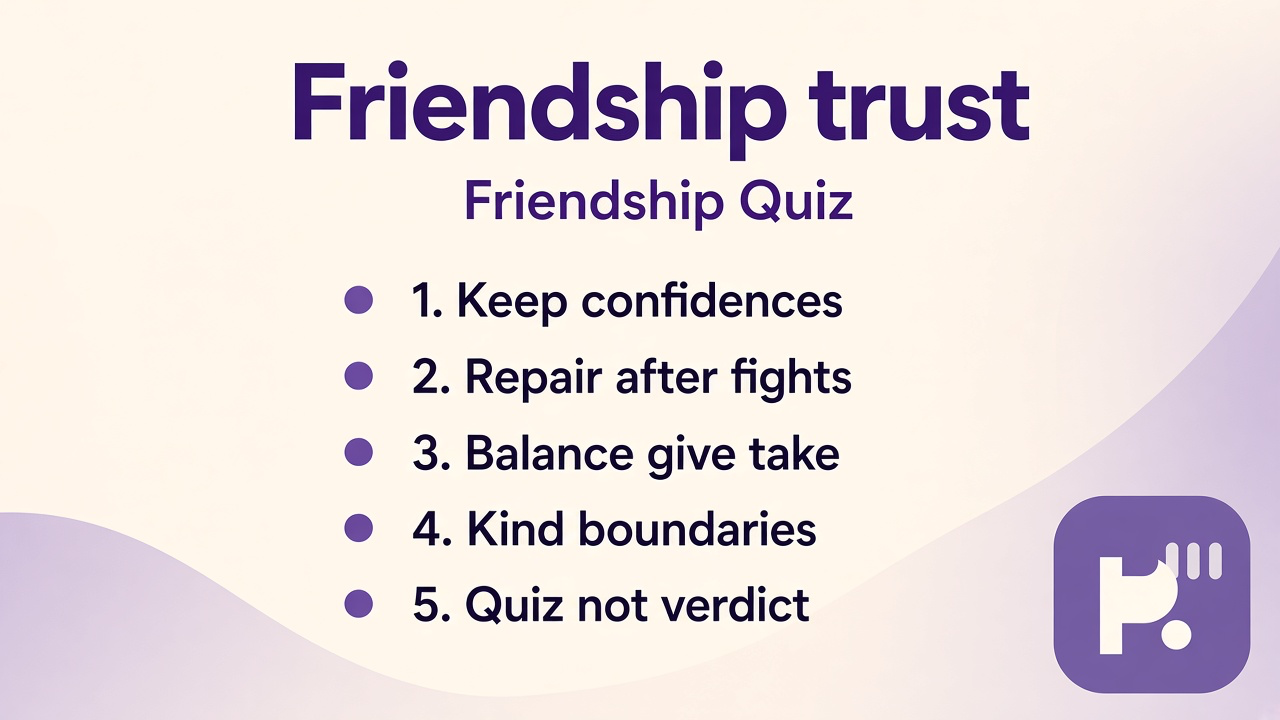
A quick takeaway graphic with topic tips (not your personal quiz scores). Start the quiz for your index, bands, and charts.
What this quiz can and cannot tell you
Can tell you
- Highlight trust, repair, and boundary habits worth practicing before the next hard conversation
- Separate unofficial habit reflection from friend-group rank scores or clinical labels
- Encourage accountable apologies and kind nos without shame spirals
- Spark better questions about everyday friendship skills without claiming therapist authority
Cannot tell you
- Replace licensed therapy, mediation, or abuse assessment when safety is in question
- Prove a friend is toxic or safe from one agree screener
- Give permission to gossip, surveil, or publicly exile someone based on bar height
- Predict friendship longevity from habit bars alone
Why friendship quizzes need trust repair and verdict separation
Search traffic around friendship quizzes usually wants vocabulary for everyday trust, fights, and favors, not a friend-group popularity score or a public toxic label machine. Those goals help when readers keep confidences, repair after tone slips, and balance give-and-take with kind boundaries. They hurt when habit bars become proof someone must be exiled, or when silent treatment gets treated as healthy discipline. General friendship literacy works best when it names repair habits and unofficial limits together while staying distinct from clique dynamics and long-haul milestone siblings.
Dr. Priya Sharma reviews relationships screeners with a simple split: reward honest trust habits and honest limits on verdict substitution and public diagnosis at the same time. Trust and vulnerability tracks confidences, honest pacing, and white-lie awareness without vent-sharing traps. Conflict repair habits tracks apologies, cool-down returns, curiosity, and mutual change without silent-treatment myths. Reciprocity and boundaries tracks emotional labor balance, accepting help, kind nos, and borrow timelines without midnight-availability traps. Quiz not friend verdict keeps this page separate from clinical labels and exile orders.
Real friendships mix bars. You might score high on keeping secrets while keeping repair moderate, which often describes loyal friends who avoid awkward apologies until texts explode. You might score high trust with softer verdict-limit items, which can mean you avoid public labels yet still treat quiz totals like stay-or-leave orders. Reverse items catch overconfidence: secret venting, trust blacklists, winning over repair, week-long silent treatment, boundary testing, or automatic cut-off myths should not inflate bars meant to track layered everyday manners.
Pair results with siblings on this hub instead of forcing one loyalty lecture. Our friend group quiz sibling stays on circle dynamics and in-group roles with stems separate from general trust here. Our friends for life quiz explores decade milestone care and reconnect habits rather than everyday repair lanes on this page. Our frenemy quiz measures gossip and competition boundaries when mixed signals need sharper naming. Browse the relationships and dating hub for more reflection screeners. Share scores as private reflection with consent, not as orders to confront someone in a group chat.
Busy seasons and sleep debt move faster than one repair script on the fridge. A repair bar might dip after one flooded week while trust recall stays high until you retake gently. When you share results, say unofficial habit reflection. When you borrow tips, credit friends who modeled accountable apologies and partners who deserve privacy off-screen. Retake after one hard month and watch whether verdict-limit bars stay high even if reciprocity naming rises, which often means you separated curious study from exile pressure.
| Test | Focus |
|---|---|
| Friend group quiz | Circle dynamics and roles rather than general trust repair on this page |
| Friends for life quiz | Decade milestone care and reconnect habits rather than everyday conflict stems here |
| Frenemy quiz | Gossip and competition boundaries rather than broad trust vocabulary on this screener |
Friendship Quiz FAQ
What does the Friendship Quiz measure?
It measures how much you agree with statements about trust and vulnerability, conflict repair habits, reciprocity and boundaries, and quiz-not-friend-verdict limits. You get an index from 0 to 100 plus four bars. It reflects self-reported everyday habits on this screener, not clinical outcomes.
How is this different from the friend group quiz?
This page focuses on general trust, repair, and boundaries with any friend. The friend group quiz uses separate stems about circle dynamics, roles, and in-group manners.
How is this different from the friends for life quiz?
Friends for life items focus on decades-long milestone care and reconnecting after gaps. This screener stays on everyday honesty, fights, favors, and kind nos.
Does a low score mean I must end a friendship?
No. Verdict-limit items reject automatic cut-off myths. Low bars highlight habits you reported here; courageous conversations and safety planning still matter more than one screener.
Who reviewed this quiz?
Dr. Priya Sharma reviewed the unofficial framing, habits not verdicts separation, friendship ethics, and result explanations. See our editorial policy for review standards.
Reviewed by