What the Friend Group Quiz measures
This quiz does not diagnose personality disorders, rank your friends clinically, or replace licensed therapy. It measures how much you agree with statements in four groups: inclusion habits about invite fairness, welcoming new members, noticing who gets skipped, and accessibility checks before venues lock; gossip loops about rumor consent, avoiding triangulation, moving sensitive talk offline, and refusing loyalty tests built on unverified stories; plans and follow-through about confirmed times, budget-aware options, flake patterns addressed kindly, and celebrating hangouts that actually happen; and quiz not clinical labels about unofficial reflection framing, refusing bar screenshots as exile orders, and keeping shares habit-based instead of disorder verdicts. You rate 22 statements from strongly disagree to strongly agree, with reverse-worded items so one drama night cannot inflate every inclusion bar. Your answers also feed a second chart on closeness and trust habits, because group stress sometimes overlaps with intimacy fears when chats turn into courts. The total becomes an index from 0 to 100 where higher means more reported group habit awareness on this screener, not proof your squad earned a clinician stamp.
Inclusion habits
Fair invites, welcoming newcomers, and noticing quiet members.
Gossip loops
Fewer rumor chains, offline repair, and no triangulation games.
Plans and follow-through
Confirmed hangs, budget care, and less endless maybe talk.
Quiz not clinical labels
Habit mirror only; disorder verdicts and pile-ons stay out.
How it works
Answer 22 agreement items
Rate each statement from Strongly disagree to Strongly agree. Tap Next after each answer.
Answers sort into four domains
Each answer feeds one of four friend group habit groups, and every item also feeds a closeness and trust layer.
See your index and charts
You get a 0 to 100 index, a band, four domain bars, and a second chart for intimacy habits.
Take the Friend Group Quiz
Answer 22 short statements to see your friend group dynamics index, four domain bars, and a closeness and trust chart.
What your result means
Your index is the average of all 22 answers, scaled from 0 to 100, with reverse-worded myth items flipped first. Read quiz-not-clinical-label bars together with gossip loops before you treat a high score as proof someone should be exiled. Fear, bullying, or coercion that lingers for weeks deserves advocates and clinicians, not only another retake.
| Band | Index range | Typical reading |
|---|---|---|
| Building group habit awareness | 0 to 35 | Fewer agreed habits on inclusion, gossip limits, plan follow-through, or clinical-label boundaries on this screener. |
| Mixed group habits | 36 to 65 | Solid inclusion or plan wins with gossip slips, flake loops, or clinical-label share traps. |
| Stronger group habits | 66 to 100 | Frequent agreement on inclusion, gossip limits, plans, and clinical boundaries; still unofficial reflection only. |
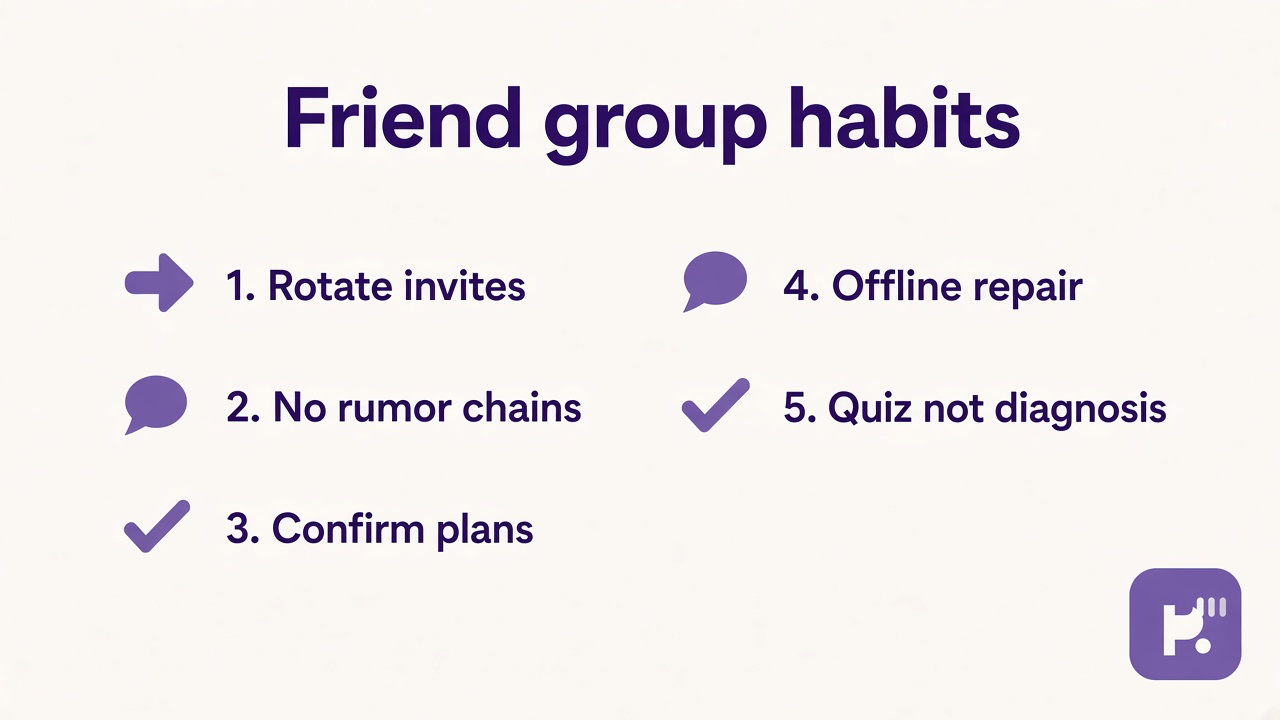
Tips at a glance
A quick takeaway graphic with topic tips (not your personal quiz scores). Start the quiz for your index, bands, and charts.
What this quiz can and cannot tell you
Can tell you
- Highlight inclusion, gossip, and plan habits worth revisiting before the next group outing
- Separate unofficial reflection from clinical diagnosis and public conviction threads
- Encourage offline repair talks without shame spirals in the main chat
- Spark better questions about squad norms without surveilling friends
Cannot tell you
- Diagnose narcissism, borderline traits, or any disorder from one agree screener
- Prove someone is toxic enough to harass online from bar height
- Replace therapy, mediation, or safety planning when harm is serious
- Authorize exile votes, secret monitoring, or humiliation campaigns in group chats
Why friend group quizzes need inclusion and gossip limits without clinical dunking
Search traffic around friend group quizzes usually wants a playful mirror after a messy chat week, not a clinical court ruling on the squad. Those goals help when readers name invite fairness, rumor consent, and plans that actually happen. They hurt when quiet members get ghosted by assumption, maybe threads waste everyone time, or agree bars get shared as narcissism proof.
Dr. Priya Sharma reviews relationships-dating reflection tools with a respect-first lens. Inclusion habits tracks invite rotation, newcomer welcome, and noticing who gets skipped without hazing walls. Gossip loops tracks rumor checks, triangulation refusal, and offline repair before verdict stages. Plans and follow-through tracks confirmed times, budget care, and kind responses to flake patterns. Quiz not clinical labels keeps unofficial framing visible so friendship talk does not slide into disorder label pile-ons or screenshot convictions.
Real groups mix bars. You might score high on inclusion while moderate on plans, which often describes welcoming chats that still struggle to pick a date. You might score high on gossip limits with strong clinical boundaries, which can mean solid consent norms without claiming therapist authority. Reverse items catch sloppy answers: assuming quiet means hate, loyalty through rumor dumps, maybe threads as optional forever, or bar screenshots as exile orders should not inflate bars meant to track layered squad manners.
Pair results with siblings on this hub instead of forcing one friendship story. Our fake friend quiz explores red flag exposure when one person pattern matters more than whole-group habits on this page. Our frenemy quiz stays on trust, gossip, and competition boundaries with stems separate from squad-wide inclusion here. Our am I a good friend quiz turns the mirror toward your own care habits rather than group chat exposure items here. Browse the relationships and dating hub for more low-stakes screeners. Share scores as conversation starters with trusted allies, not as orders to surveil or humiliate someone.
Semesters and reunion weekends rotate faster than chat norms update. A gossip bar might spike after one rumor night while inclusion bars stay steady until you retake calmly. When you share results, say unofficial group habits. When you borrow tips, credit friends who modeled offline repair. Retake after one heated month and watch whether clinical limit bars stay high even if plan follow-through rises, which often means you separated cozy squad joy from diagnosis substitution pressure.
| Test | Focus |
|---|---|
| Fake friend quiz | One-on-one red flag exposure rather than whole-group inclusion and plan habits on this page |
| Frenemy quiz | Trust and competition boundary literacy rather than squad-wide invite and plan stems here |
| Am I a good friend quiz | Your own care habits rather than group chat gossip and plan exposure on this screener |
Friend Group Quiz FAQ
What does the Friend Group Quiz measure?
It measures how much you agree with statements about inclusion habits, gossip loops, plans and follow-through, and quiz-not-clinical-label limits. You get an index from 0 to 100 plus four bars. It describes self-reported group habits on this screener, not a clinician verdict on your friends.
Is this quiz therapy or a clinical personality test?
No. This is unofficial reflection about everyday group chat and hangout habits. Therapists use structured assessments this page does not provide. Do not treat your index as a diagnosis for anyone in the squad.
Should I share results in the group chat?
Usually no. Limit items encourage private reflection and offline talks. Public screenshots can feel like conviction posts even when you mean well.
How is this different from the fake friend quiz?
This page focuses on squad-wide inclusion, gossip, and plan norms. The fake friend quiz focuses on red flag exposure with one close friend pattern. Stems stay separate so you can use both mirrors without duplicate items.
Who reviewed this quiz?
Dr. Priya Sharma reviewed the reflection framing, clinical separation, and result explanations. See our editorial policy for review standards.
Reviewed by