What the Gay Culture Quiz measures
This quiz does not out strangers, certify ally credentials, or prove sexual orientation from recall alone. It measures how much you agree with culture literacy statements grouped four ways: history and pride literacy about Stonewall context, AIDS activism memory, and timelines without costume trivia; media and representation literacy about who tells queer stories and which tropes repeat without villain coding jumps; community respect habits about elders, local organizers, names, and listening before loud expertise; and anti-mockery limits about playful study without femmephobia, accent mockery, or bar-height identity verdicts. You rate 22 statements from strongly disagree to strongly agree, with reverse-worded traps so one lucky guess cannot inflate every bar. Your answers also feed a second chart on closeness and trust habits, because culture debates sometimes spill into friendship stress when shame or pride runs hot. The total becomes an index from 0 to 100 where higher means more reported culture literacy play on this screener, not proof you belong in every queer space.
History and pride literacy
Context for marches, activism, and timelines.
Media and representation
Who tells stories and which tropes repeat.
Community respect habits
Listen, credit elders, use chosen names.
Anti-mockery limits
Play mirror only; no outing or punch-down cosplay.
How it works
Answer 22 agreement items
Rate each statement from Strongly disagree to Strongly agree. Tap Next after each answer.
Answers sort into four domains
Each answer feeds one of four culture literacy groups, and every item also feeds a closeness and trust layer.
See your index and charts
You get a 0 to 100 index, a band, four domain bars, and a second chart for intimacy habits.
Take the Gay Culture Quiz
Answer 22 short statements to see your gay culture literacy index, four domain bars, and a closeness and trust chart.
What your result means
Your index is the average of all 22 answers, scaled from 0 to 100, with reverse-worded items flipped first. Read anti-mockery bars together with community respect before you treat a high score as identity proof. Cozy reflection supports kinder learning spaces; mentors and lived experience still own the deepest context.
| Band | Index range | Typical reading |
|---|---|---|
| Building culture literacy habits | 0 to 35 | Fewer agreed habits on history, media, respect, or anti-mockery items on this screener. |
| Mixed culture literacy habits | 36 to 65 | Solid curiosity with stereotype slips, villain coding jumps, outing jokes, or elder-demand myths. |
| Strong culture literacy habits | 66 to 100 | Frequent agreement with history, media, respect, and anti-mockery limits; still unofficial play only. |
Tips at a glance
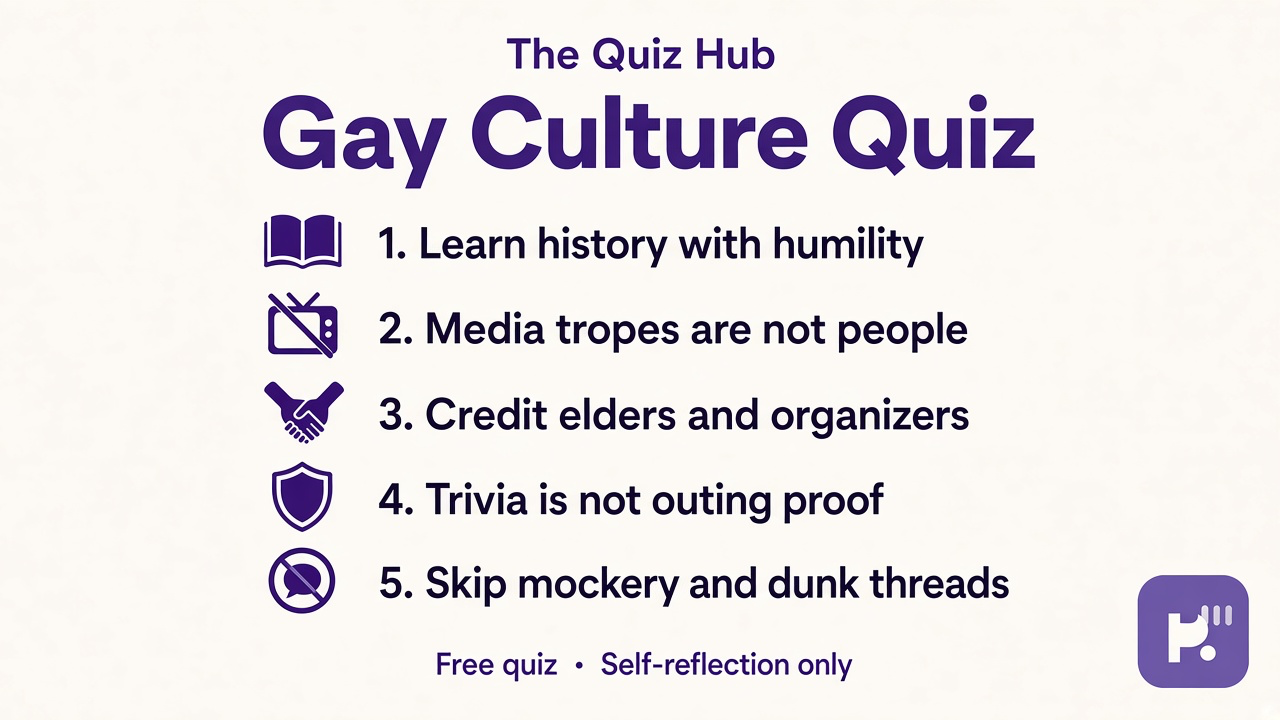
A quick takeaway graphic with topic tips (not your personal quiz scores). Start the quiz for your index, bands, and charts.
What this quiz can and cannot tell you
Can tell you
- Highlight history, media, and respect habits worth revisiting before your next culture meme share
- Separate unofficial literacy reflection from outing games and punch-down humor
- Encourage documentary and archive reading without public shame spirals
- Spark better book club questions without claiming authority over anyone identity
Cannot tell you
- Prove sexual orientation, ally purity, or community membership from one couch screener
- Replace mentors, local organizers, or lived experience you have not lived
- Give permission to mock accents, bodies, or presentation from trivia bar height
- Out classmates or celebrities because recall looked impressive on a retake
Why gay culture quizzes need history, media, and anti-mockery humility
Search traffic around gay culture quizzes usually wants a light mirror after pride season, drag appreciation posts, or a film club debate, not a license to mock strangers or guess orientations from outfits. Those goals help when readers seek history context, notice representation tropes, and keep trivia separate from identity verdicts. They hurt when literacy bars become proof someone is more or less gay, or when meme threads skip AIDS history while recycling punch-down jokes. Culture literacy play works best when it names respect habits and unofficial limits together while staying distinct from identity screeners on the same hub.
Dr. Morgan Chen reviews sexuality and LGBTQ+ screeners with a simple split: reward honest curiosity and honest limits on mockery at the same time. History and pride literacy tracks marches, activism memory, and timelines without costume trivia. Media and representation tracks storytellers, tropes, and camp joy without villain coding jumps. Community respect tracks elders, organizers, and names without surveillance cosplay. Anti-mockery limits keep screeners separate from outing threads, accent baiting, and bar-height moral rank.
Real learners mix bars. You might score high on media literacy while keeping history moderate, which often describes film fans who have not yet read local archive pages. You might score high literacy with softer respect items, which can mean you avoid dunking yet still treat quiz totals like ally badges. Reverse items catch overconfidence: Stonewall as fashion week, villain coding as real-life proof, elder demand myths, or outing guesses should not inflate bars meant to track layered study manners.
Pair results with siblings instead of forcing one culture story. Our LGBTQ+ test sibling emphasizes community belonging and advocacy comfort with separate stems from trivia habits here. Our am I gay test explores same-gender attraction reflection rather than parade history recall on this page. Our gay stereotype quiz focuses on refusing harmful labels rather than celebratory culture facts here. Browse the sexuality and LGBTQ+ hub for more screeners. Caption shares as study play, credit sources, and skip grading strangers who never opted into your thread.
Pride seasons and streaming drops rotate faster than school syllabi on classroom drives. A respect bar might dip after one heated comment week while history curiosity stays high until you retake calmly. When you share results, say unofficial culture literacy habits. When you borrow tips, credit elders and archivists who did the work before your first quiz. Retake after one learning unit and watch whether anti-mockery bars stay high even if trivia enthusiasm rises, which often means you separated cozy joy from punch-down pressure.
| Test | Focus |
|---|---|
| LGBTQ+ test | Community belonging and advocacy rather than culture trivia recall here |
| Am I gay test | Same-gender attraction reflection rather than parade history on this page |
| Gay stereotype quiz | Stereotype refusal habits rather than celebratory culture facts here |
Gay Culture Quiz FAQ
What does the Gay Culture Quiz measure?
It measures how much you agree with statements about history and pride literacy, media and representation, community respect, and anti-mockery limits. You get an index from 0 to 100 plus four bars. It reflects self-rated culture curiosity on this screener, not sexual orientation proof or ally credentials.
Does a high score mean I am gay?
No. Culture literacy bars describe habits you endorsed here. Orientation and identity exploration belong on separate screeners with their own limits.
How is this different from the am I gay test?
This quiz centers history, media, and respect habits. The am I gay test sibling uses separate stems aimed at attraction reflection rather than trivia recall here.
Can I use this to guess if someone else is gay?
No. Anti-mockery items reject outing and surveillance cosplay. High bars do not license labeling strangers from outfits or meme recall.
Who reviewed this quiz?
Dr. Morgan Chen reviewed the culture play framing, anti-mockery separation, and result explanations. See our editorial policy for review standards.
Reviewed by