What this foot injury quiz measures
This page does not read X-rays, assign fracture types, or replace clinician exams from one agree screener. It measures how much you agree with foot injury triage literacy grouped four ways: foot injury red flags when open wounds, deformity, numb cold toes, spreading infection signs, or failed weight bearing deserve urgent escalation; clinician visit judgment when persistent pain, comorbidity risk, or follow-up plans need professional contact instead of guesswork; home care humility not self X-ray when RICE-style support fits minor sprains yet quiz scores and social photos never replace ordered imaging; and injury screener not diagnosis when unofficial bars stay separate from couch radiology cosplay and skipped follow-up. You answer 22 statements from strongly disagree to strongly agree, with reverse-worded items so one lucky RICE habit or one 988 awareness answer cannot hide dangerous wait-and-see myths. Your answers also feed a second chart on closeness and trust habits, because fear of medical bills sometimes blocks asking for help. The total becomes an index from 0 to 100 where higher means more reported foot injury triage literacy on this screener, not proof of a specific diagnosis.
Foot injury red flags
Open wounds, deformity, numb cold toes, spreading infection, weight-bearing failure.
Clinician visit judgment
When to call urgent care, mention comorbidities, keep follow-up.
Home care humility not self X-ray
Sensible RICE on minor twists without radiology cosplay.
Injury screener not diagnosis
Quiz triage only; clinicians own labels and imaging.
How it works
Answer 22 agreement items
Rate each statement from Strongly disagree to Strongly agree. Tap Next after each answer.
Answers sort into four domains
Each answer feeds one of four foot injury triage groups, and every item also feeds a closeness and trust layer.
See your index and charts
You get a 0 to 100 index, a band, four domain bars, and a second chart you can discuss with clinicians.
Take the Foot Injury Diagnosis Quiz
Answer 22 short statements to see your foot injury triage literacy index, four domain bars, and a closeness and trust chart.
What your result means
Your index is the average of all 22 answers, scaled from 0 to 100, with reverse-worded items flipped first. Higher means more reported triage and help-seeking literacy on this screener. Read screener-not-diagnosis bars together with red-flag habits before you treat any total as fracture proof. Persistent hopelessness or safety worries deserve crisis support, not only home-care tips.
| Band | Index range | Typical reading |
|---|---|---|
| Building foot injury triage literacy | 0 to 35 | Fewer agreed red-flag, clinician visit, home-care humility, or screener-not-diagnosis items on this screener. |
| Mixed foot injury triage literacy | 36 to 65 | Solid red-flag recall with myths about stubbed-toe invincibility, couch X-ray cosplay, or quiz-as-diagnosis slips. |
| Strong foot injury triage literacy | 66 to 100 | Frequent agreement with red flags, clinician judgment, home-care humility, and screener limits; still not a diagnosis. |
Tips at a glance
A quick takeaway graphic with topic tips (not your personal quiz scores). Start the quiz for your index, bands, and charts.
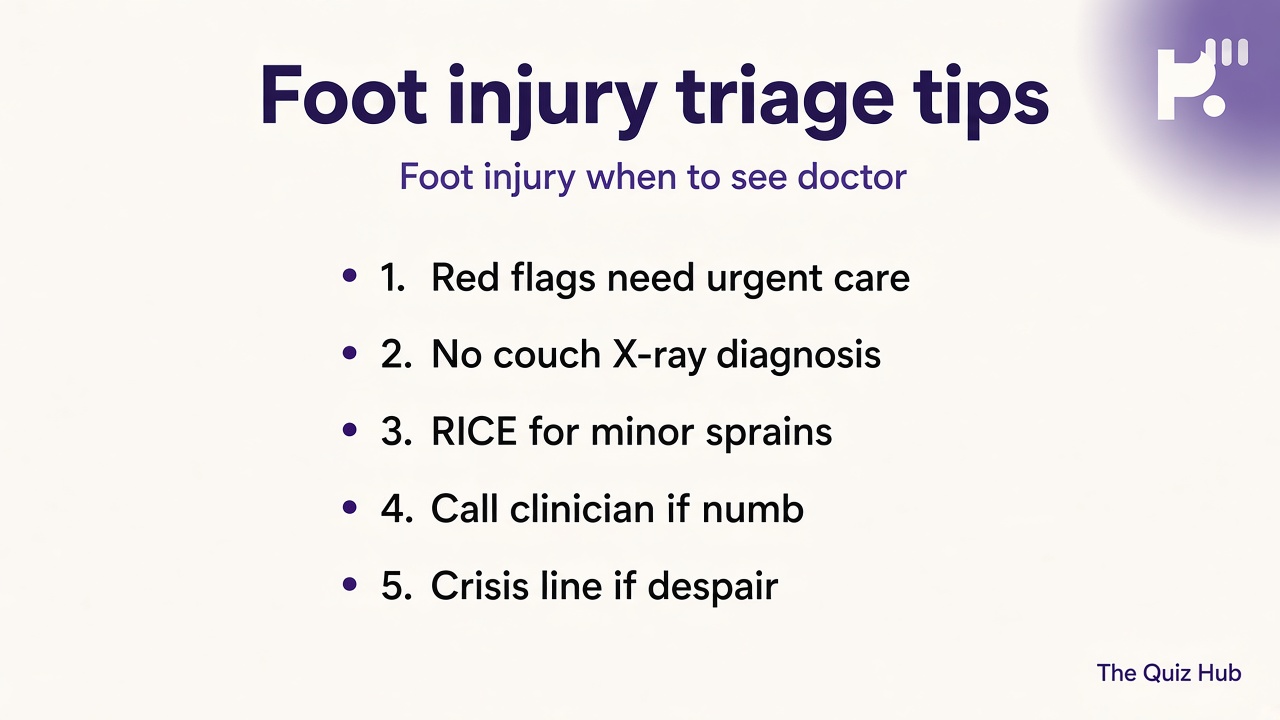
What this quiz can and cannot tell you
Can tell you
- Name red-flag foot and ankle signs worth urgent escalation in plain language
- Highlight when clinician visits, timelines, or follow-up plans are missing from habits
- Support honest injury conversations without forcing online fracture labels
- Offer a baseline if you retake after one sprain season with safer help-seeking
Cannot tell you
- Diagnose sprains, fractures, infections, or compartment syndrome from one score
- Replace clinician exams, ordered X-rays, MRI, or specialist referrals
- Authorize couch radiology reading or social-media diagnosis from photos
- Substitute for emergency care when open wounds, deformity, or numb cold toes appear
Foot sprains, red flags, and quiz-not-couch-X-ray limits
Traffic to foot injury quizzes mixes sensible when-to-go guidance with threads that treat agree screeners like fracture oracle machines. Clinicians diagnose after history, exam, and appropriate imaging, which is why triage literacy matters more than hobby totals. This online screener uses that reflection lens unofficially; it cannot replace in-person evaluation or tell you which bone broke without professional assessment.
Red flags deserve plain language. Open wounds with heavy bleeding, obvious deformity, numb or cold toes after trauma, spreading redness with fever after punctures, and inability to bear weight with climbing pain are examples where waiting for forum votes is unsafe. Stubbed-toe invincibility myths and ignore-the-fever traps are reverse items on purpose.
Clinician visit judgment covers when pain outlasts a sensible home trial, when diabetes or neuropathy raises complication risk, when staff recommend imaging, and when follow-up instructions are not optional. Home care humility covers RICE-style support on minor twists without heat on fresh swelling, without DIY joint reduction, and without pretending quiz bars train radiologists.
Real people mix bars. You might score high red-flag literacy yet still share bar screenshots like diagnosis proof online, which screener-not-diagnosis items flag. You might score high home-care humility while underestimating puncture infections, which clinician visit items complement. Reverse items catch overconfidence: social photos as exams, self-X-ray cosplay, skipped follow-up, and perfect bars ignoring emergency calls should not inflate triage charts.
Pair results with siblings on this hub instead of forcing one injury story. Our first aid quiz covers broader CPR and bleed habits with separate wording, not foot-specific red-flag stems here. Our foot bones quiz stays diagram labeling literacy rather than triage when-to-go language on this page. Our fibromyalgia quiz tracks widespread pain patterns rather than acute foot trauma triage. Browse the mental health and clinical test hub for more YMYL screeners with study-not-diagnosis framing.
| Test | Focus |
|---|---|
| First aid quiz | General CPR, bleed, and 911 literacy rather than foot-specific red-flag triage stems here |
| Foot bones quiz | Skeleton diagram labeling rather than injury when-to-see-clinician habits on this screener |
| Fibromyalgia quiz | Chronic widespread pain patterns rather than acute foot trauma triage language here |
Foot Injury Diagnosis Quiz FAQ
What does the Foot Injury Diagnosis Quiz measure?
It measures how much you agree with foot injury triage literacy across red flags, clinician visit judgment, home care humility without self-X-ray cosplay, and screener-not-diagnosis limits. You get an index from 0 to 100 plus four bars. It reflects self-reported help-seeking habits on this screener, not a clinical diagnosis.
Can this quiz tell me if my foot is fractured?
No. Only licensed clinicians diagnose fractures or sprain grades after exam and appropriate tests. This screener builds triage habits, not radiology results.
Why is it called diagnosis in the URL if you say it is not diagnosis?
Searchers often use diagnosis language when they mean when should I worry. Stems and limits keep the page triage literacy: when to escalate care, not couch X-ray reading from a score.
When should I skip the quiz and call emergency services?
Open wounds with heavy bleeding, obvious deformity, numb cold toes after trauma, trouble breathing, or any immediate danger deserve emergency calls and dispatcher guidance, not retakes.
Who reviewed this quiz?
Dr. Elena Vasquez reviewed the YMYL framing, triage-not-diagnosis limits, and crisis resource language. See our editorial policy for review standards.
Reviewed by