What Female Reproductive System Quiz measures
This quiz does not perform pelvic exams, read ultrasounds, or prescribe hormones. It measures how much you agree with health literacy statements grouped four ways: organ map literacy about ovaries, tubes, uterus, cervix, and vagina roles taught in respectful education without public body ranking; cycle kindness about normal variation, anti-shame language, practical support, and humble app-timing limits; clinician not quiz about urgent red flags, persistent symptoms, screening conversations with licensed professionals, and refusing to replace triage with agree items; and repro edu limits about unofficial reflection, separating anatomy study from porn framing, and refusing disorder guesses for strangers from bar height. You rate 22 statements from strongly disagree to strongly agree, with reverse-worded traps so one lucky trivia streak cannot inflate every bar. Your answers also feed a second chart on closeness and trust habits, because body talk and vulnerability often share the same friend group. The total becomes an index from 0 to 100 where higher means more reported reproductive health literacy habits on this screener, not proof you should skip gynecology care.
Organ map literacy
Respectful organ roles without shame or public ranking.
Cycle kindness
Period support, variation language, and anti-mockery norms.
Clinician not quiz
Symptoms and screening belong with licensed care.
Repro edu limits
Study mirror only; no couch diagnosis or porn framing.
How it works
Answer 22 agreement items
Rate each statement from Strongly disagree to Strongly agree. Tap Next after each answer.
Answers sort into four domains
Each answer feeds one of four reproductive health literacy groups, and every item also feeds a closeness and trust layer.
See your index and charts
You get a 0 to 100 index, a band, four domain bars, and a second chart for intimacy habits.
Take the Female Reproductive System Quiz
Answer 22 short statements to see your reproductive health literacy index, four domain bars, and a closeness and trust chart.
What your result means
Your index is the average of all 22 answers, scaled from 0 to 100, with reverse-worded items flipped first. Read clinician-not-quiz bars together with repro edu limits before you treat a high organ map score as medical authority or a low score as body shame. Literacy supports kinder talks; OB-GYN and emergency clinicians still own symptoms.
| Band | Index range | Typical reading |
|---|---|---|
| Building reproductive health literacy | 0 to 35 | Fewer agreed habits on organ map literacy, cycle kindness, clinician-not-quiz items, or repro edu limits on this screener. |
| Mixed reproductive health literacy | 36 to 65 | Solid organ recall with cycle mockery slips, quiz-as-triage traps, screening discouragement, or diagnosis cosplay in others. |
| Strong reproductive health literacy | 66 to 100 | Frequent agreement with organ map, cycle kindness, clinician-not-quiz, and repro edu limits; still educational only. |
Tips at a glance
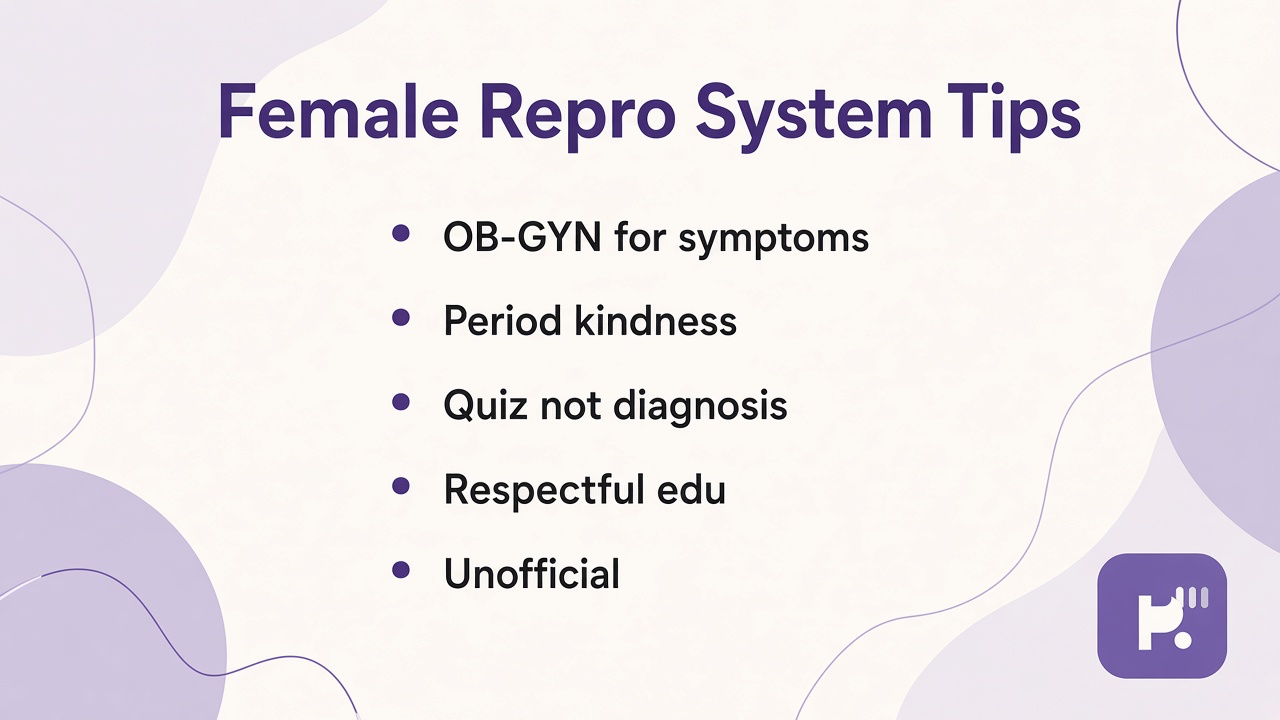
A quick takeaway graphic with topic tips (not your personal quiz scores). Start the quiz for your index, bands, and charts.
What this quiz can and cannot tell you
Can tell you
- Highlight respectful organ language and cycle kindness habits worth revisiting before health class talks
- Separate unofficial edu reflection from period shame memes or friend diagnosis games
- Encourage clinician visits for persistent symptoms without fear-mongering every quiz taker
- Spark better study questions without claiming gynecology credentials
Cannot tell you
- Diagnose PCOS, endometriosis, pregnancy status, or STIs from one agree screener
- Replace pelvic exams, prenatal care, emergency evaluation, or prescribed treatment
- Prove fertility or infertility outcomes from bar height
- Turn health literacy scores into public body ranking or porn-thread commentary
Reproductive edu before couch-diagnosis myths
People search female reproductive system quizzes when health class vocabulary blurs, when friends mix period support with gross jokes, or when apps pretend ovulation clocks are relationship law. Those goals help when readers learn organ roles respectfully, normalize variation, and route symptoms to clinicians. They hurt when trivia scores become triage, or when anatomy talk turns into public body ranking. Health literacy works best when it names kindness and OB-GYN limits together.
Dr. Elena Vasquez reviews self-image and health education screeners with a simple split: reward respectful anatomy habits and honest limits on unofficial diagnosis at the same time. Organ map literacy tracks ovaries-through-vagina roles without shame games. Cycle kindness tracks anti-mockery support without treating pain as drama. Clinician not quiz tracks red flags and screening conversations without discouraging care. Repro edu limits keep screeners separate from porn framing and stranger disorder guesses.
Real learners mix bars. You might score high on organ trivia while keeping cycle kindness moderate, which often describes confident memorizers in shamey group chats. You might score high on clinician habits with softer organ bars, which can mean strong triage language while vocabulary is still new. Reverse items catch overconfidence: public body ranking, mocking heavy pain, discouraging screening, guessing disorders online, or app clocks pressuring partners should not inflate charts meant to track kind reproductive edu habits.
Pair results with siblings on this hub instead of forcing one body story. Our female anatomy quiz stays on broader respectful gross anatomy literacy with stems separate from cycle kindness and clinician routing here. Our female reproductive system histology quiz focuses on microscope landmarks rather than health-class organ kindness on this page. Our am I pregnant quiz discusses early pregnancy reflection limits when timing questions need a different tone. Browse the self image and appearance hub for more respectful body literacy tools. Caption shares as edu practice and skip diagnosing friends who never asked.
Semesters and meme cycles rotate faster than clinic waitlists. When you share results, say clinicians beat couch verdicts. When you borrow tips, credit friends who brought pads without filming and nurses who answered shame-free questions. Retake after health class and watch whether cycle kindness bars stay high even if organ trivia rises, which often means you separated performative scoreboard talk from actual support habits.
| Test | Focus |
|---|---|
| Female anatomy quiz | Broader respectful gross anatomy literacy rather than cycle kindness and clinician routing stems on this page |
| Female reproductive system histology quiz | Microscope follicle and endometrium landmarks rather than health-class organ and period kindness habits here |
| Am I pregnant quiz | Early pregnancy reflection limits rather than full reproductive organ edu and anti-shame norms on this screener |
Female Reproductive System Quiz FAQ
What does Female Reproductive System Quiz measure?
It measures how much you agree with statements about organ map literacy, cycle kindness, clinician-not-quiz habits, and repro edu limits. You get an index from 0 to 100 plus four bars. It describes self-reported health literacy habits on this screener, not clinical findings.
Can this quiz tell me if I have PCOS or endometriosis?
No. Repro edu limit items reject stranger diagnosis games. Persistent pain, irregular cycles, or fertility concerns need licensed evaluation, not agree-item bars.
Should I skip the gynecologist if my score is high?
No. Clinician-not-quiz items stress that screening and symptoms belong with licensed professionals. High trivia bars do not replace exams or labs.
How is this different from the histology quiz?
This page focuses on organ roles, cycle kindness, and when to seek care. The histology sibling focuses on microscope landmarks with a separate stem bank and zero overlap.
Who reviewed this quiz?
Dr. Elena Vasquez reviewed the educational framing, period kindness language, OB-GYN limit boundaries, and separation from diagnosis claims. See our editorial policy for review standards.
Reviewed by