What Family Emotional Communications FEC measures
This quiz does not decide custody, rank who is the good parent, or replace licensed marriage and family therapy. It measures how much you agree with communication statements grouped four ways: I-statement habits about naming feelings and needs before character attacks or marathon lectures; listen first about phones down, repeat-back listening, and curious questions instead of cross-examination; repair after conflict about apologies, pause plans, and check-ins instead of silent punishments or receipt stacking; and quiz not family court about unofficial screeners, refusing screenshot shaming, and captioning shares as practice not legal proof. You rate 22 statements from strongly disagree to strongly agree, with reverse-worded traps so one good weekend cannot inflate every bar. Your answers also feed a second chart on closeness and trust habits, because fear of conflict sometimes looks like fixing instead of listening. The total becomes an index from 0 to 100 where higher means more reported family communication literacy on this screener, not proof you should police every relative thread.
I-statement habits
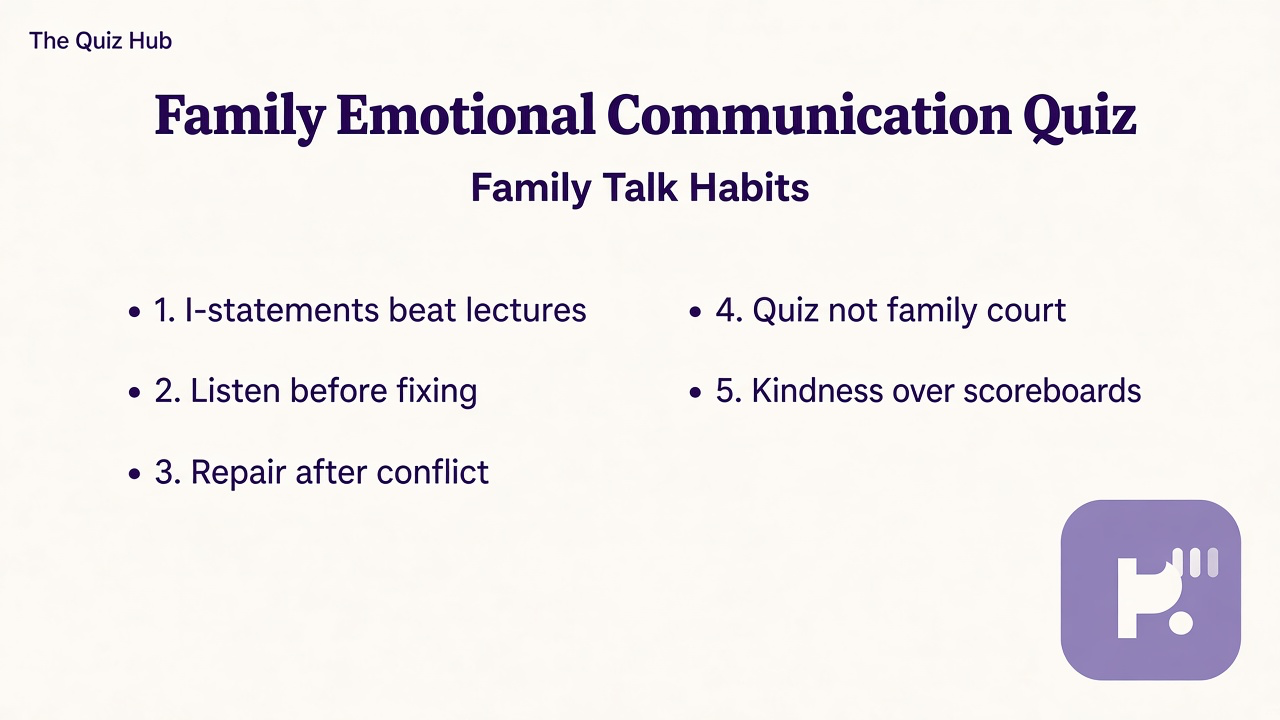
Feelings and needs in I language before lectures and character labels.
Listen first
Repeat-back curiosity before advice, defense, or interrupt fixing.
Repair after conflict
Return, apologize, and schedule calm talks after rupture.
Quiz not family court
Practice mirror only; therapists and courts own formal decisions.
How it works
Answer 22 agreement items
Rate each statement from Strongly disagree to Strongly agree. Tap Next after each answer.
Answers sort into four domains
Each answer feeds one of four family communication groups, and every item also feeds a closeness and trust layer.
See your index and charts
You get a 0 to 100 index, a band, four domain bars, and a second chart for intimacy habits.
Take the Family Emotional Communications FEC Screener
Answer 22 short statements to see your family emotional communication index, four domain bars, and a closeness and trust chart.
What your result means
Your index is the average of all 22 answers, scaled from 0 to 100, with reverse-worded items flipped first. Read quiz-not-family-court bars together with listen-first habits before you treat a high score as permission to shame relatives. Communication literacy supports kinder repair; therapists still matter when loops repeat.
| Band | Index range | Typical reading |
|---|---|---|
| Building family communication habits | 0 to 35 | Less agreement with I-statements, listen-first pauses, repair after conflict, or quiz-not-family-court limits on this screener. |
| Mixed family communication habits | 36 to 65 | Solid habits in some domains with lecture traps, interrupt slips, silent treatment, or family-court cosplay in others. |
| Strong family communication habits | 66 to 100 | Frequent agreement with I-statements, listening first, repair, and quiz-not-family-court limits; still reflection only. |
Tips at a glance
A quick takeaway graphic with topic tips (not your personal quiz scores). Start the quiz for your index, bands, and charts.
What this quiz can and cannot tell you
Can tell you
- Highlight I-statement, listening, and repair habits worth revisiting before the next hard conversation
- Separate unofficial literacy from family-court cosplay or parent ranking fantasies
- Encourage listen-back and repair questions before public call-outs in chat
- Spark honest talk with partners or teens about practice captions on shares
Cannot tell you
- Prove custody outcomes or who is the unfit parent from one online screener
- Replace family therapy, mediation, or legal advice from trivia bars
- Detect abuse or coercion on its own
- Turn communication scores into harassment, relative pile-ons, or screenshot verdicts
Family talk habits before screenshot verdicts
Search traffic around family emotional communications quizzes usually wants two things: language for hard conversations at home, and relief from threads that treat every holiday fight like a custody trial. Those goals help when readers use I-statements, listen before fixing, and repair after rupture. They hurt when communication scores become parent rankings, or when pile-ons mock relatives while claiming perfect bars. Family talk language works best when it names repair habits and humility limits together.
Dr. Priya Sharma reviews relationships screeners with a simple split: reward honest listening habits and honest limits on family-court fantasy at the same time. I-statement habits track feelings and needs before lectures without calling every stressed parent cruel forever. Listen first tracks repeat-back curiosity without cross-examination cosplay. Repair after conflict tracks return after tension without silent punishments that teach fear instead of boundaries. Quiz not family court keeps screeners, therapists, and mediators separate from bar height.
Real families mix bars. You might score high on listen-first with teens while keeping repair with partners moderate, which often describes patience at the table yet harsh texts after work. You might score high I-statements with softer limit items, which can mean good feeling language plus occasional screenshot shaming slips. Reverse items catch sloppy answers: you always speeches, interrupt fixing, silent treatment, receipt stacking, mockery tied to high bars, or demanding therapy only for others should not inflate charts meant to track layered communication knowledge.
Pair results with siblings on this hub instead of forcing one holiday story. Our drama triangle questionnaire stays on victim rescuer persecutor loops with stems separate from FEC talk habits on this page. Our family adaptability and cohesion scale FACES III covers past-month rigidity and distance frequency rather than agree-style I-statements here. Our constructive destructive family CDF pairs warmth and hostile routine climate with its own wording. Browse the relationships and dating hub for more reflection screeners. Caption shares as practice, listen before advising, and skip bait threads on relatives who never opted in.
Move seasons and caregiving stress refresh faster than group chat arguments. When you share results, say repair and humility beat scoreboard. When you borrow tips, credit therapists who model listen-back habits and relatives who disagree without bad-parent labels. Retake after one communication homework block and watch whether quiz-not-family-court bars stay high even if listen-first recall rises, which often means you separated book rules from actual table manners.
| Test | Focus |
|---|---|
| Drama triangle questionnaire | Victim rescuer persecutor conflict roles rather than I-statement and listen-first habits on this page |
| Family adaptability and cohesion scale FACES III | Past-month adaptability and cohesion strain frequency rather than agree-style talk habits here |
| Constructive destructive family CDF | Warmth and hostile routine climate rather than emotional communication agree items on this screener |
Family Emotional Communications FEC Screener FAQ
What does Family Emotional Communications FEC measure?
It measures how much you agree with statements about I-statement habits, listening first, repair after conflict, and quiz-not-family-court limits. You get an index from 0 to 100 plus four bars. It describes self-reported communication habits on this screener, not legal custody status or therapist credentials.
Is this the published FEC research instrument?
No. Published family emotional communication measures use validated item banks and trained scoring. This page is an unofficial inspired screener with its own stems for reflection only, not family court evidence and not a licensed evaluation.
Does a high score mean I am a better parent than my ex?
No. Quiz-not-family-court items explicitly reject ranking relatives from bars. High scores mean you related to communication statements here, not that you should use results in legal disputes or public shaming.
Why include repair items with listening habits?
Families often listen well yet still punish with silence after fights. Repair items keep return-after-rupture separate from performative calm so results stay honest about which habits you endorse.
Who reviewed this screener?
Dr. Priya Sharma, PhD reviewed the relationship framing, anti-pile-on limits, safety notes, and separation from family-court fantasy claims. See our editorial policy for review standards.
Reviewed by