What Fake News Quiz measures
This quiz does not hire you for a newsroom, rank intelligence, or replace journalism teachers and library media specialists. It measures how much you agree with literacy statements grouped four ways: source triangulation about second outlets, skepticism toward anonymous chains, and holding shares until independent references appear; emotional headlines about outrage titles, clickbait hooks, mismatched thumbnails, and resisting fury-as-proof myths; primary sources about tracing memes to speeches, filings, studies, and agency posts instead of cropped screenshots alone; and quiz not journalism about unofficial screeners, refusing screenshot shaming, and captioning shares as warm-up not credential drops. You rate 22 statements from strongly disagree to strongly agree, with reverse-worded traps so one lucky guess cannot inflate every bar. Your answers also feed a second chart on closeness and trust habits, because share performance sometimes chases winning arguments over honest listening. The total becomes an index from 0 to 100 where higher means more reported media literacy on this screener, not proof you should harass people over reposts.
Source triangulation
Second outlets, weak cousin chains, and pause-before-share habits.
Emotional headlines
Outrage titles, clickbait cues, and breath-before-react pauses.
Primary sources
Original reports, studies, and traces beyond logo memes.
Quiz not journalism
Study warm-ups only; newsrooms and fact-check teams own professional work.
How it works
Answer 22 agreement items
Rate each statement from Strongly disagree to Strongly agree. Tap Next after each answer.
Answers sort into four domains
Each answer feeds one of four fake news literacy groups, and every item also feeds a closeness and trust layer.
See your index and charts
You get a 0 to 100 index, a band, four domain bars, and a second chart for intimacy habits.
Take the Fake News Quiz
Answer 22 short statements to see your fake news literacy index, four domain bars, and a closeness and trust chart.
What your result means
Your index is the average of all 22 answers, scaled from 0 to 100, with reverse-worded items flipped first. Read quiz-not-journalism bars together with triangulation habits before you treat a high score as permission to shame relatives. Literacy supports kinder source talk; teachers still matter for rubrics.
| Band | Index range | Typical reading |
|---|---|---|
| Building fake news literacy | 0 to 35 | Fewer agreed habits on triangulation, emotional headline pauses, primary-source tracing, or quiz-not-journalism limits on this screener. |
| Mixed fake news literacy | 36 to 65 | Solid habits in some domains with like-count myths, rage-as-proof traps, meme-study slips, or fact-checker cosplay in others. |
| Strong fake news literacy | 66 to 100 | Frequent agreement with triangulation, headline caution, primary-source habits, and quiz-not-journalism limits; still study only. |
Tips at a glance
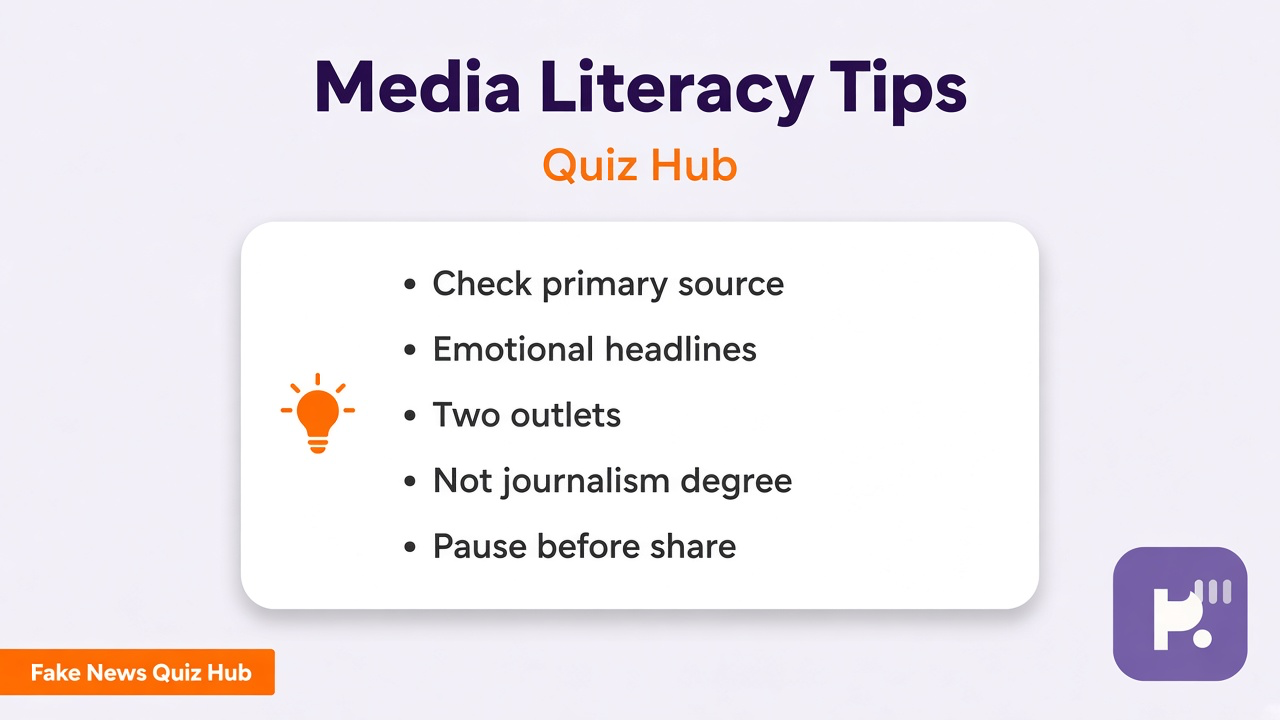
A quick takeaway graphic with topic tips (not your personal quiz scores). Start the quiz for your index, bands, and charts.
What this quiz can and cannot tell you
Can tell you
- Highlight triangulation, headline, and primary-source habits worth revisiting before the next civics unit
- Separate unofficial literacy from fact-checker cosplay or IQ fantasies
- Encourage second-source and primary-trace questions before reposting in chat
- Spark honest talk with friends about warm-up captions on shares
Cannot tell you
- Hire you for professional fact-checking or newsroom roles from one online screener
- Prove journalism credentials or certify election dispute wins from trivia bars
- Replace teachers, librarians, rubrics, or graded media literacy coursework
- Turn literacy scores into harassment, relative pile-ons, or screenshot verdicts
Fake news literacy before screenshot verdicts
Search traffic around fake news quizzes usually wants two things: quick habits for checking surprising claims, and relief from threads that treat every cousin forward like certified reporting. Those goals help when readers triangulate sources, pause on emotional headlines, and trace memes to primary documents. They hurt when literacy scores become fact-checker cosplay, or when pile-ons mock relatives while claiming perfect bars. Media literacy language works best when it names classroom habits and kindness limits together.
Dr. James Whitfield reviews iq-cognitive literacy screeners with a simple split: reward honest source habits and honest limits on journalism fantasy at the same time. Source triangulation tracks second outlets, skepticism toward anonymous chains, and holding shares without ranking slow readers as gullible forever. Emotional headlines tracks outrage cues and breath-before-react pauses without calling every angry title accurate. Primary sources tracks speeches, filings, studies, and agency posts without study-proves-caption magic. Quiz not journalism keeps screeners, teachers, and librarians separate from bar height.
Real learners mix bars. You might score high on headline pauses while keeping primary-source tracing moderate, which often describes strong rage-bait spotting who still skips PDF homework. You might score high triangulation with softer limit items, which can mean good second-source questions plus occasional screenshot shaming slips. Reverse items catch sloppy answers: cousin chains as verified news, likes replacing checks, fury proving accuracy, calm headlines as lies, meme logos as endorsements, family shaming screenshots, or pile-ons tied to high bars should not inflate charts meant to track layered literacy knowledge.
Pair results with siblings on this hub instead of forcing one rumor story. Our fact and opinion quiz stays on claim-type labeling with stems separate from fake-news triangulation on this page. Our ethos pathos logos quiz covers rhetorical appeals when persuasion habits ride beside source checks. Our ethics quiz pairs moral reasoning literacy with supply-chain and political posts you see in feeds. Browse the IQ and cognitive hub for more study screeners. Caption shares as warm-up, trace primary sources kindly, and skip bait threads on friends who never opted in.
Election seasons and health scares refresh faster than forum arguments. When you share results, say evidence and humility beat scoreboard. When you borrow tips, credit teachers who model source checks and classmates who disagree without lying labels. Retake after one news literacy block and watch whether quiz-not-journalism bars stay high even if triangulation recall rises, which often means you separated book rules from actual table manners online.
| Test | Focus |
|---|---|
| Fact and opinion quiz | Evidence versus opinion claim typing rather than fake-news triangulation and primary-source tracing on this page |
| Ethos pathos logos quiz | Rhetorical appeals and persuasion habits rather than outlet cross-checks and headline pause habits here |
| Ethics quiz | Broader moral reasoning literacy rather than media source triangulation drills on this page |
Fake News Quiz FAQ
What does Fake News Quiz measure?
It measures how much you agree with statements about source triangulation, emotional headline caution, primary-source tracing, and quiz-not-journalism limits. You get an index from 0 to 100 plus four bars. It describes self-reported media literacy habits on this screener, not professional fact-checker status or journalism credentials.
What is source triangulation on this quiz?
Triangulation means checking whether more than one credible outlet or primary document supports the same core claim before you share. Cousin-of-a-cousin chains and single anonymous accounts are framed as weak evidence that deserves extra skepticism.
Does a high score mean I should fact-check everyone online?
No. Quiz-not-journalism items explicitly reject screenshot shaming and stranger pile-ons. High bars mean you related to literacy statements here, not that you hold a newsroom job or should harass relatives over forwards.
Why include emotional headline items with source checks?
Feeds train fast shares when titles spike outrage. Headline items keep feeling furious separate from proof a story is accurate so results stay honest about which habits you endorse.
Who reviewed this quiz?
Dr. James Whitfield reviewed the educational framing, anti-pile-on limits, and separation from journalism degree or fact-checker hiring claims. See our editorial policy for review standards.
Reviewed by