What Fair Trade Chocolate Quiz measures
This quiz does not certify supply-chain auditors, grade import law exams, or prove you inspected a cocoa warehouse. It measures how much you agree with literacy statements grouped four ways: certification label literacy about registered marks, different program logos, and resisting decorative fair words as magic audits; farmer pay and coop basics about premiums through cooperatives, minimum price ideas when markets dip, and resisting tip-jar fantasies about label photos; child labor awareness limits about standards targeting exploitative labor while audits stay imperfect, poverty drivers staying complex, and reporting through credible channels not quiz screenshots; and quiz not auditor about unofficial screeners, refusing candy shaming verdicts, and captioning shares as warm-up not clearance badges. You rate 22 statements from strongly disagree to strongly agree, with reverse-worded traps so one wrapper binge cannot inflate every bar. Your answers also feed a second chart on closeness and trust habits, because ethics talk sometimes chases winning over honest listening. The total becomes an index from 0 to 100 where higher means more reported ethical cocoa literacy on this screener, not proof you cleared a port or should harass people over snack brands.
Certification label literacy
Registered marks, different programs, and packaging beats vibe guessing.
Farmer pay and coop basics
Premiums, price floors, and systems not tip-jar myths.
Child labor awareness limits
Standards plus audit limits without zero-risk or nihilist traps.
Quiz not auditor
Study warm-ups only; auditors and teachers own certified work.
How it works
Answer 22 agreement items
Rate each statement from Strongly disagree to Strongly agree. Tap Next after each answer.
Answers sort into four domains
Each answer feeds one of four fair trade chocolate literacy groups, and every item also feeds a closeness and trust layer.
See your index and charts
You get a 0 to 100 index, a band, four domain bars, and a second chart for intimacy habits.
Take the Fair Trade Chocolate Quiz
Answer 22 short statements to see your fair trade chocolate literacy index, four domain bars, and a closeness and trust chart.
What your result means
Your index is the average of all 22 answers, scaled from 0 to 100, with reverse-worded items flipped first. Read quiz-not-auditor bars together with label habits before you treat a high score as permission to shame classmates over candy. Literacy supports kinder store questions; teachers still matter for rubrics.
| Band | Index range | Typical reading |
|---|---|---|
| Building fair trade chocolate literacy | 0 to 35 | Fewer agreed facts on certification marks, coop premiums, child labor limits, or quiz-not-auditor items on this screener. |
| Mixed fair trade chocolate literacy | 36 to 65 | Solid label habits in some lanes with coop myths, zero-risk child labor traps, or auditor fantasy slips in others. |
| Strong fair trade chocolate literacy | 66 to 100 | Frequent agreement with label habits, coop basics, child labor limits, and quiz-not-auditor caps; still study only. |
Tips at a glance
A quick takeaway graphic with topic tips (not your personal quiz scores). Start the quiz for your index, bands, and charts.
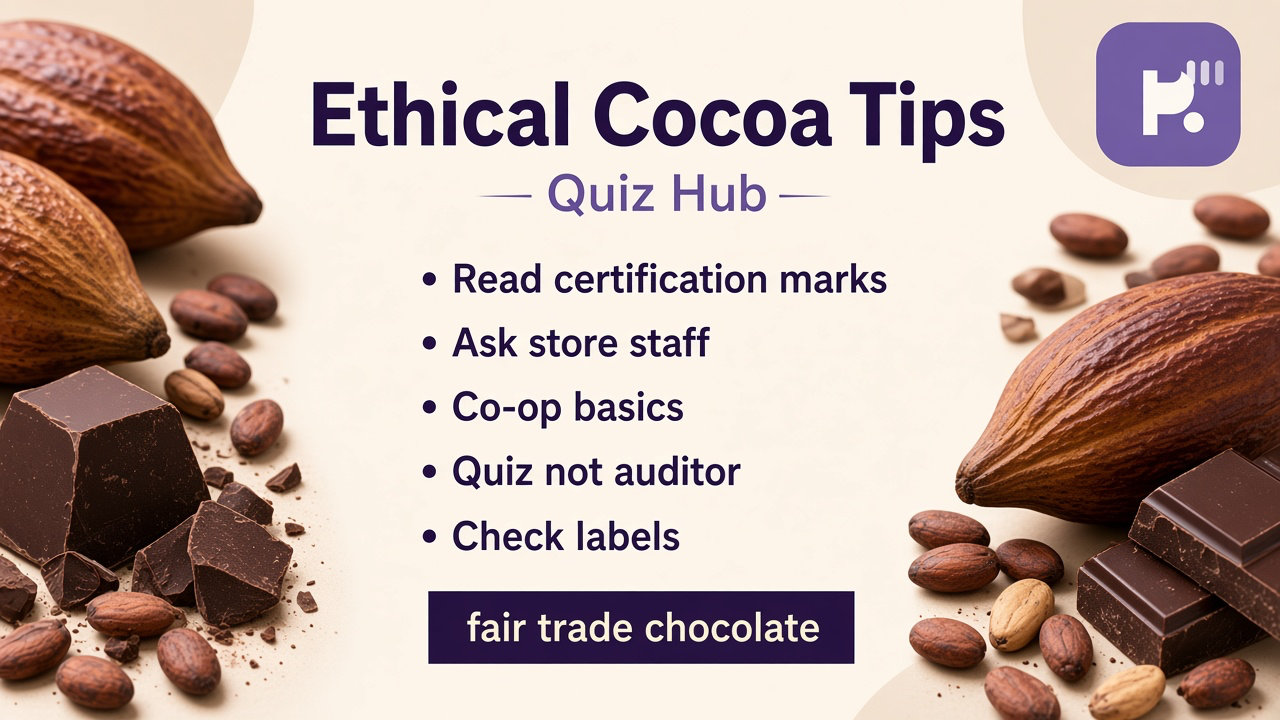
What this quiz can and cannot tell you
Can tell you
- Highlight certification, coop, and child labor limit habits worth revisiting before the next ethics unit
- Separate unofficial literacy from supply-chain auditor or import law fantasies
- Encourage reading marks and asking store staff before reposting candy dunk threads
- Spark honest talk with friends about warm-up captions on shares
Cannot tell you
- Certify supply-chain auditors or customs inspectors from one online screener
- Prove you inspected a farm or warehouse from trivia bars
- Replace teachers, ethics courses, or company transparency reports
- Turn literacy scores into harassment, boycott pile-ons, or auditor cosplay
Ethical cocoa literacy before auditor cosplay
Search traffic around fair trade chocolate quizzes usually wants two things: quick label rules for grocery aisles, and relief from threads that treat every snack choice like a morality trial. Those goals help when readers notice certification marks differ from decorative words and that coop premiums travel through programs, not tip jars. They hurt when literacy scores become boycott trophies, or when pile-ons mock classmates while claiming perfect bars. Ethical cocoa language works best when it names store habits and kindness limits together.
Dr. James Whitfield reviews iq-cognitive literacy screeners with a simple split: reward honest label reading and honest limits on auditor cosplay at the same time. Certification label literacy tracks registered marks, program differences, and resisting vibe-only shopping without ranking slow readers as careless. Farmer pay and coop basics tracks premiums and price floor ideas without luxury-wage myths. Child labor awareness limits tracks standards plus audit limits without zero-risk stickers or nihilist label trashing. Quiz not auditor keeps screeners, teachers, and real auditors separate from bar height.
Real learners mix bars. You might score high on label literacy while keeping coop basics moderate, which often describes strong logo spotting who still skips premium homework. You might score high coop with softer limit items, which can mean good premium questions plus occasional screenshot shaming slips. Reverse items catch sloppy answers: cursive fair as audit, one bar fixing global rules, instant luxury wages, worthless labels, zero child labor guarantees, or pile-ons tied to high bars should not inflate charts meant to track layered cocoa knowledge.
Pair results with siblings on this hub instead of forcing one candy story. Our ethics quiz stays on broader moral reasoning habits with stems separate from fair trade label literacy on this page. Our chocolate quiz covers general cocoa trivia when you want flavor facts beside sourcing marks. Our fake news quiz pairs media literacy with supply-chain claims you see in ads and posts. Browse the IQ and cognitive hub for more study screeners. Caption shares as warm-up, ask store staff kindly, and skip bait threads on friends who never opted in.
Holiday seasons and school fundraisers refresh faster than forum arguments. When you share results, say read-the-mark beats scoreboard. When you borrow tips, credit teachers who model certification homework and classmates who disagree without shaming. Retake after one candy-heavy month and watch whether quiz-not-auditor bars stay high even if label recall rises, which often means you separated book rules from actual aisle manners online.
| Test | Focus |
|---|---|
| Ethics quiz | Broader moral reasoning habits rather than fair trade certification label literacy on this page |
| Chocolate quiz | General cocoa trivia and flavor lore rather than coop premium and label mark drills here |
| Fake news quiz | Media literacy and source triangulation rather than packaging mark reading on this slug |
Fair Trade Chocolate Quiz FAQ
What does Fair Trade Chocolate Quiz measure?
It measures how much you agree with statements about certification label literacy, farmer pay and coop basics, child labor awareness limits, and quiz-not-auditor caps. You get an index from 0 to 100 plus four bars. It describes self-reported ethical cocoa literacy on this screener, not auditor certification or import clearance.
Does a Fairtrade logo mean zero child labor everywhere?
No. Child labor limit items frame standards and audits as risk reducers, not magic guarantees. Ethical literacy includes knowing poverty and enforcement stay complex while labels still matter for many buyers.
Does a high score mean I should shame friends over candy brands?
No. Quiz-not-auditor items explicitly reject screenshot shaming and inspector cosplay. High bars mean you related to literacy statements here, not that you won a morality debate or cleared a warehouse.
Why include coop premium items with basic label rules?
Store debates mix logos with pay stories. Coop items keep premium paths separate from tip-jar myths so results stay honest about which habits you endorse.
Who reviewed this quiz?
Dr. James Whitfield reviewed the educational framing, anti-pile-on limits, and separation from auditor or import law claims. See our editorial policy for review standards.
Reviewed by