What Factors Of Professional Development measures
This quiz does not score promotions, replace managers or HR, or rank coworkers from one screener. It measures how much you agree with habit statements grouped four ways: feedback and learning about finding useful signal in notes, asking clarifying questions, resisting all-feedback-is-attack myths, and practicing one change after awkward reviews; mentors and networks about naming guides, bringing concrete questions, sharing credit, and resisting mentor-shame or LinkedIn-only networking traps; skill goals and reflection about one focus at a time, logging wins on a keepable rhythm, treating stalls as data, and reviewing goals before certificate ad binges; and quiz not HR file about unofficial screeners, refusing promotion-packet screenshots, and captioning shares as warm-up not rank proof. You rate 22 statements from strongly disagree to strongly agree, with reverse-worded traps so one strong week cannot inflate every bar. Your answers also feed a second chart on closeness and trust habits, because career performance posts sometimes chase belonging over honest listening at home. The total becomes an index from 0 to 100 where higher means more reported professional development habits on this screener, not proof you beat colleagues.
Feedback and learning
Useful signal, clarifying questions, and small experiments after reviews.
Mentors and networks
Concrete questions, shared credit, and peers who challenge assumptions.
Skill goals and reflection
One skill focus, win logs, and setbacks as data not identity.
Quiz not HR file
Unofficial warm-up only; managers and HR own formal records.
How it works
Answer 22 agreement items
Rate each statement from Strongly disagree to Strongly agree. Tap Next after each answer.
Answers sort into four domains
Each answer feeds one of four professional development groups, and every item also feeds a closeness and trust layer.
See your index and charts
You get a 0 to 100 index, a band, four domain bars, and a second chart for intimacy habits.
Take the Factors Of Professional Development
Answer 22 short statements to see your professional development index, four domain bars, and a closeness and trust chart.
What your result means
Your index is the average of all 22 answers, scaled from 0 to 100, with reverse-worded items flipped first. Read quiz-not-HR bars together with feedback habits before you treat a high score as promotion proof. Growth habits support kinder career talk; managers still matter for decisions.
| Band | Index range | Typical reading |
|---|---|---|
| Building professional development habits | 0 to 35 | Fewer agreed habits on feedback, mentors, skill goals, or quiz-not-HR limits on this screener. |
| Mixed professional development habits | 36 to 65 | Solid habits in some domains with feedback-as-attack myths, mentor shame, goal scatter, or HR fantasy slips in others. |
| Strong professional development habits | 66 to 100 | Frequent agreement with feedback, mentor, goal, and quiz-not-HR habits; still study only. |
Tips at a glance
A quick takeaway graphic with topic tips (not your personal quiz scores). Start the quiz for your index, bands, and charts.
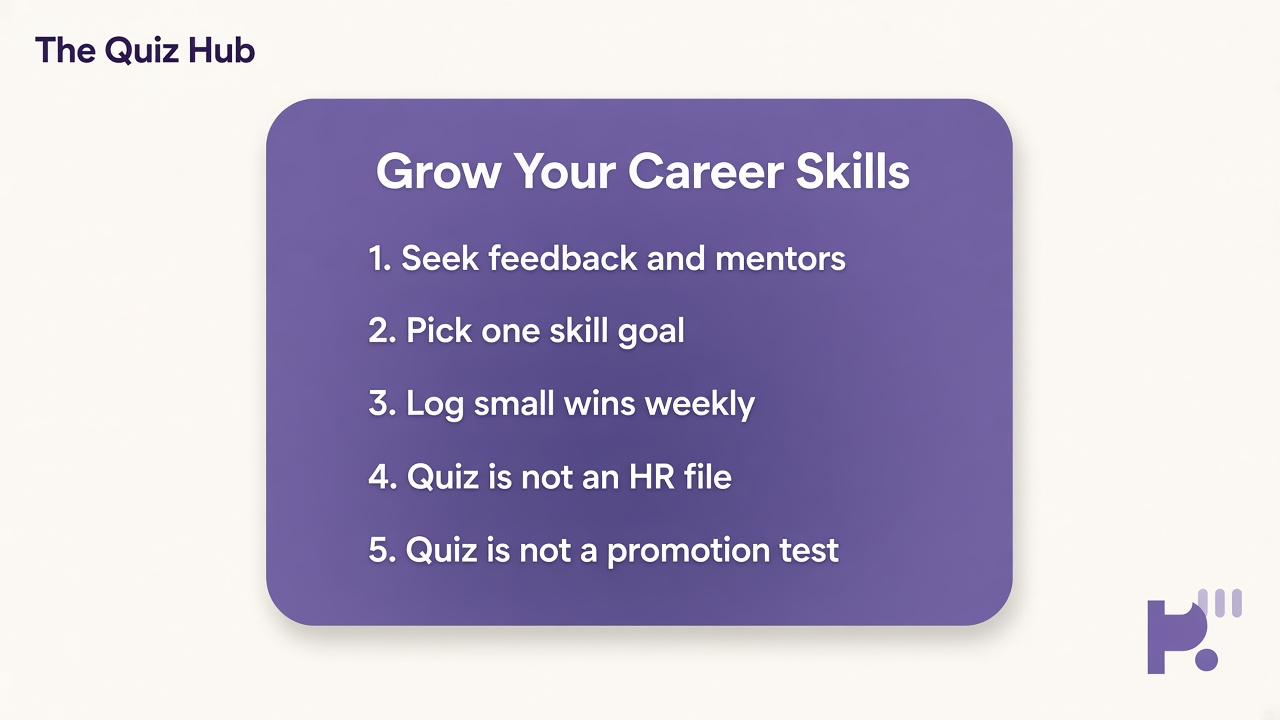
What this quiz can and cannot tell you
Can tell you
- Highlight feedback, mentor, and goal habits worth revisiting before the next review season
- Separate unofficial reflection from HR files and promotion panel fantasies
- Encourage one concrete mentor question before career debates in chat
- Spark honest talk with trusted peers about unofficial captions on shares
Cannot tell you
- Prove promotion readiness or salary bands from one online screener
- Replace managers, HR, unions, or written performance systems
- Rank coworkers or justify demotion talk from trivia bar height
- Turn growth scores into harassment, purity tests, or HR documentation
Professional development habits before promotion-meme cosplay
Search traffic around professional development quizzes usually wants two things: quick habits for feedback and growth, and relief from threads that treat every career quiz like a promotion verdict. Those goals help when readers pick one skill goal and log wins. They hurt when bars become HR cosplay, or when pile-ons rank quiet colleagues while claiming perfect indexes. Growth language works best when it names mentor questions and quiz limits together.
Dr. James Whitfield reviews iq-cognitive career screeners with a simple split: reward honest feedback and mentor habits and honest limits on HR pretense at the same time. Feedback and learning tracks useful signal without all-notes-are-attacks myths. Mentors and networks tracks concrete questions without mentor-shame traps. Skill goals and reflection tracks one focus and win logs without abandoning skills after slow starts. Quiz not HR file keeps screeners, managers, and panels separate from bar height.
Real workers mix bars. You might score high on mentors while keeping win logs moderate, which often describes strong question habits who still skip reflection rhythm. You might score high goals with softer limit items, which can mean good focus plus occasional promotion-screenshot slips. Reverse items catch sloppy answers: reject-all feedback, praise-only development, mentor shame, LinkedIn-only networks, quit-after-month-one skills, HR packet screenshots, or panel-skipping fantasies should not inflate charts meant to track layered growth knowledge.
Pair results with siblings on this hub instead of forcing one career story. Our employment quiz stays on general work fit reflection with stems separate from professional development habit depth on this page. Our employment freelancing entrepreneurship path covers W2 versus founder tradeoffs when you want path language beside growth habits. Our career values quiz pairs values clarity with skill goals many development plans share. Browse the IQ and cognitive hub for more study screeners. Caption shares as warm-up, ask mentors kindly, and skip bait threads on colleagues who never opted in.
Quarters and review cycles refresh faster than forum arguments. When you share results, say feedback and humility beat scoreboard. When you borrow tips, credit managers and mentors who gave honest notes and peers who disagreed without rank games. Retake after one focused skill month and watch whether quiz-not-HR bars stay high even if mentor recall rises, which often means you separated book rules from actual table manners at work.
| Test | Focus |
|---|---|
| Employment quiz | General employment fit reflection rather than feedback, mentor, and win-log habit depth on this page |
| Employment freelancing entrepreneurship | W2 versus freelance versus founder path tradeoffs rather than day-to-day development habit bars |
| Career values quiz | Values clarity and priority ranking rather than feedback uptake and mentor question habits |
Factors Of Professional Development FAQ
What does Factors Of Professional Development measure?
It measures how much you agree with statements about feedback and learning, mentors and networks, skill goals and win logs, and quiz-not-HR limits. You get an index from 0 to 100 plus four bars. It describes self-reported growth habits on this screener, not promotion decisions or HR ratings.
How should I use feedback and mentor items here?
Feedback items focus on finding useful signal and trying small changes after reviews. Mentor items focus on concrete questions and shared credit, not proving you never need help.
Does a high score mean HR should promote me?
No. Quiz-not-HR items explicitly reject promotion-packet screenshots and panel-skipping fantasies. High bars mean you related to growth statements here, not that managers owe you a title.
Why include one skill goal and win log items?
Professional development plans fail when goals scatter across ten resolutions. Reflection items keep one focus and logged wins visible so results stay honest about which habits you endorse.
Who reviewed this quiz?
Dr. James Whitfield reviewed the educational framing, anti-ranking limits, and separation from HR or promotion claims. See our editorial policy for review standards.
Reviewed by