What Expert Evaluation of Organizational Activity Style measures
This quiz does not place you on a promotion list, certify HR credentials, or speak for your employer. It measures how much you agree with habit statements grouped four ways: leadership style habits about clear priorities, room for pushback, calm under deadline stress, and resisting title-powered debate shutdowns; collaboration norms about spoken agreements on updates and urgency, named ownership, conflict repair, and refusing vibe-only handoffs; feedback and planning about asking how your communication landed, quarterly plans compared to capacity, specific praise and correction, and avoiding review-season-only honesty myths; and quiz not HR limits about unofficial screeners, refusing promotion packet fantasies, and captioning shares as study trivia not ranking proof. You rate 22 statements from strongly disagree to strongly agree, with reverse-worded traps so one heroic week cannot inflate every bar. Your answers also feed a second chart on closeness and trust habits, because performative manager cosplay sometimes chases belonging over honest team listening. The total becomes an index from 0 to 100 where higher means more reported activity style habits on this screener, not proof HR approved your feed.
Leadership style habits
Direction, dissent, and calm priorities without title theater.
Collaboration norms
Named owners, urgency rules, and repair after tense threads.
Feedback and planning
Ask for your own feedback, calendar check-ins, and specific notes.
Quiz not HR limits
Unofficial reflection only; HR files and 360 tools stay separate.
How it works
Answer 22 agreement items
Rate each statement from Strongly disagree to Strongly agree. Tap Next after each answer.
Answers sort into four domains
Each answer feeds one of four organizational activity style groups, and every item also feeds a closeness and trust layer.
See your index and charts
You get a 0 to 100 index, a band, four domain bars, and a second chart for intimacy habits.
Take the Expert Evaluation of Organizational Activity Style
Answer 22 short statements to see your organizational activity style index, four domain bars, and a closeness and trust chart.
What your result means
Your index is the average of all 22 answers, scaled from 0 to 100, with reverse-worded items flipped first. Read unofficial limits with collaboration bars before you treat a high leadership score as permission to rank coworkers. Activity style habits support kinder team talk; HR partners and coaches still matter for hard people decisions.
| Band | Index range | Typical reading |
|---|---|---|
| Building organizational activity style habits | 0 to 35 | Fewer agreed habits on leadership listening, collaboration norms, feedback loops, or unofficial limits on this screener. |
| Mixed organizational activity style habits | 36 to 65 | Solid habits in some domains with feedback avoidance, norm gaps, or HR fantasy slips in others. |
| Strong organizational activity style habits | 66 to 100 | Frequent agreement with leadership listening, collaboration norms, feedback loops, and unofficial limits; still not licensing. |
Tips at a glance
A quick takeaway graphic with topic tips (not your personal quiz scores). Start the quiz for your index, bands, and charts.
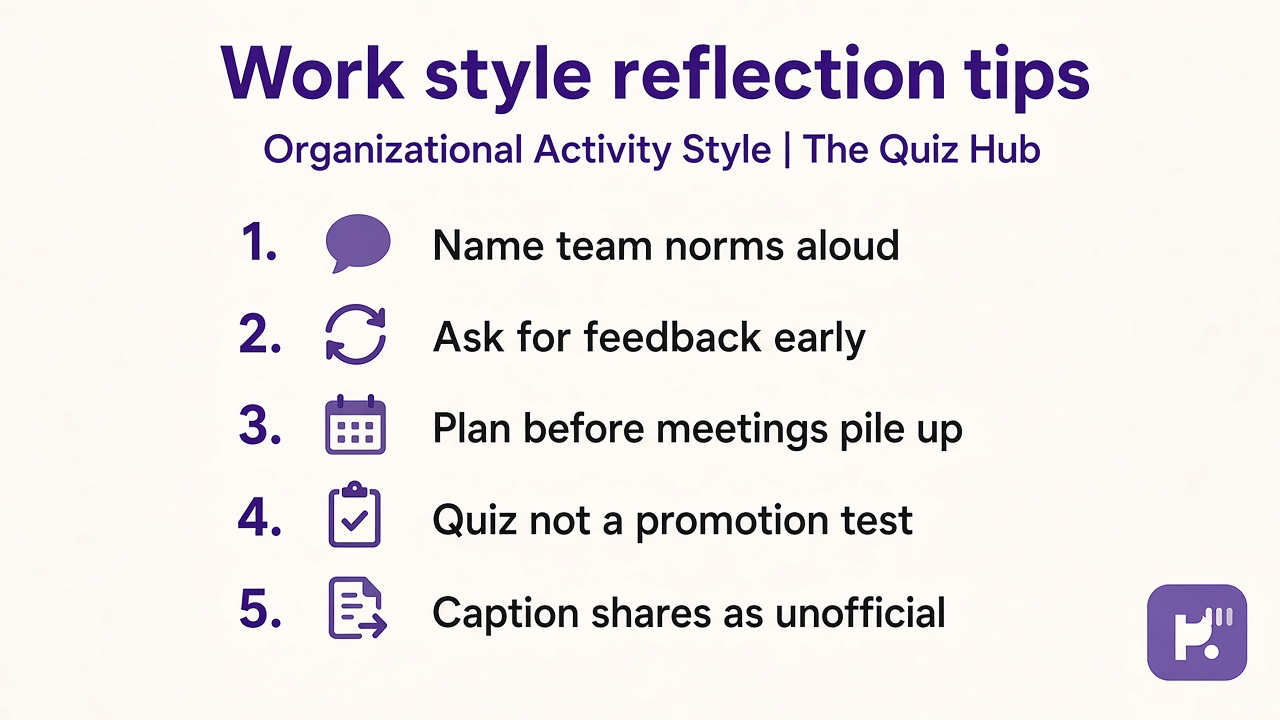
What this quiz can and cannot tell you
Can tell you
- Highlight leadership, collaboration, and feedback habits worth revisiting before the next planning cycle
- Separate unofficial reflection from promotion or hiring fantasies
- Encourage named team norms before reorg debates in chat
- Spark honest talk with peers about unofficial captions on shares
Cannot tell you
- Place anyone on a promotion list or prove demotion risk from one online screener
- Speak for HR, legal, unions, or your company review system
- Replace coaching, mediation, or formal performance feedback
- Turn activity style scores into harassment, ranking pile-ons, or purity tests
Organizational activity style before promotion-meme cosplay
Manager search intent often blends two needs: prove you run calm meetings for your own confidence, and claim a share lane that feels competent in mixed work chats. Those goals help when they spark norm writing and feedback questions. They hurt when quiz scores become licenses to rank quiet teammates, or when threads blur study trivia into proof someone deserves a raise.
Dr. James Whitfield reviews iq-cognitive work-style screeners with a simple split: reward honest team habits and honest limits on HR pretense at the same time. Leadership style habits tracks priorities, dissent, and stress behavior without title shutdowns. Collaboration norms tracks spoken agreements and repair talk without vibe-only handoffs. Feedback and planning keeps ask habits and calendars inside realistic capacity. Quiz not HR limits keeps screeners, review cycles, and HR partners separate from bar height.
Real leads mix bars. You may score high on collaboration while keeping feedback moderate, which often describes strong norm talk before personal ask habits land. You may score high planning with softer limit items, which can mean good calendar habits plus occasional unofficial caption slips. Reverse items catch sloppy answers: title trumping dissent, conflict as disloyalty, feedback only at review season, promotion screenshots without manager talks, or pile-ons tied to high bars should not inflate charts meant to track humble team habits.
Pair results with siblings instead of forcing one work story. Our expert assessment of sociocultural adaptation covers heritage pride, local norms, and acculturation humility on a parallel unofficial reflection lane. Our ethical leadership style questionnaire leans moral leadership habits when you want values language separate from daily team norm writing. Our communicative and organizational inclinations COI stays on briefing and task-sorting habits when you want coordination trivia without manager promotion framing. Browse the IQ and cognitive hub for more study screeners. Caption shares unofficial, read the room, and skip ranking threads on friends who never opted in.
Planning seasons shift faster than one reorg rumor cycle. When you share results, say listening and norms beat scoreboard. When you borrow tips, credit teammates who co-wrote charters and HR partners who welcome questions. Retake after a quarterly planning block and watch whether feedback bars rise even if collaboration trivia felt easy, which often means you separated performative manager posts from actual team listening.
| Test | Focus |
|---|---|
| Expert assessment of sociocultural adaptation | Heritage pride, local norms, and acculturation balance rather than manager-lens team charter and feedback habits |
| Ethical leadership style questionnaire | Moral leadership values and ethical decision habits rather than daily collaboration norm and check-in routines |
| Communicative and organizational inclinations COI | Briefing, task sorting, and cross-role update habits rather than feedback loops and quiz-not-HR limit framing |
Expert Evaluation of Organizational Activity Style FAQ
What does Expert Evaluation of Organizational Activity Style measure?
It measures how much you agree with statements about leadership style habits, collaboration norms, feedback and planning, and unofficial quiz limits. You get an index from 0 to 100 plus four bars. It describes self-reported manager-lens habits on this screener, not promotion readiness or HR endorsement.
Is this affiliated with my employer or HR department?
No. The Quiz Hub wrote this page without partnership from your company, HR vendors, or review software providers. Internal promotion systems and licensed 360 tools exist separately.
Does a high score mean I should argue for promotion in every thread?
No. High bars mean you related to habit statements here. Limit items explicitly reward unofficial captions and manager conversations; ranking coworkers from screenshots still harms mixed teams.
Why include collaboration and feedback items together?
Team health blends spoken norms with ask habits. Feedback items keep planning and correction inside realistic calendars without turning trivia into harassment licenses.
Who reviewed this quiz?
Dr. James Whitfield, PhD reviewed the unofficial framing, work respect limits, and result explanations. See our editorial policy for review standards.
Reviewed by