What the Ethical Leadership Style Questionnaire (ELSQ) measures
This quiz does not administer the published Ethical Leadership Style Questionnaire from peer-reviewed leadership research, employer 360 feedback, or HR leadership certification. It measures how much you agree with unofficial ethical leadership habit statements grouped four ways: fairness and equity about listening first, consistent standards, and reducing favoritism; transparency and accountability about explaining decisions within appropriate limits, owning mistakes, and inviting questions; integrity under pressure about crediting teams, refusing harmful shortcuts, and mentoring honest error admission; and unofficial not official ELSQ about disclaimers, separating this screener from research instruments and workplace review programs, and rejecting scoreboard authority over peers. You rate 22 statements from strongly disagree to strongly agree, with reverse-worded myths so one hustle-culture streak cannot inflate every bar. Your answers also feed a second chart on closeness and trust habits, because some leaders avoid vulnerability or peer feedback when title feels safer than honesty. The total becomes an index from 0 to 100 where higher means more reported ethical leadership habit agreement on this unofficial screener, not proof HR endorsed you or that you outrank teammates morally.
Fairness and equity
Listen first, consistent standards, and less favoritism in praise and consequences.
Transparency and accountability
Explain decisions, own mistakes, and document trust-critical choices.
Integrity under pressure
Credit teams, refuse harmful shortcuts, and keep promises when metrics squeeze.
Unofficial not official ELSQ
Reflection separate from published ELSQ and employer 360 programs.
How it works
Answer 22 agreement items
Rate each statement from Strongly disagree to Strongly agree. Tap Next after each answer.
Answers sort into four domains
Each answer feeds one of four ethical leadership groups, and every item also feeds a closeness and trust layer.
See your index and charts
You get a 0 to 100 index, a band, and two bar charts for personal development reflection.
Take the Ethical Leadership Style Questionnaire (ELSQ)
Answer 22 short statements to see your ethical leadership habit index, four domain bars, and a closeness and trust chart.
What your result means
Your index is the average of all 22 answers, scaled from 0 to 100, with reverse-worded items flipped first. Read unofficial limits with fairness and transparency bars before you treat the total as official ELSQ credentials or permission to judge coworkers. Reflection supports better one-on-ones; employer feedback systems and trained coaches matter more than scoreboard wins.
| Band | Index range | Typical reading |
|---|---|---|
| Building ethical leadership habits | 0 to 35 | Fewer agreed ethical habit statements on fairness, transparency, integrity, or unofficial limits. |
| Mixed ethical leadership habits | 36 to 65 | Solid habits in some domains with favoritism, secrecy, or official-ELSQ myths in others. |
| Strong ethical leadership habits | 66 to 100 | Frequent agreement with ethical habit statements and humble unofficial limits. |
Tips at a glance
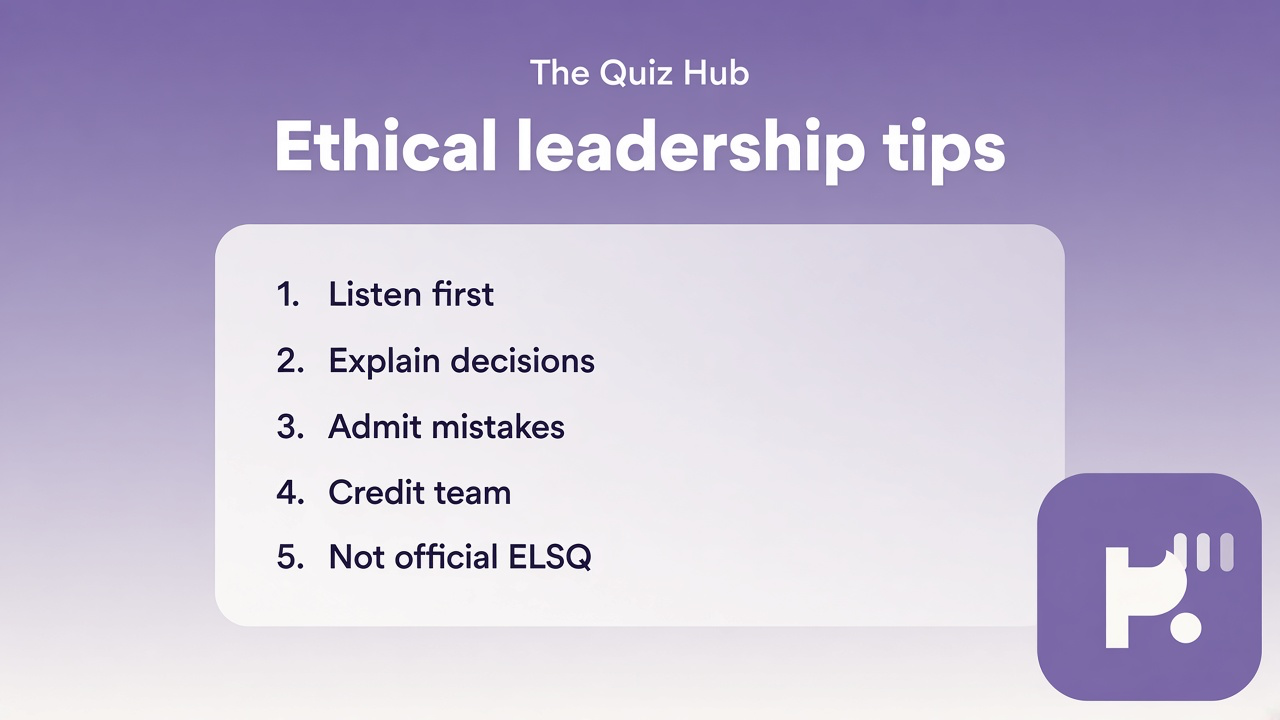
A quick takeaway graphic with topic tips (not your personal quiz scores). Start the quiz for your index, bands, and charts.
What this quiz can and cannot tell you
Can tell you
- Highlight fairness, transparency, and pressure-integrity habits worth practicing in your next week
- Separate unofficial reflection from published ELSQ and 360 review fantasies
- Encourage humble shares when you discuss results with a mentor or coach
- Spark better team questions about decisions without public ranking games
Cannot tell you
- Issue official Ethical Leadership Style Questionnaire research scores from one online screener
- Replace employer 360 feedback, HR investigations, or licensed executive coaching
- Prove you are an ethical leader for hiring or promotion decisions without workplace context
- Turn habit scores into excuses to shame or discipline peers without proper process
Lead with clarity: fairness, transparency, and unofficial ELSQ limits
Managers search ethical leadership style questionnaires when teams ask for fairness and transparency yet calendars fill with metrics decks. Published ELSQ instruments in leadership research use validated items and workplace study designs this page does not replicate. This unofficial screener teaches listen-first fairness, explain-the-why transparency, credit-under-pressure integrity, and humble limits so you can reflect without claiming HR endorsement.
Fairness and equity keeps listening and consistent standards visible before favoritism becomes team lore. Transparency and accountability keeps decision reasoning and mistake ownership visible within confidentiality bounds. Integrity under pressure keeps team credit and safety refusals visible when deadlines tempt shortcut ethics. Unofficial not official ELSQ keeps disclaimers visible beside any pride in high bars.
Real leads mix scores. You might agree strongly with crediting teams while moderate on explaining unpopular reorgs, which often describes speed before communication plans. You might score high on habits while keeping unofficial limits moderate, which can mean you practice ethics yet still hear friends treat any leadership quiz as a 360 substitute. Reverse items catch overconfidence: favoritism excuses, mistake hiding, ethics-skipping under metrics pressure, or web certification fantasies should not inflate bars meant to track layered habits.
Pair results with siblings on this hub instead of forcing one leadership story. Our authentic leadership questionnaire (ALQ) explores a different unofficial habit bank when label familiarity helps study chats. Our leadership assessment sibling emphasizes broader leadership reflection with its own limits. Browse the personality and psychology hub for more unofficial screeners. Caption shares unofficial and skip ranking people who never opted in.
Quarters outlast viral leadership threads. A transparency bar might spike after one hard conversation while fairness language sleeps until you run a listening tour. Retake after one development sprint and notice whether unofficial limits stay high even when habit scores rise, which often marks healthy growth. Reflection is a mirror for your next one-on-one, not a published ELSQ certificate or a license to fire by email.
| Test | Focus |
|---|---|
| Authentic leadership questionnaire (ALQ) | Separate unofficial authenticity habit bank, not these ELSQ-themed stems |
| Leadership assessment | Broader leadership reflection rather than ethical habit frequency here |
Ethical Leadership Style Questionnaire (ELSQ) FAQ
What does this quiz measure?
It measures how much you agree with unofficial ethical leadership habit statements across fairness, transparency, integrity under pressure, and unofficial limits. You get an index from 0 to 100 and four bars. It reflects self-reported habits on this screener, not a published ELSQ research score.
Is this the official Ethical Leadership Style Questionnaire (ELSQ)?
No. This is an unofficial reflection tool inspired by common ethical leadership themes. Published ELSQ instruments and employer leadership programs use methods, validation, and workplace context this page does not provide.
Can I use my score in a 360 review or HR file?
No. This screener is personal development reflection only. Employer 360 feedback and HR processes require structured programs, rater groups, and policies your workplace defines—not one public quiz total.
Why are some statements worded as myths?
Reverse-worded myths catch overconfidence. Agreeing that favoritism is fine, leaders should never look uncertain, ethics can be skipped under deadline pressure, or web scores grant official ELSQ firing authority should not inflate your habit index.
Who reviewed this quiz?
Dr. James Whitfield, PhD reviewed the unofficial framing, leadership ethics limits, not-360 disclaimers, and result explanations. See our editorial policy for review standards.
Reviewed by