What this child school adaptation quiz measures
This page does not administer a validated clinic expert assessment battery, and it cannot decide IEP eligibility, 504 status, gifted placement, or remedial tracks from one score. It measures how much you agree with parent observation statements grouped four ways: school routines about morning prep, transitions, schedules, and materials without treating one bad day as a permanent failure story; teacher rapport about help-seeking, sharing problems early, and partnering with teachers on patterns that last weeks; study habits about homework attempts, seatwork focus, homework spots, and simple organization tools; and quiz not IEP placement about unofficial screeners, conference notes versus courtroom proof, and refusing bar-height myths about special education or placement tests. You rate 22 statements from strongly disagree to strongly agree, with reverse-worded traps so one perfect-focus myth or IEP fantasy cannot hide shaky rapport or routine items on other days. Your answers also feed a second chart on closeness and trust habits, because school stress sometimes shrinks family listening before anyone emails the teacher. The total becomes an index from 0 to 100 where higher means more reported adaptation literacy habits on this screener, not proof a school team must adopt your chart as policy.
School routines
Materials, transitions, and schedule habits with age-typical reminders.
Teacher rapport
Help-seeking at school and calm caregiver-teacher contact.
Study habits
Homework attempts, focus, and organization tools at home.
Quiz not IEP placement
Unofficial notes only; IEP, 504, and placement tests stay separate.
How it works
Answer 22 agreement items
Rate each statement from Strongly disagree to Strongly agree. Tap Next after each answer.
Answers sort into four domains
Each answer feeds one of four school adaptation groups, and every item also feeds a closeness and trust layer.
See your index and charts
You get a 0 to 100 index, a band, four domain bars, and a second chart for intimacy habits.
Take the Expert Assessment of a Child's Adaptation to School
Answer 22 short statements to see your child school adaptation index, four domain bars, and a closeness and trust chart.
What your result means
Your index is the average of all 22 answers, scaled from 0 to 100, with reverse-worded items flipped first. Read quiz-not-IEP bars with teacher rapport scores before you treat a high routine bar as placement proof. Literacy supports kinder conference talk; school psychologists and IEP teams still own formal decisions.
| Band | Index range | Typical reading |
|---|---|---|
| Building school adaptation literacy | 0 to 35 | Fewer agreed items on routines, teacher rapport, study habits, or quiz-not-IEP limits on this screener. |
| Mixed school adaptation literacy | 36 to 65 | Solid signals in some domains with routine slips, rapport myths, study friction, or IEP fantasy traps in others. |
| Strong school adaptation literacy | 66 to 100 | Frequent agreement with routines, rapport, study habits, and unofficial limits; still not licensing placement or IEP proof. |
Tips at a glance
A quick takeaway graphic with topic tips (not your personal quiz scores). Start the quiz for your index, bands, and charts.
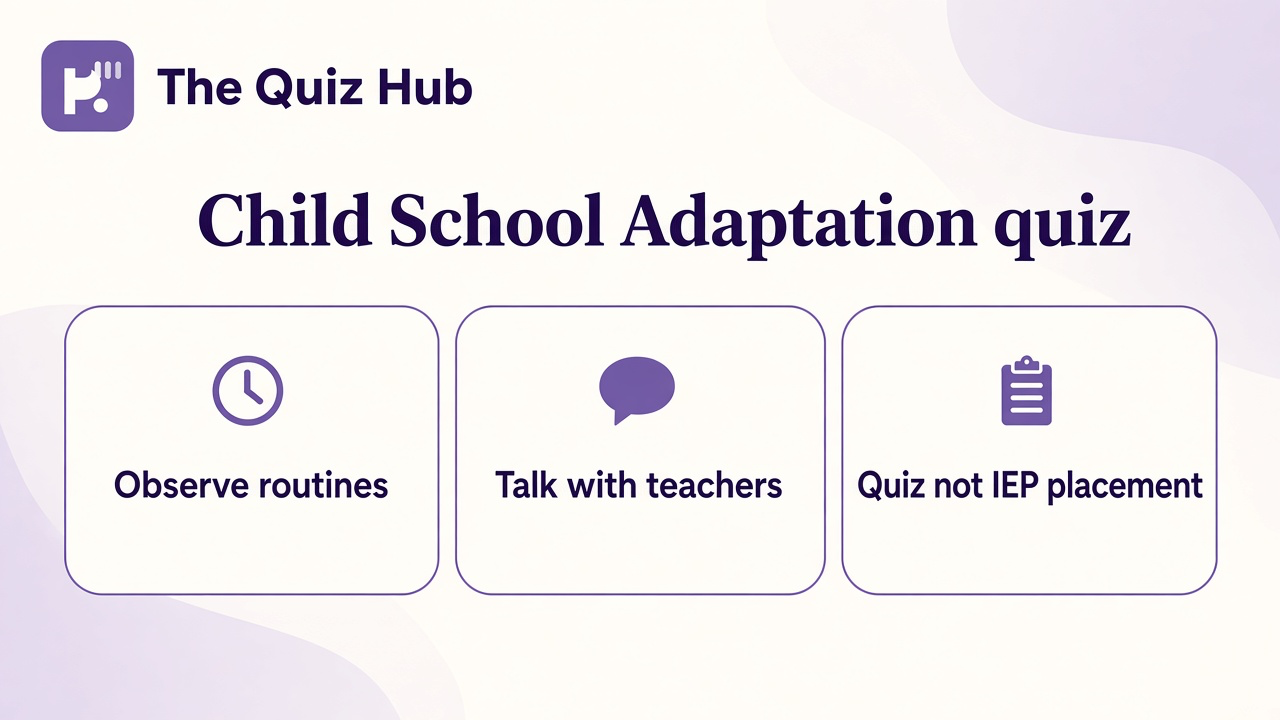
What this quiz can and cannot tell you
Can tell you
- Organize parent observations into routines, rapport, study, and limit buckets for teacher meetings
- Highlight when teacher input and formal testing may matter more than solo worry spirals
- Separate unofficial literacy from IEP, 504, and placement exam fantasies
- Offer a baseline if you retake after one semester of new habits or accommodations
Cannot tell you
- Decide IEP eligibility, 504 plans, or gifted placement from one online screener
- Replace school psychologist reports, classroom work samples, or licensed clinician evaluation
- Diagnose learning disorders, ADHD, or anxiety from parent agree bars alone
- Prove your child must change programs because one shareable chart looked high or low
School routines, teacher rapport, and quiz-not-IEP honesty
Parents search expert assessment of a child's adaptation to school when mornings feel chaotic, teacher notes sound vague, or homework fights outrun patience. School teams look at routines, relationships, classroom work, and health over time, not one dramatic Tuesday. This online screener uses that reflection lens unofficially; it cannot replace interviews, observations, and records your district uses for placement or special education decisions.
Dr. James Whitfield reviews iq-cognitive education screeners with a simple split: reward honest observation habits and honest limits on IEP and placement pretense at the same time. School routines tracks materials and transitions without one-lunch-box catastrophe stories. Teacher rapport tracks help-seeking and caregiver contact without treating every teacher email as an attack. Study habits tracks homework and focus with age-typical wobble, not perfect-minute myths. Quiz not IEP placement keeps screeners, placement offices, and school psychologists separate from bar height.
Real families mix bars. You may score high on routines while study habits stay moderate, which often describes smooth transitions before homework scaffolding lands. You may score high rapport with softer limit items, which can mean good teacher contact plus occasional screenshot-as-verdict slips. Reverse items catch sloppy answers: one bad Monday forever, neutral emails as hate mail, perfect focus as the only readiness sign, skipping homework as instant placement labels, or high bars as special education proof should not inflate charts meant to track humble observation literacy.
Pair results with siblings instead of forcing one school story. Our executive functioning quiz covers student-side planning and distraction literacy when your child is old enough to self-report study habits. Our dyslexia test for kids emphasizes parent-reported reading strain frequency when print fatigue travels with homework battles. Our child anxiety scale tracks worry frequency when stomachaches and school refusal need a separate mirror. Browse the IQ and cognitive hub for more study screeners. Caption shares unofficial, bring examples to teachers, and skip placement dunk threads on families who never opted in.
Grade blocks shift faster than one parent night. When you share results, say teacher input beats scoreboard. When you borrow tips, credit educators who answered plain questions and school staff who welcome observation notes. Retake after a semester and watch whether study bars rise even if routine trivia felt easy, which often means you separated performative placement posts from actual listening at conferences.
| Test | Focus |
|---|---|
| Executive functioning quiz | Student self-reported planning, chunking, and distraction literacy rather than parent-observed K-8 routines and teacher rapport |
| Dyslexia test for kids | Parent-reported reading strain and school evaluation delays rather than whole-school adaptation routines and rapport bars |
| Child anxiety scale | Child worry frequency screener rather than classroom routine and homework habit observation items here |
Expert Assessment of a Child's Adaptation to School FAQ
What does this child school adaptation quiz measure?
It measures how much you agree with statements about school routines, teacher rapport, study habits, and unofficial quiz limits. You get an index from 0 to 100 plus four bars. It describes parent-reported observation habits on this screener, not IEP eligibility or placement test scores.
Can this quiz decide if my child needs an IEP or gifted program?
No. IEP, 504, and placement decisions require school team process, records, and often formal testing. This tool helps you organize observations for teacher conferences, not replace district evaluation.
Should I talk with teachers if my bars look low?
Yes when patterns last weeks. Bring specific examples from home and ask what teachers see in class. One low bar is a map for questions, not proof your child failed school forever.
How is this different from the executive functioning quiz?
The executive functioning sibling targets student study skills self-report for older learners. This page uses parent agree items about younger-to-middle-grade routines, rapport, and homework habits with quiz-not-IEP limits.
Who reviewed this quiz?
Dr. James Whitfield, PhD reviewed the unofficial framing, school team limits, and result explanations. See our editorial policy for review standards.
Reviewed by