What the Dyslexia Test for Kids measures
This quiz does not diagnose dyslexia, specific learning disorder, or any other condition, and it does not measure IQ. Only a qualified professional using interview methods, school records, classroom work, and standardized reading tests when appropriate can determine whether a reading learning difference fits your child's profile. It measures how often you have noticed habit patterns educators and clinicians discuss when letter accuracy, reading stamina, phonological skills, and delayed help-seeking shape day-to-day life, grouped four ways: confusing similar letters or words, tiring quickly on print, struggling with sounds and spelling, and pursuing school evaluation or accommodations when problems repeat. You answer 22 how-often statements about the past three months from a parent observer view, with reverse-worded items so one good week cannot hide frequent strain across other days. Your responses also feed a second chart on closeness and trust habits, because worry about a child's learning sometimes makes it hard to co-parent on school calls or ask for help. The total becomes an index from 0 to 100 where higher means more frequent reported reading-related strain on this screener, not proof your child lacks ability.
Letter and word accuracy
How often similar letters or words slipped during reading aloud, homework, or copying.
Reading stamina
How often sessions ended early, place was lost, or fatigue showed up sooner than expected.
Phonics and spelling
How often rhyming, sounding out, or spelling lists felt unusually hard compared with peers.
School eval and support
How often teacher notes, homework battles, or delayed testing showed up while patterns returned.
How it works
Answer 23 frequency items
Rate each statement from Never to Very often for the past three months. Tap Next after each answer.
Answers sort into four domains
Each answer feeds one of four reading strain groups, and every item also feeds a closeness and trust layer.
See your index and charts
You get a 0 to 100 index, a band, and two bar charts you can bring to a school or clinical intake.
Take the Dyslexia Test for Kids
Answer 22 short statements to see your parent-reported reading strain index, four domain bars, and a closeness and trust chart.
What your result means
Your index is the average of all 22 answers, scaled from 0 to 100, with reverse-worded items flipped first. Higher means more frequent reported reading strain on this screener. Read school eval and support bars together with stamina before the total, since homework panic can look moderate while avoided evaluation keeps support out of reach.
| Band | Index range | Typical reading |
|---|---|---|
| Lower reported reading strain | 0 to 35 | Fewer frequent letter, stamina, phonics, or school support strain patterns in the past three months. |
| Mixed reported reading strain | 36 to 65 | Some domains spike while letter accuracy, stamina, or help-seeking look steadier on better weeks. |
| Higher reported reading strain | 66 to 100 | Frequent letter, stamina, phonics, or school support strain; consider formal learning evaluation. |
Tips at a glance
A quick takeaway graphic with topic tips (not your personal quiz scores). Start the quiz for your index, bands, and charts.
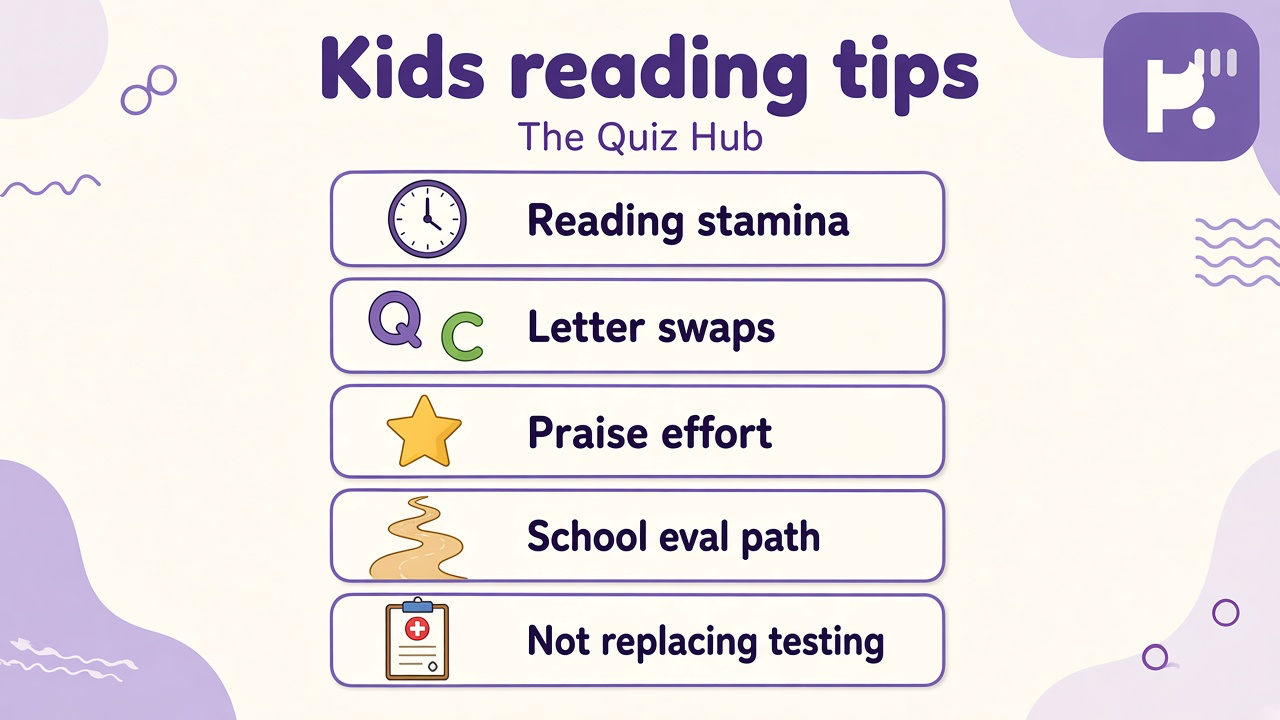
What this quiz can and cannot tell you
Can tell you
- Organize worries into letter accuracy, stamina, phonics, and school support buckets
- Give you language for teacher conferences or school psychologist intake
- Highlight when repeated strain may warrant formal testing rather than more shame or drill alone
- Offer a baseline if you retake after tutoring or accommodations start
Cannot tell you
- Diagnose dyslexia or specific learning disorder without professional evaluation
- Replace psychoeducational batteries administered by qualified examiners
- Measure IQ, vision, attention, or every cause of reading difficulty on its own
- Prove you should skip school testing because one online score looked low or high
Reading struggle signs in children and when to seek evaluation
Dyslexia refers to persistent difficulty with accurate and fluent word recognition and spelling that is not explained by lack of instruction alone. Parent searches often mix normal late bloomers with children who need structured literacy support. Frequency across months matters because two kids can both dislike homework while one rarely swaps letters and the other rereads every line to feel safe.
Letter and word accuracy items on this screener ask about b and d confusion, skipped small words, and stumbling on the same word twice. One hard week does not prove dyslexia, but patterns that repeat in books, worksheets, and signs may deserve documentation. Reading stamina items connect to real life: chapter books, timed tests, and homework marathons still show up even when phones read aloud for fun.
Phonics and spelling items focus on rhyming, sound order, and guessing from first letters. Clinicians often look at both skill and confidence profiles. School eval and support items ask whether teacher notes, homework battles, or delayed testing continued while the same errors returned. Praise effort at home while you pursue facts at school; shame predicts avoidance more reliably than extra worksheets alone.
The American Psychiatric Association includes specific learning disorder with impairment in reading among diagnosable conditions, but diagnosis requires structured assessment, not a free quiz. Schools in many regions offer evaluation pathways when learning problems affect education; private clinicians serve homeschool families too. Our dyslexia test screens self-reported adult reading and phonology strain when parents wonder about family overlap. The dyscalculia test emphasizes number sense when math strain travels alongside reading difficulty.
Higher scores mean more frequent parent-reported strain on this tool, not a lower IQ. Pair changes with tutors, explicit phonics programs, and professional evaluation when patterns persist. Retake after one semester of targeted help and compare domain bars, not only the total.
| Test | Focus |
|---|---|
| Dyslexia test | Self-reported adult reading accuracy, fluency, and phonology strain rather than parent-observed child habits over three months |
| Dyscalculia test | Number sense and math anxiety frequency rather than letter swaps and reading stamina |
| Analog clock quiz | Clock reading confidence without full phonics or school evaluation domains |
Dyslexia Test for Kids FAQ
What does this quiz measure?
It measures how often you noticed letter or word confusion, reading stamina drops, phonics and spelling friction, and school support delays in the past three months. You get an index from 0 to 100 plus four domain bars. It reports parent observation frequency, not a clinical diagnosis.
Can this quiz tell me if my child has dyslexia?
No. Dyslexia is identified through qualified evaluation using history, classroom work, and appropriate tests. This tool helps you organize observations for teacher or school psychologist conversations.
What should parents do if a child struggles with reading?
Document examples, talk with teachers, praise effort, and request school psychoeducational evaluation when strain is steady. Avoid calling your child lazy; ask what instruction and accommodations they need.
What should I do if my score is high?
Bring this snapshot to teachers, a school psychologist, or a clinician. Consider tutoring and accommodations while you pursue formal testing, not instead of it.
Who reviewed this quiz?
Dr. Elena Vasquez, PhD reviewed the YMYL framing, evaluation-not-diagnosis limits, and parent help-seeking guidance. See our editorial policy for review standards.
Reviewed by