What Executive Functioning Quiz measures
This quiz does not diagnose ADHD, autism, learning disorders, or any clinical condition. It does not replace neuropsychological testing, school psychologist evaluations, 504 planning, or medical care. It measures how much you agree with statements in four groups: planning and calendars about due dates, buffers, and master lists instead of memory-only hope; chunking homework about mini-deadlines, page goals, next five-minute actions, breaks, and sleep before cram sessions; distraction habits about phones, study spots, tabs, worry lists, and multitask realism; and quiz not diagnosis about playful reflection, refusing web-score clinician fantasies, and keeping formal assessment with licensed pros. You rate 22 statements from strongly disagree to strongly agree, with reverse-worded traps so agreeing that perfect planners never need calendars, that one-night hero cram always beats chunking, that shame spirals beat environment changes, or that high bars replace neuropsych testing cannot inflate every bar. Your answers also feed a second chart on closeness and trust habits, because study shame sometimes blocks asking roommates or tutors for planning help. The total becomes an index from 0 to 100 where higher means more reported executive functioning study literacy on this screener, not IQ rank.
Planning and calendars
Due dates, buffers, and master lists instead of memory-only hope.
Chunking homework
Mini-deadlines, page goals, and sleep-before-cram realism.
Distraction habits
Phones, study spots, tabs, and gentle focus resets.
Quiz not diagnosis
Study reflection without disorder labels or clinician myths.
How it works
Answer 22 agreement items
Rate each statement from Strongly disagree to Strongly agree. Tap Next after each answer.
Answers sort into four domains
Each answer feeds one of four executive functioning study groups, and every item also feeds a closeness and trust layer.
See your index and charts
You get a 0 to 100 index, a band, and two bar charts you can share as study notes with consent.
Take the Executive Functioning Quiz
Answer 22 short statements to see your executive functioning study literacy index, four domain bars, and a closeness and trust chart.
What your result means
Your index is the average of all 22 answers, scaled from 0 to 100, with reverse-worded items flipped first. Read quiz-not-diagnosis with distraction bars before you treat a high planning score as clinical proof. Literacy is for class habits; licensed pros own formal assessment.
| Band | Index range | Typical reading |
|---|---|---|
| Building executive functioning study literacy | 0 to 35 | Fewer agreed items on calendars, chunking, distraction tweaks, or quiz-not-diagnosis limits. |
| Mixed executive functioning study literacy | 36 to 65 | Solid habits in some domains with calendar gaps, cram traps, or diagnosis myths in others. |
| Stronger executive functioning study literacy | 66 to 100 | Frequent agreement across planning, chunking, distractions, and limits; still study reflection only. |
Tips at a glance
A quick takeaway graphic with topic tips (not your personal quiz scores). Start the quiz for your index, bands, and charts.
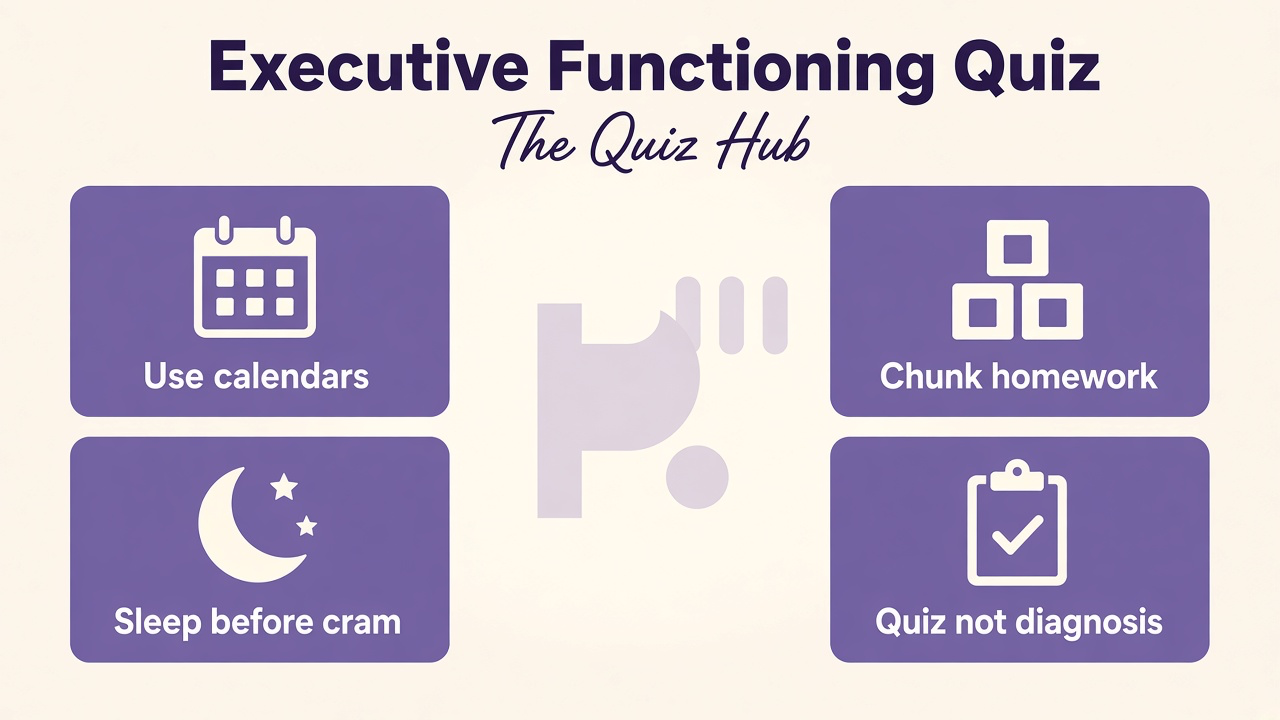
What this quiz can and cannot tell you
Can tell you
- Highlight which planning, chunking, or focus habits your self-report resembles this month
- Encourage calendars and mini-deadlines before all-night cram spirals
- Separate playful study reflection from disorder labeling in plain language
- Offer a baseline if you retake after a schedule change or new term
Cannot tell you
- Diagnose ADHD, autism, learning disorders, or any clinical condition from agree items alone
- Replace neuropsychological testing, school psychologist reports, or medical treatment plans
- License labeling classmates, roommates, or coworkers based on bar height
- Substitute for IQ testing, gifted placement, or employment screening
Executive functioning study literacy without disorder labels
Readers search executive functioning quizzes when syllabi stack up or phones win every study hour. The gap online is not lack of listicles; it is thin guidance on calendars, chunking, and distraction tweaks that stay kind while refusing diagnosis dunking.
Dr. James Whitfield reviews IQ and cognitive study literacy screeners with a simple split: reward honest planning habits and honest limits at the same time. Planning and calendars keeps due dates, buffers, and master lists visible beside memory-only myths. Chunking homework keeps mini-deadlines, page goals, and sleep-before-exam realism visible beside one-night hero cram traps.
Distraction habits keeps phone distance, quieter study spots, and tab discipline visible beside shame-spiral traps. Quiz not diagnosis keeps study reflection honest so bars never become disorder tags or clinician replacements.
Reverse items catch calendar-free perfection fantasies, cram-only bravado, shame-as-strategy myths, and high-score neuropsych shortcuts. Those myths should not inflate bars meant to track curious study habits.
Pair results with siblings on this hub instead of forcing one executive story. Our executive dysfunction test sibling uses a how-often frequency scale for habit reflection with separate stems, not the agree literacy lane on this slug. Browse the IQ and cognitive test hub for more study screeners. Retake after one calendar-and-chunk week; literacy grows when planning, focus, and limits stay linked.
| Test | Focus |
|---|---|
| Executive dysfunction test | Frequency-scale habit mirror with clinical honesty limits, not agree literacy stems on this slug |
| IQ and cognitive hub | More study screeners when you want habits beside executive wording |
Executive Functioning Quiz FAQ
What does Executive Functioning Quiz measure?
It measures how much you agree with planning and calendar habits, homework chunking, distraction awareness, and quiz-not-diagnosis limits. You get an index from 0 to 100 and four bars. It is study reflection, not clinical diagnosis.
Is this the same as Executive Dysfunction Test?
No. Executive Functioning Quiz uses agree statements about study literacy on the IQ and cognitive hub. Executive Dysfunction Test uses a how-often frequency scale with separate stems and clinical honesty limits on the mental health hub.
Does a high score mean I have ADHD or perfect IQ?
No. Bars describe habits you reported here. They do not diagnose disorders, measure IQ, or replace neuropsychological testing.
Why are some statements worded as myths?
Reverse-worded myths catch overconfidence. Agreeing that calendars are pointless, that shame beats environment changes, or that web scores replace clinicians should not inflate your literacy index.
Who reviewed this quiz?
Dr. James Whitfield, PhD reviewed the educational framing, anti-label limits, and result explanations. See our editorial policy for review standards.
Reviewed by