
What the Executive Function Assessment Questionnaire Brief measures
This quiz does not diagnose ADHD, learning disorders, autism, brain injury, or any other condition. Only a licensed clinician using interview methods, history, and sometimes formal testing can do that. It measures how often you noticed executive function strain patterns grouped four ways: planning and priorities when time estimates, task order, or urgency sorting slipped; inhibition and impulse control when urges moved words, clicks, purchases, or yes answers before pause space; working memory when details faded mid-task, mid-message, or mid-routine despite caring about outcomes; and brief screen limits when you treat this page as neuropsych proof, IQ rank, school placement authority, or reason to skip qualified help when strain persists. You answer 22 how-often statements about the past two weeks, with reverse-worded items so one good list day cannot hide frequent strain across other days. Your responses also feed a second chart on closeness and trust habits, because some people lose focus hardest when vulnerability already feels unsafe. The total becomes an index from 0 to 100 where higher means more frequent reported strain patterns on this screener. Your responses suggest habits to discuss with support; they do not mean you lack intelligence.
Planning and priorities
How often sequencing, time estimates, or choosing first steps felt harder than the task deserved.
Inhibition and impulse control
How often urges moved action before you had pause space to check tone, time, or consequences.
Working memory
How often details slipped mid-task even when you cared about finishing well.
Brief screen limits
How often you treat this quiz as neuropsych battery, IQ proof, or placement verdict instead of intake notes.
How it works
Answer 22 frequency items
Rate each statement from Never to Very often for the past two weeks. Tap Next after each answer.
Answers sort into four domains
Each answer feeds one of four executive function groups, and every item also feeds a closeness and trust layer.
See your index and charts
You get a 0 to 100 index, a band, and two bar charts you can bring to a clinician.
Take the Executive Function Assessment Questionnaire Brief
Answer 22 short statements to see your executive function brief screen index, four domain bars, and a closeness and trust chart.
What your result means
Your index is the average of all 22 answers, scaled from 0 to 100, with reverse-worded items flipped first. Higher means more frequent reported strain patterns on this screener. Read planning and working memory bars together before the total, because time slips and mid-task forgetfulness often rise as a pair.
| Band | Index range | Typical reading |
|---|---|---|
| Lower reported EF strain | 0 to 35 | Fewer frequent planning, inhibition, or working memory strain patterns in the past two weeks. |
| Mixed reported EF strain | 36 to 65 | Some steadier stretches alongside planning, inhibition, memory, or hype spikes on others. |
| Higher reported EF strain | 66 to 100 | Frequent planning, inhibition, or memory strain; qualified evaluation may help more than self-blame. |
Tips at a glance
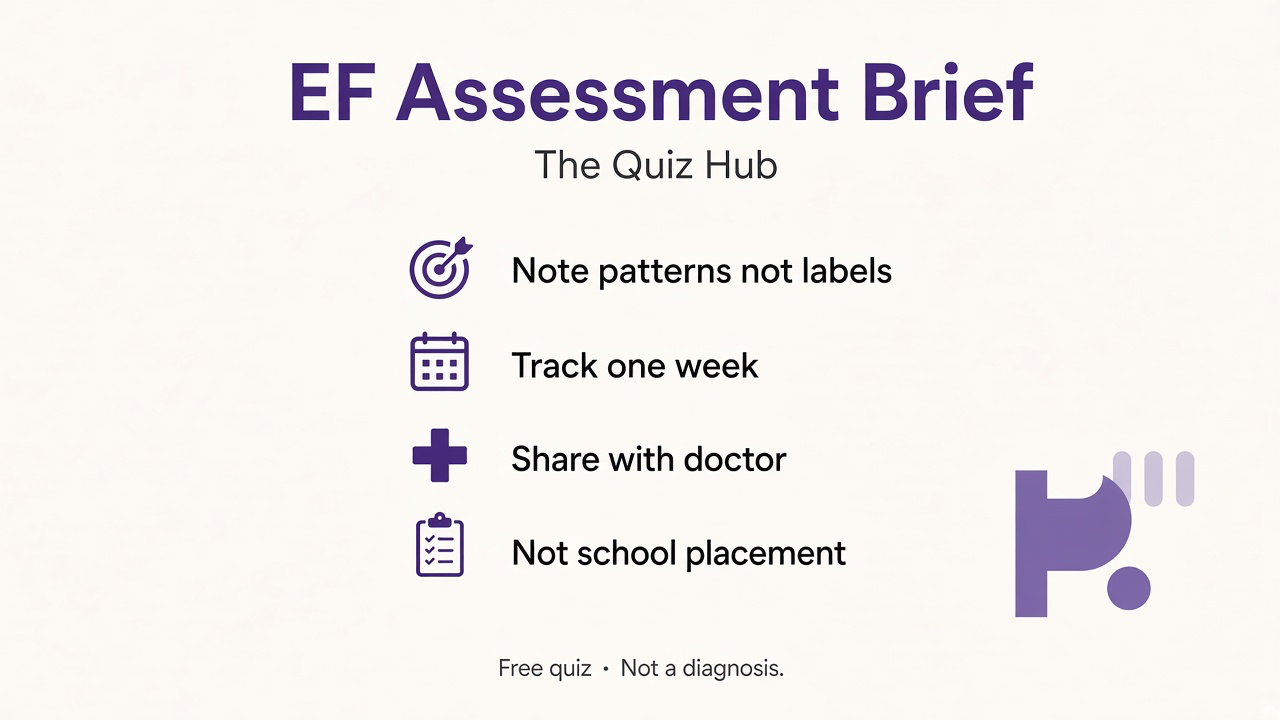
A quick takeaway graphic with topic tips (not your personal quiz scores). Start the quiz for your index, bands, and charts.
What this quiz can and cannot tell you
Can tell you
- Name planning, inhibition, and memory strain in plain language for intake
- Highlight when executive function bars run high enough to deserve compassion or evaluation
- Support early conversations with clinicians, school teams, or coaches
- Offer a baseline if you retake after one list-plus-pause experiment
Cannot tell you
- Replace neuropsychological batteries, IQ testing, or medical workups without evaluation
- Decide special education placement, gifted programs, or hiring fitness from one web total
- Prove you are lazy or unintelligent from one score when sleep and stress matter
- Tell you that struggling means moral failure instead of a pattern worth skilled assessment
Brief EF screens: planning, inhibition, memory, and neuropsych limits
People search executive function assessment questionnaire brief pages when a clinician mentions screening yet the wait list stretches and memes treat forgetfulness as a moral flaw. Real neuropsychology measures planning, inhibition, and working memory with longer batteries, observation, and history. This page scores frequency so your responses suggest where strain clusters, not whether you earn an IQ sticker or a school label from a bar chart.
Planning and priorities is the first domain because daily life runs on sequencing. Underestimating time, juggling too many open loops, or freezing when everything feels urgent is common during sleep debt, caregiving, chronic pain, and exam crunch. Writing a short list or breaking a task into steps is not virtue signaling; it is a habit many clinicians encourage when brains are tired. Reverse items capture when you already used planners or chunking, signs practice is landing, not proof you will never slip again.
Inhibition and impulse control is the second domain because urges often move before labels arrive. Blurting, regretful messages, endless scrolling, or automatic yes answers can be attempts to escape boredom, shame, or overload, not proof you are careless. A brief delay, breath, or step-away is a skill many therapy groups rehearse; this screener only asks how often those moves showed up for you lately. Agreeing that you sometimes paused before a high-stakes urge should not inflate an index meant to track strain on other days.
Working memory is the third domain because holding steps in mind is invisible until something breaks. Forgetting why you entered a room, rereading the same line, or dropping a familiar routine step frustrates people who care deeply about quality. Repeating a short list aloud or leaving a visible reminder is a lawful coping tactic, not cheating. Clinicians sometimes explore sleep apnea, anemia, mood conditions, or attention differences when memory strain repeats across settings.
Brief screen limits are the fourth domain, patterned after YMYL honesty on screeners. Treating a low bar as laziness, expecting one web quiz to replace neuropsychological testing, or believing this page is the published Behavior Rating Inventory of Executive Function with clinic cutoffs should not inflate a strain index meant to track real moments. Brief tools can start intake talks; they cannot alone decide gifted placement, disability services, or job rank. Agreeing that screeners name habits for doctors and school teams keeps scores tied to humility, not hype. Our executive dysfunction test sibling emphasizes task initiation strain and ADHD overlap honesty with its own unofficial limits. Our executive functioning quiz sibling on the cognitive hub stresses study-skills framing rather than clinical brief-screen habits. Our behavior rating inventory of executive function brief sibling offers a separate literacy lane when you want BRIEF-named reflection with its own limits. Browse the mental health and clinical test hub for more screeners with study-not-diagnosis language.
Retake after two weeks of one tracked week journal, one list before mornings, one pause before reactive messages, or one outreach to a clinician, and compare domain bars. Your responses suggest whether habits are shifting, not whether you deserve care. Licensed clinicians turn examples into evaluation plans this page cannot deliver. If distress feels unbearable tonight, call or text 988 in the US or your local crisis line before debating results alone.
| Test | Focus |
|---|---|
| Executive dysfunction test | Task initiation and ADHD overlap reflection rather than brief planning-inhibition-memory screen habits |
| Executive functioning quiz | Study skills and calendar habits on the cognitive hub, not YMYL brief clinical screen limits |
| Behavior rating inventory of executive function brief | BRIEF-named literacy screener with separate stems, not this unofficial EF assessment brief bank |
Executive Function Assessment Questionnaire Brief FAQ
What does this brief executive function questionnaire measure?
It measures how often you noticed planning, inhibition, working memory, and brief-screen limit patterns during the past two weeks. You get an index from 0 to 100 plus four domain bars. Your responses suggest self-reported frequency for reflection, not a clinical diagnosis or IQ score.
Does a high score mean I have ADHD or a learning disorder?
No. Your responses suggest how often strain patterns showed up on this screener lately. Only a licensed clinician using interviews, history, and sometimes formal testing can evaluate ADHD, learning differences, or other conditions. Use bars to describe habits, not to shame yourself.
Can this quiz replace neuropsychological testing or decide school placement?
No. Neuropsychologists and school teams use longer batteries, records, and observation. This page is education and self-reflection only. It cannot prove gifted status, disability eligibility, or job fitness from one total.
How is working memory different from being unintelligent?
Working memory is about holding steps in mind for short periods under load. People with strong reasoning can still forget mid-task when sleep, stress, pain, or attention differences stack up. Your responses suggest frequency of slips here, not worth or IQ.
How does this differ from the executive dysfunction test on this site?
The executive dysfunction test sibling emphasizes initiation strain and ADHD overlap honesty with its own question bank. This brief questionnaire focuses on planning, inhibition, working memory, and neuropsych-not-replaced limits without recycling those stems.
What should I do if my score is high or I feel in crisis?
Contact a psychologist, psychiatrist, neurologist, or primary care clinician with domain examples from your results. Call or text 988 (US) if you feel hopeless, unsafe, or in emotional crisis. Seek urgent help if thoughts turn toward self-harm.
Who reviewed this quiz?
Dr. Sarah Chen, PhD reviewed the YMYL framing, crisis resources, neuropsych-not-replaced limits, and result explanations. See our editorial policy for review standards.
Reviewed by
