
What this Excel interview quiz measures
This quiz does not issue job offers, score you for employers, or replace timed work tests, take-home models, or licensed career counseling when money and safety are on the line. It measures how much you agree with prep habits grouped four ways: pivot table habits about header rows, refresh discipline, purposeful aggregations, field layout with a question in mind, sanity checks, and rejecting auto-clean myths; VLOOKUP limits literacy about left-column search rules, exact versus approximate match, reading #N/A, INDEX MATCH awareness, and stable ranges when copying; interview explain-aloud practice about narrating formula steps, stating assumptions, giving reasons for function choices, tracing errors calmly, rehearsing concrete business examples, and rejecting silent-speed myths; and quiz not job offer limits about playful reflection, rejecting guaranteed-offer myths, keeping bars private, and avoiding applicant dunking from shared totals. You rate 22 statements from strongly disagree to strongly agree, with reverse-worded myths so agreeing that pivots fix messy data without cleaning, that VLOOKUP ignores layout, that silent typing always beats narration, or that high bars guarantee offers cannot inflate every bar. Your answers also feed a second chart on closeness and trust habits, because interview pressure sometimes overlaps with how much you fear judgment when work meets vulnerability. The total becomes an index from 0 to 100 where higher means more reported Excel interview prep habits on this screener, not hiring credentials or harassment license over recruiters.
Pivot table habits
Clean sources, refresh, aggregations, layout, sanity checks.
VLOOKUP limits literacy
Match modes, #N/A, layout limits, INDEX MATCH awareness.
Interview explain-aloud practice
Narration, assumptions, reasons, error tracing, mock stories.
Quiz not job offer limits
Prep fun; not offers, employer files, or applicant dunking.
How it works
Answer 22 agreement items
Rate each statement from Strongly disagree to Strongly agree. Tap Next after each answer.
Answers sort into four domains
Each answer feeds one of four Excel interview prep groups, and every item also feeds a closeness and trust layer.
See your index and charts
You get a 0 to 100 index, a band, and two bar charts you can share as study notes with consent.
Take the Excel Quiz for Interview
Answer 22 short statements to see your Excel interview prep index, four domain bars, and a closeness and trust chart.
What your result means
Your index is the average of all 22 answers, scaled from 0 to 100, with reverse-worded items flipped first. Higher means more reported prep habits on this screener. Read quiz-not-offer bars with pivot and lookup bars before you treat any total as hiring proof or recruiter certification.
| Band | Index range | Typical reading |
|---|---|---|
| Building Excel interview prep habits | 0 to 35 | Fewer agreed habits on pivots, VLOOKUP limits, explain-aloud practice, or quiz-not-offer limits on this screener. |
| Mixed Excel interview prep habits | 36 to 65 | Solid habits in some domains with pivot-fix myths, lookup drift, silent demos, or offer shortcuts in others. |
| Stronger Excel interview prep habits | 66 to 100 | Frequent agreement with pivot, lookup, explain-aloud, and limit habits; still not a job offer. |
Tips at a glance
A quick takeaway graphic with topic tips (not your personal quiz scores). Start the quiz for your index, bands, and charts.
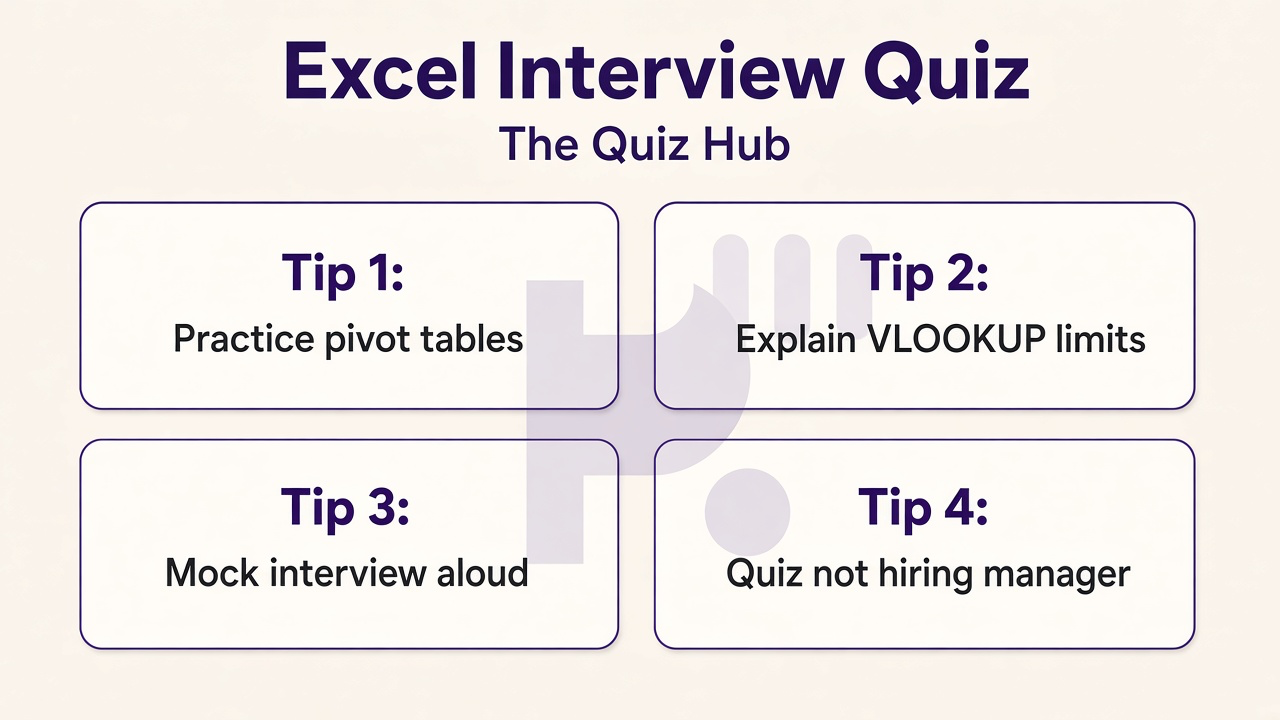
What this quiz can and cannot tell you
Can tell you
- Highlight pivot refresh and lookup limit habits worth rehearsing before a live spreadsheet screen
- Encourage explain-aloud practice without shaming peers who learn Excel in a second language
- Separate playful reflection from offer letter fantasies and employer file confusion in plain language
- Spark better questions for mentors about assumptions, data cleaning, and mock interview pacing
Cannot tell you
- Replace employer work samples, proctored tests, references, or formal HR processes
- Prove you deserve an offer or that another applicant is less worthy from bar shape alone
- Replace legal advice, union guidance, or therapist care when job stress harms safety or health
- Override respect for someone who needs any paycheck this month because your prep bar looks higher today
Spreadsheet prep habits without offer letter myths
People search Excel interview quizzes when pivot refreshes fail, lookup errors stack, and panels ask you to think out loud while formulas break. The gap online is not lack of shortcut lists; it is thin guidance on clean source tables, VLOOKUP limit language, and candidates who need narration reps without treating fan screeners like hiring offices.
Dr. James Whitfield reviews iq-cognitive screeners with a simple split: reward honest agreement with practical prep habits and honest limits on hiring overclaim at the same time. Pivot table habits keeps headers, refresh, and aggregation choices visible beside auto-clean myths. VLOOKUP limits literacy keeps match modes, layout rules, and #N/A reading visible beside layout-free fantasies. Interview explain-aloud practice keeps assumptions, reasons, and calm error tracing visible beside silent-speed brags. Quiz not job offer limits keeps offers, work samples, and employer judgment language honest so readers know official hiring differs from fan pages.
Real readers mix bars. You might score high on lookup recall while explain-aloud wobbles, which often describes flashcard strength without mock reps. You might score high on pivots with moderate offer limits, which can mean solid refresh habits yet little experience captioning unofficial shares. Reverse items catch sloppy answers: pivots fix messy data without cleaning, VLOOKUP ignores column order, silent typing always wins, or quiz bars guarantee offers should not inflate bars meant to track layered prep habits.
Pair results with siblings on this hub instead of forcing one job story everywhere. Our engineering quiz sibling covers discipline and team documentation habits when your crew shares technical interviews and project folders. Our employment quiz covers values, growth questions, and interview red flags when spreadsheet prep sits beside broader fit reflection. Browse the IQ and cognitive test hub for more study-style screeners that skip credential posing. Caption shares as prep practice, not offer proof.
Seasons change faster than hiring pipelines. Bootcamps, layoffs, and promotion tracks shift which habits feel alive. When you share results, say unofficial study beats recruiter shortcuts. When you borrow tips, credit mentors who lent you practice datasets. Retake after one interview month and notice whether quiz-not-offer bars stay high even when pivot bars rise, which often marks healthier prep than dunking strangers for one #N/A typo.
| Test | Focus |
|---|---|
| Engineering quiz | Discipline and team documentation study literacy rather than Excel pivot and lookup depth on this slug |
| Employment quiz | Values, growth, and interview red-flag habits rather than spreadsheet formula prep here |
| IQ and cognitive hub | More study screeners that avoid hiring credential posing |
Excel Quiz for Interview FAQ
What does this Excel interview quiz measure?
It measures how much you agree with prep habits across pivot table habits, VLOOKUP limits literacy, interview explain-aloud practice, and quiz-not-job-offer limits. You get an index from 0 to 100 and four bars. It is study reflection, not recruiter certification.
Does a high score mean I will get a job offer?
No. Bars describe habits you reported here. Employers still use work samples, live screens, references, and their own rubrics. Quiz-not-offer items explicitly reject guaranteed-offer myths.
How is this different from the employment quiz?
The employment sibling focuses on values fit, growth questions, and interview red flags across roles. This page focuses on Excel pivot, lookup, and explain-aloud prep with a separate stem bank.
Why include VLOOKUP limit items instead of only pivot tricks?
Intent brief readers asked for formula literacy beside shortcut memes. Lookup bars keep match modes and layout limits visible so memorized syntax does not mask #N/A confusion in live demos.
Who reviewed this quiz?
Dr. James Whitfield, PhD reviewed the study framing, hiring limit language, and result explanations. See our editorial policy for review standards.
Reviewed by
