What this ever never quiz measures
This quiz does not certify party host licenses, cannot diagnose relationship health from one agree screener, and cannot replace licensed couples counseling when trust fights persist after games. It measures how much you agree with Never Have I Ever habits grouped four ways: opt-in party norms about explaining the game, pass rules, PG prompts for mixed groups, pausing when energy shifts, host buddies who call time-out, and rejecting forced drink or story penalties; consent to share about asking before posts, keeping private answers off feeds, blur requests, checking before retelling stories, fixing posts when friends say stop, and rejecting screenshot dunk myths; laugh with not at about shared laughter prompts, skipping trauma or power-trip bait without upfront spicy rules, redirecting mockery, rejecting shy-guest pressure myths, skipping wildest purity scoreboards, and apologizing when someone felt like the punchline; and quiz not couples therapy about playful reflection, rejecting partner homework myths from high bars, treating totals as trivia notes not confession warrants, and pointing persistent jealousy to licensed counselors. You rate 22 statements from strongly disagree to strongly agree, with reverse-worded myths so agreeing that forced drinks are fair culture, that dunk screenshots are expected fun, that pressuring shy guests is peak comedy, or that high bars prove relationship health cannot inflate every bar. Your answers also feed a second chart on closeness and trust habits, because party shame sometimes masks fear of rejection. The total becomes an index from 0 to 100 where higher means more reported party game norms on this screener, not relationship credentials.
Opt-in party norms
Explain the game, pass rules, PG defaults, pause when tense.
Consent to share
Ask before posts, blur faces, fix crosses quickly.
Laugh with not at
Shared jokes, skip bait, no purity scoreboards.
Quiz not couples therapy
Playful habits; no partner diagnosis from bars.
How it works
Answer 22 agreement items
Rate each statement from Strongly disagree to Strongly agree. Tap Next after each answer.
Answers sort into four domains
Each answer feeds one of four party game norm groups, and every item also feeds a closeness and trust layer.
See your index and charts
You get a 0 to 100 index, a band, and two bar charts you can share as playful self-coaching with consent.
Take the Ever Never Quiz
Answer 22 short statements to see your party game norm index, four domain bars, and a closeness and trust chart.
What your result means
Your index is the average of all 22 answers, scaled from 0 to 100, with reverse-worded items flipped first. Higher means more reported opt-in and consent habits on this screener. Read quiz-not-couples-therapy with consent bars before you treat a high laugh-with score as license to post friend answers.
| Band | Index range | Typical reading |
|---|---|---|
| Building party game norms | 0 to 35 | Fewer agreed facts on opt-in rules, consent before sharing, laugh-with habits, or quiz-not-therapy limits. |
| Mixed party game norms | 36 to 65 | Solid opt-in or consent in some domains with forced drinks, dunk screenshots, punchline pressure, or partner-diagnosis myths in others. |
| Stronger party game norms | 66 to 100 | Frequent agreement with opt-in, consent, laugh-with, and quiz limits; still not relationship certification. |
Tips at a glance
A quick takeaway graphic with topic tips (not your personal quiz scores). Start the quiz for your index, bands, and charts.
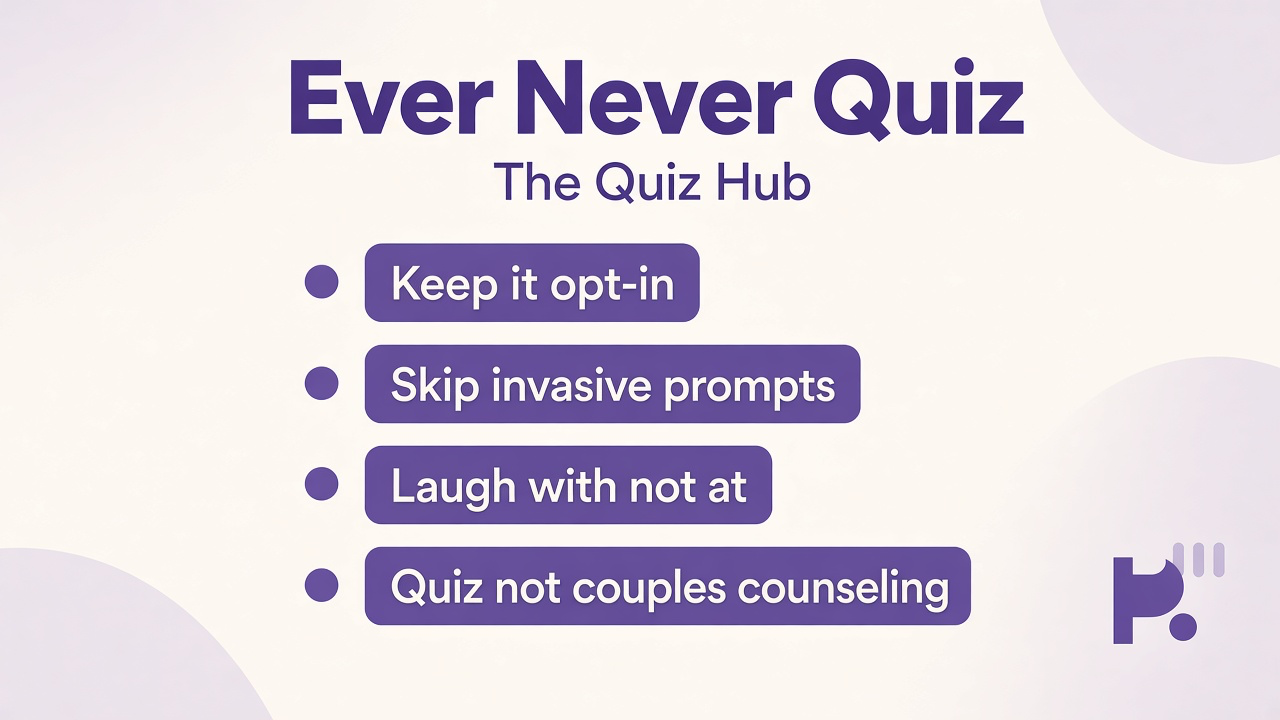
What this quiz can and cannot tell you
Can tell you
- Highlight opt-in, pass, and PG habits worth trying before the next Never Have I Ever night
- Encourage ask-before-post rules without screenshot dunk threads
- Separate playful reflection from partner diagnosis in plain language
- Spark better host questions for roommates or friend groups about shared boundaries
Cannot tell you
- Prove relationship health, loyalty, or cheating from one agree screener
- Override sober guests, trauma history, or boss-employee power gaps with one prompt list
- License posting private party answers because consent bars scored high once
- Replace licensed couples counseling or therapy when jealousy disrupts sleep and trust
Opt-in circles, consent before shares, and quiz-not-couples-therapy limits
People search ever never and Never Have I Ever tips when party season collides with screenshot leaks and one guest treated like the running joke. The gap online is not lack of spicy prompt lists; it is thin guidance on pass rules, ask-before-post habits, and hosts who need opt-in speeches without purity scoreboards.
Dr. James Whitfield reviews fun novelty screeners with a simple split: reward honest agreement with kind host habits and honest limits on relationship overclaim at the same time. Opt-in party norms keeps explain-the-game, pass rules, PG defaults for mixed groups, pause when energy shifts, and host buddies visible beside forced-drink trap myths. Consent to share keeps ask-before-post, private answers off feeds, blur requests, retell checks, and quick edits visible beside screenshot dunk myths. Laugh with not at keeps shared laughter prompts, spicy-rule upfront checks, mockery redirects, and apologies visible beside shy-guest pressure myths and wildest purity scoreboards.
Real readers mix bars. You might score high on opt-in while consent bars wobble, which often describes great in-room speeches yet loose group chat habits. You might score high on laugh-with with moderate quiz limits, which can mean kind prompts yet little experience refusing partner-diagnosis captions. Reverse items catch sloppy answers: forced drinks as fair culture, dunk screenshots as expected fun, pressuring shy guests as peak comedy, or high bars as relationship proof should not inflate bars meant to track layered host habits.
Pair results with siblings on this hub instead of forcing one party story. Our never have I ever quiz sibling can stay on prompt literacy when you want a separate stem bank from this norms page. The event planning quiz covers timelines and guest counts when you host larger nights. Browse the fun and novelty test hub for more low-stakes screeners that skip couples counseling tone. Caption shares as host notes, not confession badges.
Weekends move faster than apology texts. Pass rules help on night one, but ask-before-post habits stay useful all year. When you share results, say bars describe habits you reported here. When you borrow tips, credit friends who modeled kind circles. Retake after one game night with explicit opt-in and watch whether quiz-not-couples-therapy bars stay high even when laugh-with bars rise, which often means you separated performative spicy rank from actual consent habits.
| Test | Focus |
|---|---|
| Never have I ever quiz | Prompt and round literacy rather than opt-in and consent norm stems on this page |
| Event planning quiz | Timelines and guest logistics rather than in-circle Never Have I Ever habits here |
| Etiquette quiz | RSVP and table grace rather than party game screenshot and pass-rule habits here |
Ever Never Quiz FAQ
What does this ever never quiz measure?
It measures how much you agree with Never Have I Ever habits across opt-in party norms, consent to share, laugh with not at, and quiz not couples therapy limits. You get an index from 0 to 100 and four bars. It is playful host reflection, not relationship certification.
Does a high score mean my relationship is healthy or my partner should play?
No. Bars describe party habits you reported here. Quiz not couples therapy items explicitly reject partner homework and diagnosis myths from web totals.
Can I post friend answers from the circle online?
Consent items favor ask-before-post rules and quick fixes when someone says a share crossed a line. Screenshot dunk threads are flagged as myths, not party norms.
Why are some statements worded as myths?
Reverse-worded myths catch overconfidence. Agreeing that forced drinks are fair culture, that dunk screenshots are expected fun, that pressuring shy guests is peak comedy, or that high bars prove relationship health should not inflate your norm index.
Who reviewed this quiz?
Dr. James Whitfield, PhD reviewed the playful framing, consent and anti-diagnosis limits, and result explanations. See our editorial policy for review standards.
Reviewed by