What this unofficial EPQ literacy page measures
This page does not administer the published Forsyth Ethical Position Questionnaire, replicate its idealism and relativism scoring, or issue philosophy credentials. It measures how much you agree with statements in four groups: idealism and care about weighing harm before shortcuts, rejecting deception wins, and treating daily choices as ethical data; situational judgment about context with guardrails, rejecting crowd-approved harm, naming different responses without erasing harm, and catching rationalization; tradeoff reasoning about listening before judging, naming costs when values collide, admitting limits, crediting disagreement, and revisiting past calls; and unofficial not Forsyth EPQ about study-only framing, separating this bank from wave108 ELSQ leadership items, and refusing to treat web bars like published manual scores or moral rank. You rate 22 statements from strongly disagree to strongly agree, with reverse-worded myths so autopilot anything-goes answers cannot inflate every bar. Your answers also feed a second chart on closeness and trust habits, because moral shame sometimes overlaps with harsh self-talk toward partners. The total becomes an index from 0 to 100 where higher means more endorsed ethical position literacy on this screener, not official Forsyth EPQ points or clinical labels.
Idealism and care
Weigh harm, reject deception wins, and notice when slogans skip repair.
Situational judgment
Context with guardrails, not crowd-approved harm or stress excuses.
Tradeoff reasoning
Listen, name costs, admit limits, and revisit calls when outcomes teach.
Unofficial not Forsyth EPQ
Not published EPQ; ELSQ sibling uses a different leadership bank.
How it works
Answer 22 agreement items
Rate each statement from Strongly disagree to Strongly agree. Tap Next after each answer.
Answers sort into four domains
Each answer feeds one of four ethical position groups, and every item also feeds a closeness and trust layer.
See your index and charts
You get a 0 to 100 index, a band, and two bar charts you can compare after one listening experiment.
Take the Ethical Position Questionnaire (EPQ)
Answer 22 short statements to see your ethical position literacy index, four domain bars, and a closeness and trust chart.
What your result means
Your index is the average of all 22 answers, scaled from 0 to 100, with reverse-worded myth items flipped first. Read unofficial Forsyth EPQ limits with idealism and situational bars before you treat any total as published scoring or moral rank. Persistent moral shame deserves skilled support, not only meme reframes.
| Band | Index range | Typical reading |
|---|---|---|
| Building ethical position literacy | 0 to 35 | Fewer agreed statements on idealism, situational guardrails, tradeoff reasoning, or unofficial Forsyth EPQ limits. |
| Mixed ethical position literacy | 36 to 65 | Solid idealism or tradeoff language in some domains with relativism traps or unofficial-limit gaps in others. |
| Stronger ethical position literacy | 66 to 100 | Frequent agreement on care, guarded situational judgment, tradeoff reasoning, and unofficial Forsyth EPQ limits. |
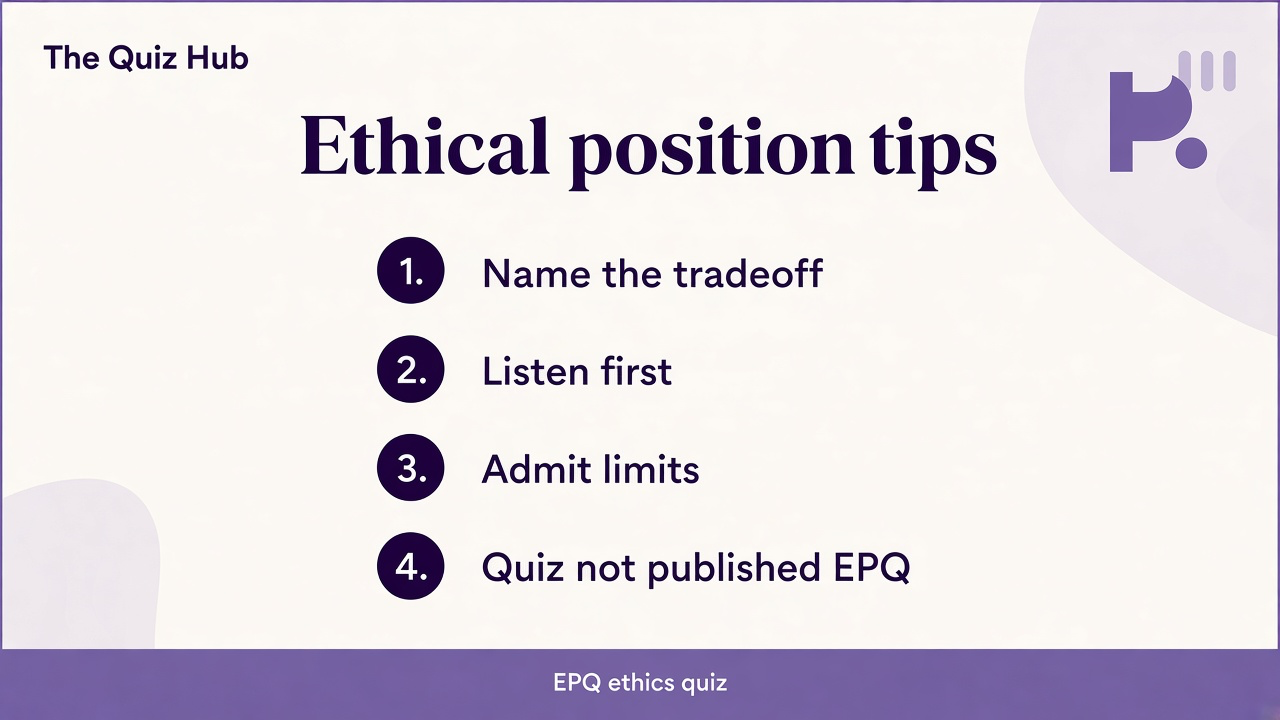
Tips at a glance
A quick takeaway graphic with topic tips (not your personal quiz scores). Start the quiz for your index, bands, and charts.
What this quiz can and cannot tell you
Can tell you
- Highlight idealism, situational guardrails, and tradeoff habits worth trying after the next dilemma
- Separate unofficial literacy from published Forsyth EPQ and ELSQ leadership banks
- Encourage listening and named tradeoffs without anything-goes excuses
- Spark better study questions without web score moral rank claims
Cannot tell you
- Replace the published Forsyth Ethical Position Questionnaire or its scoring manuals
- Prove philosophy readiness or diagnose disorders from one agree screener
- Excuse fraud, bullying, or broken consent because situational language scored high
- Substitute for therapy when moral shame or rigidity disrupts safety and relationships
Idealism, situational judgment, and unofficial Forsyth EPQ limits
Readers search EPQ and ethical position topics when classroom debates mix idealism with anything-goes slogans and fan quizzes get mistaken for Forsyth forms. Those goals help when bars stay reflection notes for tradeoff habits. They hurt when harm gets excused, listeners get skipped, or screeners pose as published EPQ scores beside wave108 ELSQ leadership items on the same hub.
Dr. James Whitfield reviews personality psychology literacy screeners with a simple split: reward honest agreement with widely taught harm-and-tradeoff habits and honest limits on instrument overclaim at the same time. Idealism and care keeps harm-before-shortcut language visible beside rule-as-excuse traps. Situational judgment keeps guarded nuance visible beside stress excuses and crowd-approved harm myths. Tradeoff reasoning keeps listen-first and name-cost habits visible beside certainty performance. Unofficial not Forsyth EPQ keeps published form language honest so readers know peer-reviewed Forsyth packets differ from fan pages and from ELSQ leadership stems.
Real readers mix bars. You might score high on idealism while situational items wobble after a harsh debate season, which often describes care language atop old hot-take habits. You might score high on tradeoff reasoning with moderate limits, which can mean solid listening yet little experience with official scale names. Reverse items catch sloppy answers: policy excuses all harm, stress excuses all harm, listening is weakness, or web bars replace Forsyth validation should not inflate bars meant to track layered reflection habits.
Pair results with siblings on this hub instead of forcing one ethics story. Our ethical leadership style questionnaire (ELSQ) stays on leadership fairness and transparency habits with a different question bank. Our ethics quiz sibling emphasizes everyday harm, consent, and promise literacy on the IQ and cognitive hub. Browse the personality and psychology hub for more unofficial screeners. Caption shares as reflection notes, not Forsyth badges.
Semesters shift faster than one thread screenshot. New teams, classes, and therapy work change which tradeoffs feel loud. When you share results, say published Forsyth EPQ beats unofficial bars for research fidelity. When you borrow tips, credit people who modeled listen-first repair. Retake after one month and watch whether unofficial limit bars stay high even when idealism bars rise, which often means you separated performative certainty from actual care habits.
| Test | Focus |
|---|---|
| Ethical leadership style questionnaire (ELSQ) | Leadership fairness and transparency bank, not these EPQ ideology stems |
| Ethics quiz | Everyday harm and consent literacy rather than idealism versus relativism framing here |
Ethical Position Questionnaire (EPQ) FAQ
What does this unofficial EPQ page measure?
It measures how much you agree with statements about idealism and care, situational judgment with guardrails, tradeoff reasoning, and unofficial Forsyth EPQ limits. You get an index from 0 to 100 plus four bars. It describes self-rated reflection habits on this screener, not published Forsyth EPQ scores.
How is this different from the wave108 ELSQ quiz?
The ELSQ sibling on this site screens ethical leadership habits such as fairness, transparency, and crediting teams under pressure. This EPQ page focuses on ethical position literacy themes such as idealism, situational judgment, and tradeoffs. The question banks differ on purpose.
Is this the published Forsyth Ethical Position Questionnaire?
No. This is unofficial literacy trivia inspired by common ethical ideology themes. It does not use the published Forsyth item set, scoring manual, or validation permissions. Do not treat your index as official Forsyth points.
Why include reverse-worded myth statements?
Myth items catch overconfidence. Agreeing that policy excuses all harm, stress excuses all harm, listening is weakness, or web scores replace Forsyth validation should not inflate your literacy index.
Who reviewed this quiz?
Dr. James Whitfield, PhD reviewed the unofficial Forsyth EPQ framing, ELSQ separation, ethical position literacy limits, and result explanations. See our editorial policy for review standards.
Reviewed by