What this quiz measures
This quiz does not measure IQ, grade your child for school, or replace teacher rubrics. It measures how much you agree with introductory class three English literacy grouped four ways: letters and sounds about phonics charts, blending, syllable claps, and same-start sounds; rhymes and stories about rhyming pairs, opposites, librarian read-alouds, and picture clues; little sentences about capitals, full stops, a versus an, I and you, and simple question starters; and kind practice about mistake-friendly coaching, parent helper framing, and leaving formal grades to teachers. You answer 22 statements from strongly disagree to strongly agree, with reverse-worded myths so agreeing with every shortcut cannot inflate every bar. Your answers also feed a second chart on closeness and trust habits, because homework stress sometimes pushes families toward harsh labels instead of calm practice. The total becomes an index from 0 to 100 where higher means more reported literacy study habits on this screener, not proof you should skip class when the next unit covers longer sentences.
Letters and sounds
Phonics charts, blending, syllables, and noticing shared starting sounds in class three warm-ups.
Rhymes and stories
Rhyming pairs, opposites, librarian vocabulary, and picture clues in early readers.
Little sentences
Capitals, end marks, a versus an, I and you, and short one-idea sentences.
Kind practice
Mistakes as practice, calm parent coaching, and online bars not replacing teacher grades.
How it works
Answer 22 agreement items
Rate each statement from Strongly disagree to Strongly agree. Tap Next after each answer.
Answers sort into four domains
Each answer feeds one of four literacy study groups, and every item also feeds a closeness and trust layer.
See your index and charts
You get a 0 to 100 index, a band, and two bar charts you can use before a class three literacy check.
Take the English Quiz For Class 3
Answer 22 short statements to see your class 3 English literacy index, four domain bars, and a closeness and trust chart.
What your result means
Your index is the average of all 22 answers, scaled from 0 to 100, with reverse-worded items flipped first. Higher means more reported literacy study habits on this screener. Read kind practice bars together with read-aloud habits before you treat the total as school immunity.
| Band | Index range | Typical reading |
|---|---|---|
| Building class 3 English literacy | 0 to 35 | Fewer agreed facts on sounds, rhymes, little sentences, or kind practice on this screener. |
| Mixed class 3 English literacy | 36 to 65 | Solid facts in some domains with myths about random spelling, all-rhyme stories, optional punctuation, or online bars replacing grades. |
| Strong class 3 English literacy | 66 to 100 | Frequent agreement with accurate class three literacy study trivia and healthy practice limits. |
Tips at a glance
A quick takeaway graphic with topic tips (not your personal quiz scores). Start the quiz for your index, bands, and charts.
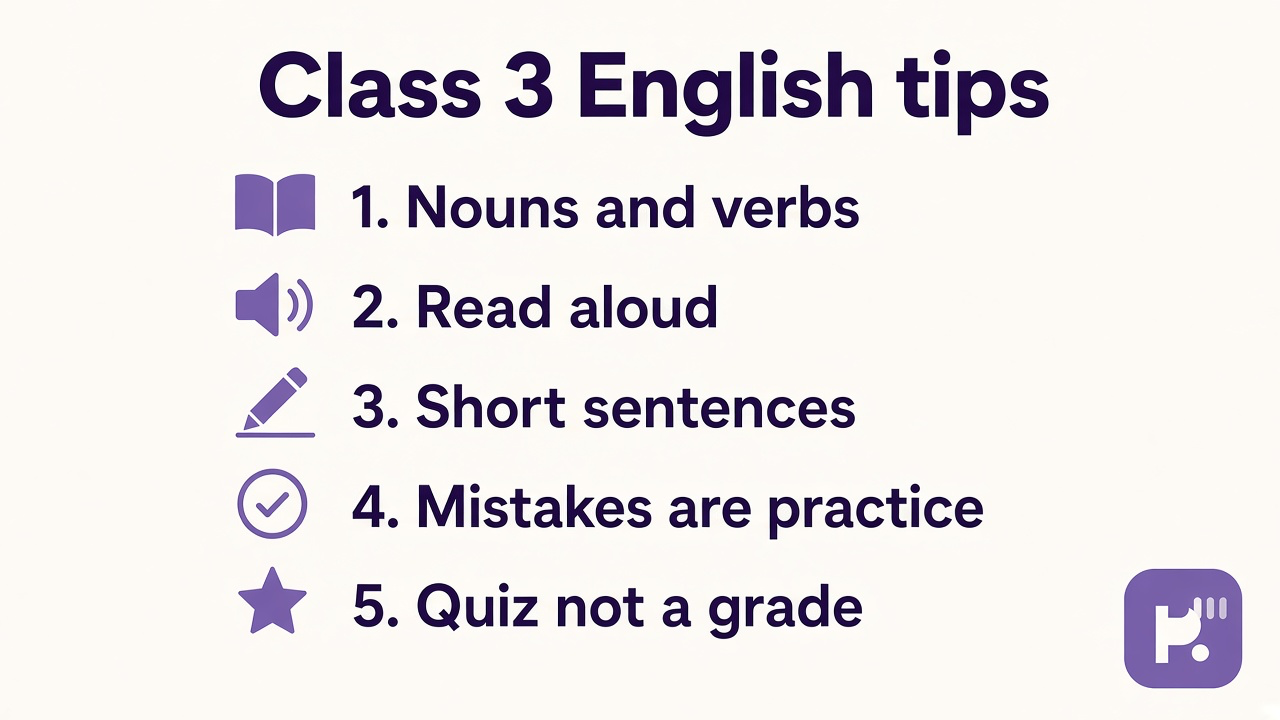
What this quiz can and cannot tell you
Can tell you
- Clarify phonics, rhyme, and little sentence basics in plain language for class three learners
- Highlight common early literacy myths worth unlearning without shaming children
- Encourage read-aloud and retake habits at home without comparing siblings
- Spark better questions during parent-teacher conferences or homework time
Cannot tell you
- Replace teachers, school rubrics, formal assessments, or individualized education plans
- Prove intelligence rank or predict long-term academic success from one screener
- Diagnose learning disabilities or language disorders from online agree items
- Justify skipping classroom instruction because trivia bars look high
Class three literacy study without kitchen-table shame
Parents search class three English quizzes when homework mixes up sounds, rhymes, and tiny sentences and every correction turns into tears. Letter-sound links and blending like c-a-t into cat are core class three habits before heavier grammar charts arrive in later grades. Treating letters as random decorations is a trap screeners flag on purpose so kids learn sounds still matter.
Rhymes and opposites build ear for language. Hop and mop share endings; big and small help describe story characters. Not every library book rhymes cover to cover, and claiming otherwise is another myth worth rejecting aloud during read-aloud time. Picture clues and librarian vocabulary lists give children wins before they decode every word alone.
Little sentences need capitals and sensible end marks even when spelling is still wobbly. A versus an follows consonant and vowel sounds in classroom examples. I and you anchor short writing about self and listener. Question words who and what often signal question marks on worksheets teachers check.
Practice limits are the fourth domain because online scores tempt overconfidence or shame. Mistakes are data for the next page, not proof a child failed English forever. This screener helps parents coach kindly; it does not replace report cards or teacher grades. Pair it with our English quiz for elementary students when you want broader stems, or the IQ and cognitive test hub for more low-stakes study games. Retake after one phonics or story unit; literacy grows when sounds, rhymes, and little sentences stay in order.
| Test | Focus |
|---|---|
| English quiz for elementary students | Broader elementary reading and spelling habits rather than class three phonics focus |
| IQ and cognitive hub | More study games when you want literacy warm-ups beside other cognitive screeners |
English Quiz For Class 3 FAQ
What does this quiz measure?
It measures how much you agree with introductory class three English literacy across sounds, rhymes, little sentences, and kind practice limits. You get an index from 0 to 100 and four bars. It reflects self-reported study habits on this screener, not a school report card or IQ score.
How is this different from the class 5 grammar quiz?
This screener targets earlier phonics, rhyme, and simple sentence habits common around class three. The class five grammar quiz focuses on nouns, verbs, and upper-primary agreement rules. Teachers remain the authority on which page fits your child.
Does a high score mean my child will ace every reading test?
No. It is study trivia and home practice framing. Teacher rubrics, classroom quizzes, and formal assessments stay separate from any online screener, no matter how high the bars look.
Why are some statements worded as myths?
Reverse-worded myths catch overconfidence. Agreeing that letters are random decorations, that every story must rhyme, that punctuation never matters, or that online bars replace school grades should not inflate the literacy index.
Who reviewed this quiz?
Dr. James Whitfield reviewed the educational framing, parent helper limits, and result explanations. See our editorial policy for review standards.
Reviewed by