What the Emotional Burnout Questionnaire for Mothers measures
This quiz does not diagnose burnout disorder, depression, anxiety, or any other condition, and it is not a validated occupational or maternal burnout research scale. Only a licensed clinician using interview methods, safety screening, and history can evaluate clinical burnout or mood disorders. It measures how often you noticed burnout-linked habits grouped four ways: exhaustion when depletion, irritability from empty tanks, or mental load outran recovery; guilt myths when supermom stories, comparison, or martyrdom turned limits into shame; rest is valid when breaks, basics, and medical self-care were allowed or refused; and support and limits when help asks, pediatrician or therapist outreach, quiz humility, and crisis awareness showed up versus white-knuckle isolation. You answer 22 how-often statements about the past month, with reverse-worded items so one good day cannot hide frequent strain across other weeks. Your responses also feed a second chart on closeness and trust habits, because some mothers hide overwhelm when vulnerability feels unsafe. The total becomes an index from 0 to 100 where higher means more frequent reported burnout strain on this screener. Your responses suggest intensity and habits to discuss with support; they do not mean you are a bad mother or that rest is selfish.
Exhaustion
How often depletion, irritability from empty tanks, and invisible mental load drained capacity.
Guilt myths
How often supermom narratives, comparison, and shame replaced normal limits.
Rest is valid
How often recovery, basics, and breaks were allowed without martyrdom rules.
Support and limits
How often help asks, clinician outreach, and not-a-supermom-score humility showed up.
How it works
Answer 22 frequency items
Rate each statement from Never to Very often for the past month. Tap Next after each answer.
Answers sort into four domains
Each answer feeds one of four burnout-strain groups, and every item also feeds a closeness and trust layer.
See your index and charts
You get a 0 to 100 index, a band, and two bar charts you can bring to a clinician.
Take the Emotional Burnout Questionnaire for Mothers
Answer 22 short statements to see your maternal burnout index, four domain bars, and a closeness and trust chart.
What your result means
Your index is the average of all 22 answers, scaled from 0 to 100, with reverse-worded items flipped first. Higher means more frequent reported burnout strain on this screener. Read exhaustion and guilt myth bars together before the total, because depletion and shame often rise as a pair.
| Band | Index range | Typical reading |
|---|---|---|
| Lower reported burnout strain | 0 to 35 | Fewer frequent exhaustion, guilt-myth, rest-refusal, or blocked-help signals in the past month. |
| Mixed reported burnout strain | 36 to 65 | Some steadier stretches alongside exhaustion spikes, guilt loops, or uneven support on others. |
| Higher reported burnout strain | 66 to 100 | Frequent depletion, guilt, or blocked help; rest, fair load, and professional support may help more than another inner critic loop. |
Tips at a glance
A quick takeaway graphic with topic tips (not your personal quiz scores). Start the quiz for your index, bands, and charts.
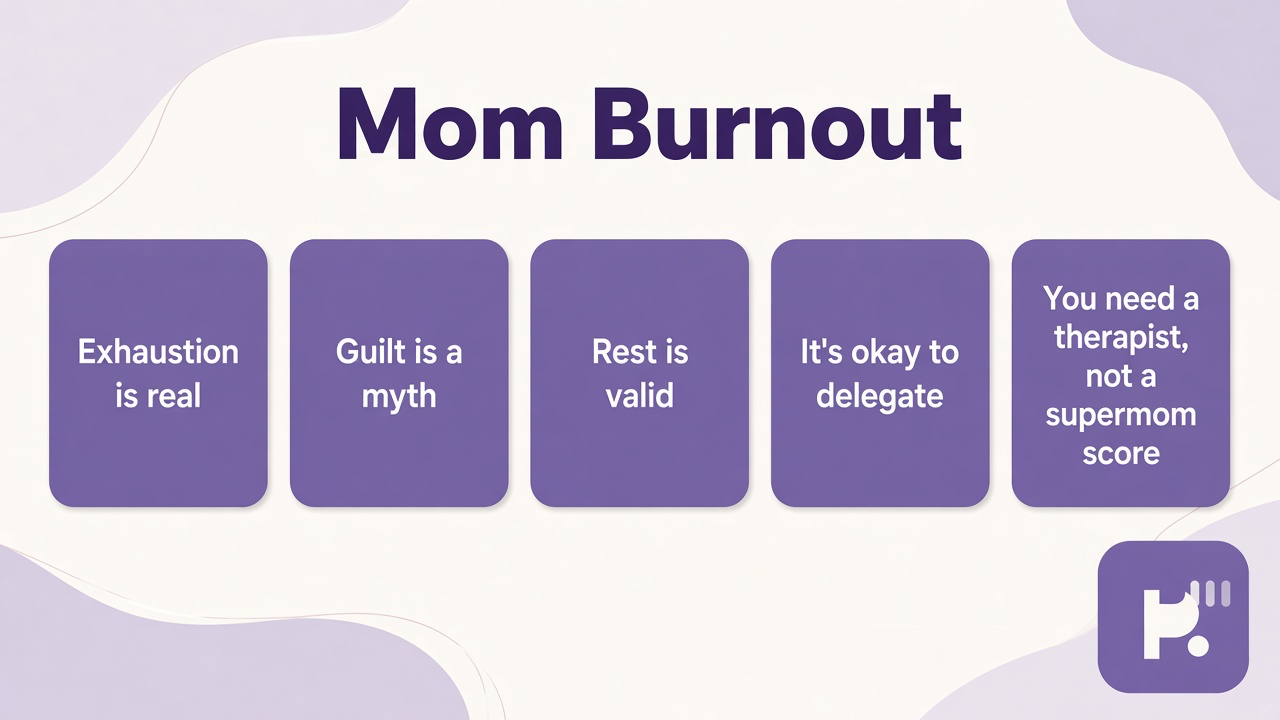
What this quiz can and cannot tell you
Can tell you
- Name exhaustion, guilt, rest, and support patterns in plain language for intake
- Highlight when strain bars run high enough to deserve compassion or clinical conversation
- Support early talks with therapists, pediatricians, partners, or trusted friends
- Offer a baseline if you retake after one rest boundary or delegate experiment
Cannot tell you
- Diagnose burnout disorder, depression, or anxiety without a licensed evaluation
- Replace therapy, medical care, fair load sharing, or crisis services with a bar chart
- Prove you are a bad mother or that others see your strain the way you feel it from one score
- Rank you against other moms as a supermom leaderboard
Mom burnout beyond supermom posts: exhaustion, guilt myths, rest, and support
Mothers search burnout questionnaires when love for their children still feels real yet patience, joy, and sleep do not keep pace. Clinical burnout instruments exist for workplaces and research settings; this page is an original frequency screener for maternal emotional load, not a copy of those validated forms. Your responses suggest where habits cluster so you can describe them to a therapist or clinician, not so a bar chart replaces rest or fair help at home.
Exhaustion is the first domain because burnout is not laziness. Numbness during ordinary moments, irritability over small noise, and mental load that never clocks out are strain signals, not proof you stopped caring. Snapping when your tank is empty is data about capacity, not a permanent bad-mother verdict. Noticing depletion without turning it into shame is literacy that pairs well with actual recovery time.
Guilt myths are the second domain because culture still sells supermom as the default. Believing good mothers never need breaks, feeling selfish for solo time, or scrolling comparison feeds can amplify exhaustion without adding support. Naming a normal limit without a character attack is a reverse signal that rest permission is still reachable. Martyrdom is not a badge; it is often unpaid labor with a flattering filter.
Rest is valid is the third domain because recovery is physiological, not a prize you earn only after collapse. Skipping meals, postponing your own medical care, or staying up to finish invisible chores teaches your nervous system that your needs are optional. A real break before meltdown is not indulgence; it is maintenance that protects kids from living with a constantly frayed caregiver.
Support and limits are the fourth domain because burnout is rarely solo work. Avoiding delegate asks, praising strength while load stays unequal, or delaying therapy because moms should tough it out keeps strain private. Asking a pediatrician or primary care clinician for referral, treating screeners as mirrors not supermom scores, and knowing when to call or text 988 when crisis spikes are YMYL honesty, not weakness. Our emotion regulation in parents Peri2 inspired screener emphasizes perinatal co-regulation and sleep when your child is still in the fourth trimester. Our Edinburgh Postnatal Depression Scale EPDS inspired tool focuses on perinatal mood frequency with its own unofficial limits. Our parental burnout assessment sibling offers another reflection lane when you want burnout language aimed at all caregivers. Browse the mental health and clinical test hub for more non-diagnostic screeners.
Retake after a month of one measurable experiment, one protected rest block, one chore swap, one therapy intake, and compare domain bars. Your responses suggest whether strain is easing, not whether you deserve care. Licensed clinicians turn examples into treatment plans this page cannot deliver. If distress feels unbearable tonight, call or text 988 in the US or your local crisis line before debating results alone.
| Test | Focus |
|---|---|
| Emotion regulation in parents Peri2 | Perinatal co-regulation, sleep, and partner support rather than general mom guilt myths |
| Edinburgh Postnatal Depression Scale EPDS | Perinatal mood frequency reflection with unofficial EPDS-inspired limits |
| Parental burnout questionnaire | Broader caregiver burnout habits when you want reflection beyond mothers-only framing |
Emotional Burnout Questionnaire for Mothers FAQ
What does this quiz measure?
It measures how often you noticed exhaustion, guilt myths, rest validity, and support limit habits during the past month. You get an index from 0 to 100 plus four domain bars. Your responses suggest self-reported frequency for reflection, not a clinical diagnosis or a parenting grade.
Is this a validated maternal burnout questionnaire from research?
No. This is an original frequency screener for self-reflection. It is not a validated hospital or occupational burnout inventory and cannot replace a clinician-administered assessment.
Does a high score mean I am a bad mother?
No. Your responses suggest how often strain habits showed up on this screener. Burnout language describes load and recovery patterns, not moral worth. Bring domain examples to a therapist, pediatrician, or primary care clinician if strain disrupts daily life.
Why are some statements worded as rest, limits, or help-seeking?
Reverse-worded items catch overconfidence. Agreeing that you had enough energy some days, named limits without shame, took real breaks, asked clinicians for help, or kept screeners separate from supermom verdicts should not inflate a strain index meant to track difficulty.
What should I do if my score is high or I feel unsafe?
Contact a licensed therapist or ask your pediatrician or primary care clinician for referral with domain examples from your results. Call or text 988 (US) if you feel hopeless, unsafe, or worry about harming yourself or your children. Seek urgent medical care for physical emergencies, not quiz scores alone.
Who reviewed this quiz?
Dr. Elena Vasquez, PhD reviewed the YMYL framing, crisis resources, not-supermom-score limits, and result explanations. See our editorial policy for review standards.
Reviewed by