What Emotion Regulation in Parents measures
This quiz does not diagnose postpartum depression, postpartum anxiety, perinatal mood disorders, or any other condition. It is not the validated PERI2 postpartum emotion regulation research instrument. Only a licensed clinician using interview methods, safety screening, and history can diagnose perinatal mental health conditions. It measures how often you noticed regulation-linked habits grouped four ways: co-regulation when pausing, repairing, and staying present with infant or toddler cues felt harder or steadier; sleep and stress when night duty, depletion, skipped basics, or irritability from exhaustion outran your usual skills; partner and support when load sharing, help asks, listening, or comparison spirals helped or hurt regulation; and study not diagnosis when you treat screeners as reflection, seek perinatal clinicians when strain disrupts bonding or safety, and reject myths that web bars replace evaluation or therapy. You answer 22 how-often statements about the past two weeks, with reverse-worded items so one good night cannot hide frequent strain across other days. Your responses also feed a second chart on closeness and trust habits, because some parents hide overwhelm when vulnerability feels unsafe. The total becomes an index from 0 to 100 where higher means more frequent reported regulation strain on this screener. Your responses suggest intensity and habits to discuss with support; they do not mean you are failing as a parent or that PERI2 research scores apply to this page.
Co-regulation
How often pause, repair, shame loops, and calm presence with child cues showed up.
Sleep and stress
How often sleep debt, depletion, and skipped basics drained regulation capacity.
Partner and support
How often help asks, listening, conflict, or comparison shaped your regulation.
Study not diagnosis
How often you keep screeners separate from PERI2, labels, and perinatal therapy.
How it works
Answer 22 frequency items
Rate each statement from Never to Very often for the past two weeks. Tap Next after each answer.
Answers sort into four domains
Each answer feeds one of four regulation-strain groups, and every item also feeds a closeness and trust layer.
See your index and charts
You get a 0 to 100 index, a band, and two bar charts you can bring to a clinician.
Take the Emotion Regulation in Parents Peri2
Answer 22 short statements to see your perinatal parent regulation index, four domain bars, and a closeness and trust chart.
What your result means
Your index is the average of all 22 answers, scaled from 0 to 100, with reverse-worded items flipped first. Higher means more frequent reported regulation strain on this screener. Read sleep stress and partner support bars together before the total, because depletion and lonely load often rise as a pair.
| Band | Index range | Typical reading |
|---|---|---|
| Lower reported regulation strain | 0 to 35 | Fewer frequent co-regulation slips, sleep crashes, support gaps, or quiz-as-verdict habits in the past two weeks. |
| Mixed reported regulation strain | 36 to 65 | Some steadier days alongside sleep debt, co-regulation slips, or support friction on others. |
| Higher reported regulation strain | 66 to 100 | Frequent depletion, co-regulation strain, or support gaps; perinatal-informed care may help. |
Tips at a glance
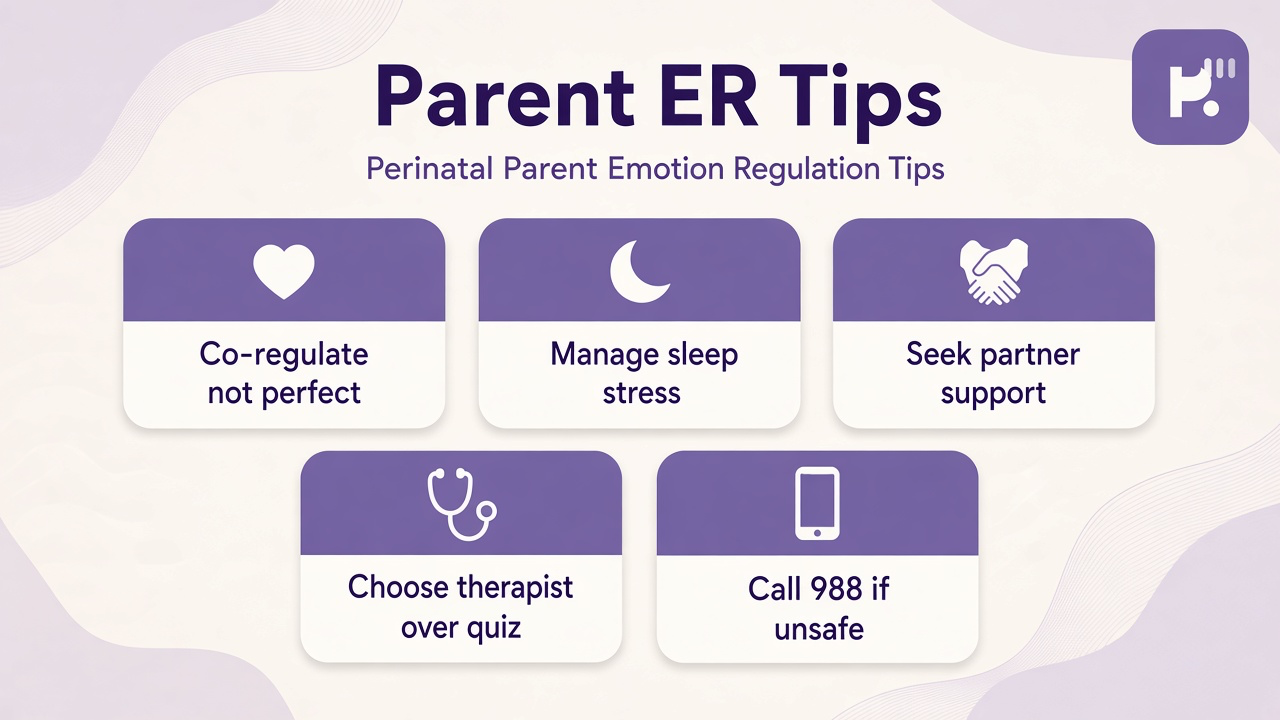
A quick takeaway graphic with topic tips (not your personal quiz scores). Start the quiz for your index, bands, and charts.
What this quiz can and cannot tell you
Can tell you
- Name co-regulation, sleep, and support patterns in plain language for intake
- Highlight when strain bars run high enough to deserve compassion or perinatal care
- Support early conversations with perinatal therapists, OBs, or partner counselors
- Offer a baseline if you retake after one help ask or sleep plan experiment
Cannot tell you
- Diagnose postpartum depression, anxiety, rage, or trauma without evaluation
- Replace the validated PERI2 instrument, perinatal therapy, or medical follow-up
- Prove you are a bad parent or that others see your strain the way you feel it from one score
- Tell you to white-knuckle regulation without support when safety feels at risk
Perinatal regulation beyond perfect-parent posts: co-regulation, sleep, support, and care limits
Parents search emotion regulation quizzes when the postpartum season stops feeling like a brief rough patch and starts feeling like every reaction arrives too fast. Research teams publish perinatal emotion regulation instruments such as PERI2 for structured studies; this page is not that scale. Clinicians still hear honest strain when sleep, hormones, pain recovery, and unequal load collide. This screener scores frequency so your responses suggest where habits cluster, not whether you earn a diagnosis from a bar chart.
Co-regulation is the first domain because infants and toddlers borrow your nervous system before they build their own. Yelling, shame, or mental replays after a hard cry do not mean you lack love; they often mean capacity ran out. Pausing, repairing, and staying present without fixing every feeling are skills that wobble under sleep debt. Noticing slips without a permanent bad-parent story is literacy, not excuse-making when harm needs accountability.
Sleep and stress are the second domain because postpartum depletion is physiological, not a willpower test. Night feeds, pumping schedules, reflux vigilance, and anxiety replay can leave you irritable over dishes while your child is safe. Skipping food or rest until you crash is a pattern worth naming to your clinician, not proof you are lazy. One morning with enough sleep belongs in the same story as limits: recovery is uneven, especially in the fourth trimester.
Partner and support are the third domain because regulation is rarely solo work. A partner asleep through feeds, dismissive comments, or fair load fights while both of you are tired can isolate the primary caregiver. Asking a doula, friend, or relative for concrete help, and being heard without instant fixing, are reverse signals that village care still exists. Comparison scrolls that make you feel uniquely broken deserve skepticism; curated posts rarely show the 3 a.m. floor.
Study not diagnosis is the fourth domain, patterned after teaching screeners that separate literacy from credentials. Agreeing that this web quiz equals validated PERI2 scores, proves clinical postpartum mood disorder alone, or replaces perinatal therapy should not inflate a strain index meant to track real habits. Treating screeners as mirrors, and reaching clinicians when bonding, sleep, or safety suffer, keeps YMYL pages honest. Our emotion regulation quiz sibling emphasizes wider daily regulation habits when you want reflection beyond the perinatal season. Our Edinburgh Postnatal Depression Scale EPDS inspired screener focuses on perinatal mood frequency with its own non-official limits. Our am I ready for a baby quiz offers preconception readiness reflection when you are still planning support systems. Browse the mental health and clinical test hub for more non-diagnostic screeners.
Retake after two weeks of one concrete experiment, such as one protected sleep block, one partner chore swap, or one therapist intake call, and compare domain bars. Your responses suggest whether strain is easing, not whether you deserve care. Licensed perinatal clinicians turn examples into treatment plans this page cannot deliver. If distress feels unbearable tonight, call or text 988 in the US or your local crisis line before debating results alone.
| Test | Focus |
|---|---|
| Emotion regulation quiz | Broader daily regulation habits rather than perinatal sleep and partner load items |
| Edinburgh Postnatal Depression Scale EPDS | Perinatal mood frequency reflection with unofficial EPDS-inspired limits, not parent ER domains |
| Am I ready for a baby quiz | Preconception readiness and support planning rather than postpartum regulation strain |
Emotion Regulation in Parents Peri2 FAQ
What does this quiz measure?
It measures how often you noticed perinatal regulation-linked habits in four areas during the past two weeks: co-regulation, sleep and stress, partner and support, and study-not-diagnosis limits. You get an index from 0 to 100 plus four domain bars. Your responses suggest self-reported frequency for reflection, not a clinical diagnosis or a PERI2 research score.
Is this the PERI2 postpartum emotion regulation scale?
No. PERI2 is a validated research instrument used in structured studies. This page is an original frequency screener inspired by perinatal parent experiences, not a copy of PERI2 items or scoring. Use bars to describe habits, not to claim official PERI2 results.
Does a high score mean I have postpartum depression?
No. Your responses suggest how often strain habits showed up on this screener. Only a licensed clinician can evaluate postpartum depression, anxiety, rage, or related conditions after a full interview and safety screening. Bring domain examples to your OB, midwife, or perinatal therapist.
Why are some statements worded as help-seeking or calmer days?
Reverse-worded items catch overconfidence. Agreeing that you paused with your child, slept enough some mornings, asked for help, felt heard, sought clinicians, or kept screeners separate from PERI2 or formal labels should not inflate a strain index meant to track difficulty.
What should I do if my score is high or I feel unsafe?
Contact a perinatal therapist, your obstetric clinician, or your pediatric office for local resources with domain examples from your results. Call or text 988 (US) if you feel hopeless, unsafe, or worry about harming yourself or your baby. Seek urgent medical care for physical emergencies, not quiz scores alone.
Who reviewed this quiz?
Dr. Elena Vasquez, PhD reviewed the YMYL framing, crisis resources, study-not-diagnosis limits, and result explanations. See our editorial policy for review standards.
Reviewed by