What Electromagnetic Induction Quiz measures
This quiz does not grade your course for credit, certify coil designers, or authorize utility work. It measures how much you agree with beginner-friendly induction habits grouped four ways: Faraday intuition about changing flux, induced EMF, constant-flux contrast, and Lenz law storytelling at concept level; coils and flux about turns, relative motion, area and orientation language, and demo visualization instead of magnet-color myths; everyday examples about generators, transformers, wireless charging, and induction cooktops as high-level stories without grid-engineer claims; and class not exam grade about instructors, lab PPE and voltage rules, and refusing to treat online bars as proctored substitutes. You rate 22 statements from strongly disagree to strongly agree, with reverse-worded myths so one cool demo clip cannot inflate every bar. Your answers also feed a second chart on closeness and trust habits, because exam panic sometimes chases perfect scores over honest I-will-ask-in-office-hours limits. The total becomes an index from 0 to 100 where higher means more reported induction literacy on this screener, not proof you should open transformers.
Faraday intuition
Changing flux, induced EMF, constant-flux contrast, and Lenz ideas at intro depth.
Coils and flux
Turns, motion, area, and field-line habits in textbook and demo language.
Everyday examples
Generators, transformers, charging pads, and cooktops as plain-language stories.
Class not exam grade
Homework supplement, lab safety, and limits on substituting screeners for finals.
How it works
Answer 22 agreement items
Rate each statement from Strongly disagree to Strongly agree. Tap Next after each answer.
Answers sort into four domains
Each answer feeds one of four induction literacy groups, and every item also feeds a closeness and trust layer.
See your index and charts
You get a 0 to 100 index, a band, and two bar charts you can compare with a lab partner after magnetism review.
Take the Electromagnetic Induction Quiz
Answer 22 short statements to see your electromagnetic induction literacy index, four domain bars, and a closeness and trust chart.
What your result means
Your index is the average of all 22 answers, scaled from 0 to 100, with reverse-worded items flipped first. Read class-not-exam and everyday examples together before you treat a high Faraday bar as license for live grid gear. Intro literacy supports safer lab questions; instructors still own graded outcomes.
| Band | Index range | Typical reading |
|---|---|---|
| Building induction literacy | 0 to 35 | Fewer agreed facts on Faraday intuition, coils and flux, everyday examples, or class-limit items on this screener. |
| Mixed induction literacy | 36 to 65 | Solid facts in some domains with steady-magnet traps, coil myths, or class-limit blind spots in others. |
| Strong induction literacy | 66 to 100 | Frequent agreement with Faraday, coil, example, and class-limit habits; still not engineering licensure. |
Tips at a glance
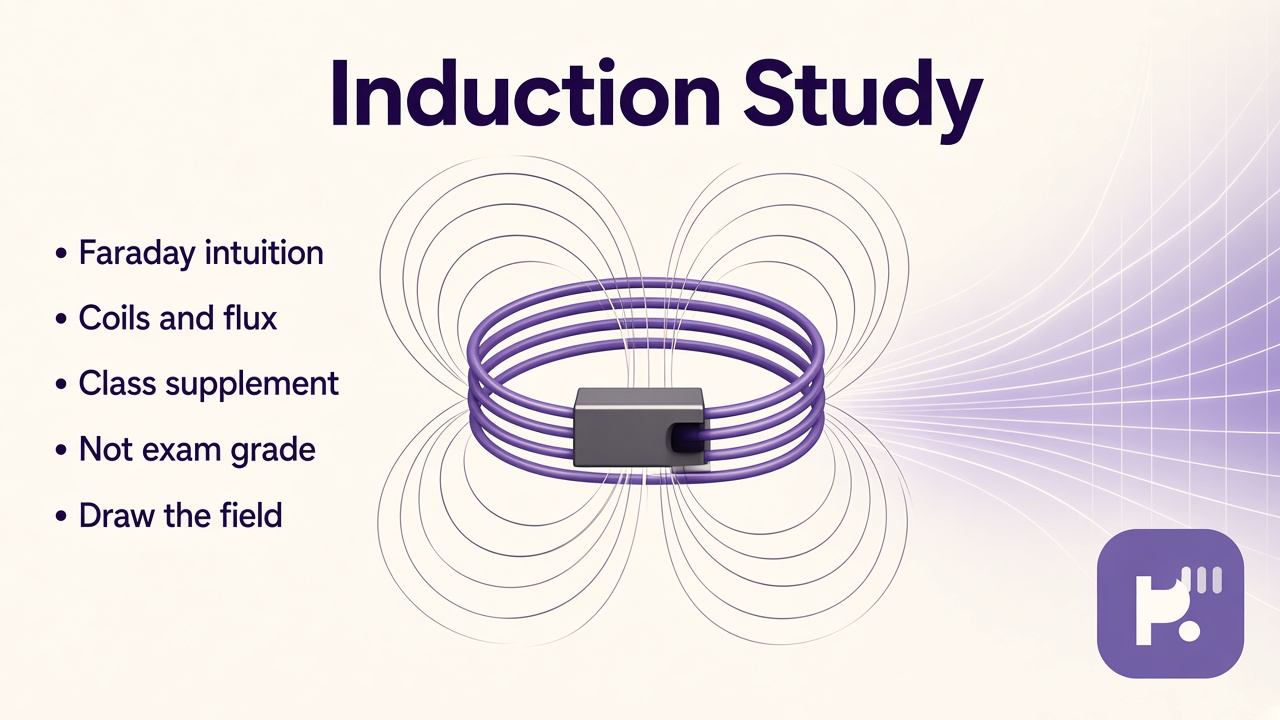
A quick takeaway graphic with topic tips (not your personal quiz scores). Start the quiz for your index, bands, and charts.
What this quiz can and cannot tell you
Can tell you
- Highlight Faraday, coil, and flux habits worth revisiting before magnetism labs
- Separate classroom intuition from engineering sign-off without merging them into one trick lane
- Encourage plain-language flux explanations for study groups and office hours
- Spark better questions for teachers when demos or homework diagrams confuse motion and turns
Cannot tell you
- Replace proctored exams, lab rubrics, or course credit decisions from one online screener
- Certify transformer design, utility maintenance, or industrial coil safety programs
- Prove it is safe to bypass lab voltage limits, PPE rules, or teacher supervision
- Turn literacy scores into harassment, dare culture, or fake engineering badges online
Induction intuition without utility dare culture
Search traffic around electromagnetic induction quizzes usually wants two things: survive magnetism homework without mixing up steady magnets and changing flux, and sound informed when videos show coils and spinning generators. Those goals help when readers notice that intuition starts better lab questions, not transformer-opening dares. They hurt when people treat bars like engineering licenses, confuse demo voltage with grid authority, or mock classmates who still sketch flux loops.
Dr. James Whitfield reviews iq cognitive study screeners with a simple split: reward honest agreement with widely taught Faraday language and honest limits on exam and engineering hype at the same time. Faraday intuition tracks changing flux, induced EMF, constant-flux contrast, and Lenz storytelling without integral homework on every stem. Coils and flux tracks turns, motion, area, and field-line habits beside jokes that only magnet color matters. Everyday examples keeps generators, transformers, charging pads, and cooktops at plain-language depth without utility work permits. Class not exam grade keeps instructors, goggles, and refusal to substitute online scores for finals visible beside brag threads.
Real readers mix bars. You might score high on everyday examples while keeping coil language moderate, which often describes consumer-tech curiosity with textbook diagrams still building. You might score high on Faraday with moderate class-not-exam items, which can mean strong flux memory yet little respect for lab voltage caps. Reverse items catch sloppy answers: steady magnets inducing ongoing voltage like fast slides, coil color myths, opening neighborhood transformers from trivia, or demanding professors accept screener scores should not inflate bars meant to track layered literacy.
Pair results with siblings on this hub instead of cramming every electromagnetism topic into one share. Our electricity quiz leans voltage, current, and outlet safety when circuits units precede magnetism. The electromagnetic spectrum quiz stays on wave band order and UV caution when you want radiation context without repeating coil stems here. Browse the IQ and cognitive test hub for more low-stakes study screeners. Caption shares as class supplement and skip utility dunking on friends who never asked for grid homework.
Syllabi and demo kits change faster than one GIF loop. New wireless chargers, old scope labs, and animation styles shift which flux picture sticks. When you share results, say office hours beat scoreboard. When you borrow intuition tips, credit teachers who demo safely and respect people who admit confusion. Retake after one magnet slide lab and watch whether class-not-exam bars rise even if Faraday bars lag, which often means you separated performative scoring from actual follow-the-instructor limits.
| Test | Focus |
|---|---|
| Electricity quiz | Voltage, current, and household safety rather than changing-flux coil intuition |
| Electromagnetic spectrum quiz | Wave band order and UV habits rather than Faraday coil demos |
Electromagnetic Induction Quiz FAQ
What does Electromagnetic Induction Quiz measure?
It measures how much you agree with statements about Faraday intuition, coils and flux, everyday examples, and class-not-exam limits. You get an index from 0 to 100 plus four bars. It describes self-rated intro induction habits on this screener, not course grades, engineering credentials, or permission to open utility equipment.
Will my professor accept this instead of a final exam?
No. This page is a voluntary study supplement. Only your instructor and institution decide exam credit, lab grades, and passing requirements.
Does a high score mean I can service transformers?
No. High bars mean you related to study statements here. Utility and industrial work require authorized training, codes, and employer programs beyond any agree quiz.
Why include everyday examples with Faraday items?
Magnetism search intent blends homework diagrams and consumer-tech curiosity. Example items stay separate from flux math language so results show whether real-world stories match classroom intuition.
Who reviewed this quiz?
Dr. James Whitfield reviewed the educational framing, class-not-exam limits, and result explanations. See our editorial policy for review standards.
Reviewed by