What Electricity Quiz measures
This quiz does not license wiring work, pass electrical inspections, or replace emergency care after shock. It measures how much you agree with beginner-friendly electricity habits grouped four ways: voltage and current basics about potential difference, charge flow, switches, and complete paths without collapsing distinct terms into one meme; household safety about water near outlets, tripping breakers, damaged cords, GFCI ideas, and kid messaging instead of penny-breaker myths; circuit literacy about conductors and insulators, simple series and parallel teaching models, and volts, amperes, and ohms at intro level; and study not licensed work about teachers and tutors, electrician scope, and calling for help when someone is hurt. You rate 22 statements from strongly disagree to strongly agree, with reverse-worded myths so one appliance sticker memory cannot inflate every bar. Your answers also feed a second chart on closeness and trust habits, because study stress sometimes chases perfect scores over honest I-will-not-open-that-panel limits. The total becomes an index from 0 to 100 where higher means more reported electricity literacy on this screener, not proof you should touch unknown mains.
Voltage and current basics
Potential difference, charge flow, switches, and complete paths in intro teaching language.
Household safety
Water, breakers, cord damage, GFCI awareness, and kid-safe outlet habits.
Circuit literacy
Conductors, simple parallel models, and common SI units without zero-resistance myths.
Study not licensed work
Class prep separate from permits, panels, and emergency response after injury.
How it works
Answer 22 agreement items
Rate each statement from Strongly disagree to Strongly agree. Tap Next after each answer.
Answers sort into four domains
Each answer feeds one of four electricity literacy groups, and every item also feeds a closeness and trust layer.
See your index and charts
You get a 0 to 100 index, a band, and two bar charts you can compare with a lab partner after review.
Take the Electricity Quiz
Answer 22 short statements to see your electricity literacy index, four domain bars, and a closeness and trust chart.
What your result means
Your index is the average of all 22 answers, scaled from 0 to 100, with reverse-worded items flipped first. Read household safety and study-not-licensed together before you treat a high voltage or circuit bar as license to open energized gear. Intro literacy supports safer questions; injured people deserve emergency care more than scoreboard wins.
| Band | Index range | Typical reading |
|---|---|---|
| Building electricity literacy | 0 to 35 | Fewer agreed facts on voltage and current, household safety, circuit basics, or study-limit items on this screener. |
| Mixed electricity literacy | 36 to 65 | Solid facts in some domains with voltage traps, safety myths, or licensing blind spots in others. |
| Strong electricity literacy | 66 to 100 | Frequent agreement with basics, safety, circuit habits, and study limits; still not licensure. |
Tips at a glance
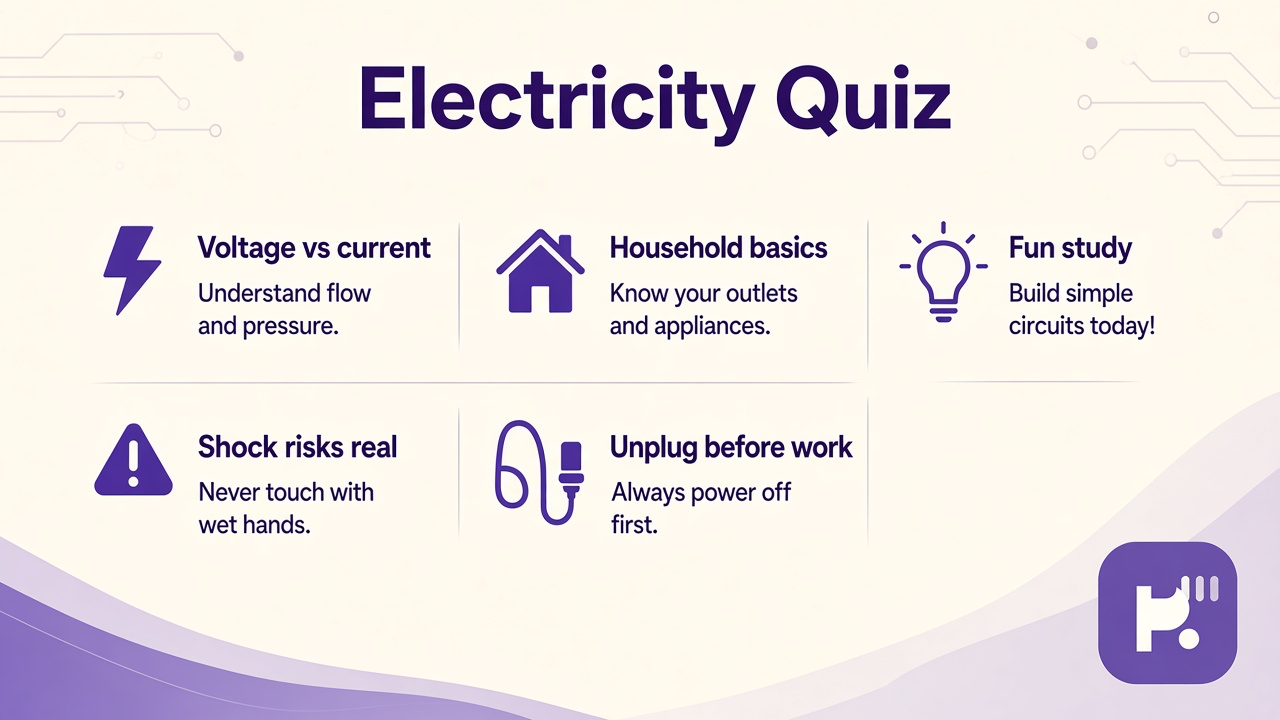
A quick takeaway graphic with topic tips (not your personal quiz scores). Start the quiz for your index, bands, and charts.
What this quiz can and cannot tell you
Can tell you
- Highlight voltage, current, and safety habits worth revisiting before labs or rental checklists
- Separate classroom models from permit work without merging them into one trick lane
- Encourage breaker and water-awareness language for study groups and family chats
- Spark better questions for teachers, tutors, and when to call licensed electricians
Cannot tell you
- Issue electrician licenses, permits, or inspection passes from one online screener
- Prove it is safe to open service panels, bypass breakers, or ignore burning smells
- Replace shock first aid training, emergency medics, or local electrical codes
- Turn literacy scores into harassment, dare culture, or fake trade badges online
Electricity literacy without outlet dare culture
Search traffic around electricity quizzes usually wants two things: survive intro physics without mixing up volts and amps, and sound informed when roommates debate breakers and phone chargers. Those goals help when readers notice that literacy starts safer questions, not panel-opening dares. They hurt when people treat bars like journeyman cards, bypass tripped breakers for convenience, or mock classmates who still mix potential and flow.
Dr. James Whitfield reviews iq cognitive study screeners with a simple split: reward honest agreement with widely taught circuit language and honest limits on licensing hype at the same time. Voltage and current basics tracks potential difference, charge flow, switches, and complete paths without collapsing distinct terms into viral shortcuts. Household safety tracks water, breakers, cord damage, GFCI awareness, and kid messaging beside meme culture that treats outlets like toys. Circuit literacy keeps conductors, parallel teaching models, and ohm vocabulary visible without zero-resistance fantasies. Study not licensed work keeps teachers, electricians, and emergency care visible beside quiz scores that cannot replace permits.
Real readers mix bars. You might score high on circuit vocabulary while keeping household safety moderate, which often describes strong homework memory with rental habits still catching up. You might score high on safety with moderate voltage items, which can mean careful outlet rules yet fuzzy on how switches stop current in diagrams. Reverse items catch sloppy answers: equating voltage with current always, penny breakers, denying resistance effects, or opening panels because trivia spiked should not inflate bars meant to track layered literacy.
Pair results with siblings on this hub instead of cramming every physics topic into one share. Our electromagnetic induction quiz leans changing flux and coil intuition when magnetism units follow your circuits chapter. The electromagnetic spectrum quiz stays on radio-through-gamma order and UV caution when you want wave context without repeating Ohm law stems here. Browse the IQ and cognitive test hub for more low-stakes study screeners. Caption shares as class prep and skip wiring dares on friends who never asked for live-panel homework.
Homes and syllabi change faster than one textbook diagram. New chargers, old extension cords, and lab kits with unfamiliar meters shift which habit matters this week. When you share results, say safety beats scoreboard. When you borrow study tips, credit teachers who explain kindly and respect people who admit confusion. Retake after one labeled circuit lab or one outlet walkthrough and watch whether safety bars rise even if vocabulary bars lag, which often means you separated performative scoring from actual do-not-touch-that-panel limits.
| Test | Focus |
|---|---|
| Electromagnetic induction quiz | Faraday intuition and coil flux habits rather than outlet safety basics |
| Electromagnetic spectrum quiz | Wave band order and UV caution rather than voltage and breaker literacy |
Electricity Quiz FAQ
What does Electricity Quiz measure?
It measures how much you agree with statements about voltage and current basics, household safety, circuit literacy, and study-not-licensed limits. You get an index from 0 to 100 plus four bars. It describes self-rated intro electricity habits on this screener, not electrician credentials, wiring permits, or proof you should open energized panels.
Is this an electrician licensing exam?
No. This page builds general literacy for class and home safety reflection. Journeyman exams, permits, and inspections require authorized training and local code knowledge this screener cannot replace.
Does a high score mean I can fix my breaker panel?
No. High bars mean you related to study statements here. Panel work and new circuits belong to qualified electricians and your local regulations regardless of online agree scores.
Why include household safety with physics items?
Electricity search intent blends homework units and real outlet habits. Safety items stay separate from voltage trivia so results show whether breaker and water awareness match textbook recall.
Who reviewed this quiz?
Dr. James Whitfield reviewed the educational framing, study-not-licensed limits, and result explanations. See our editorial policy for review standards.
Reviewed by