What EHS Quiz measures
This quiz does not certify OSHA training, audit your employer, or replace site safety officers. It measures how much you agree with beginner-friendly workplace environment, health, and safety habits grouped four ways: hazard labels and signs about pictograms, container tags, safety data sheet lookup, and posted permit areas without pretending every plant uses identical color law; PPE basics about matching glasses, gloves, respirators, and hard hats to actual hazards with inspection habits instead of one-size shield myths; report concerns about near misses, official reporting channels, stop-work ideas, and asking before copying rushed coworkers; and training not certification about employer programs, licensed safety staff, and refusing to treat online bars like federal credentials. You rate 22 statements from strongly disagree to strongly agree, with reverse-worded myths so one safety poster memory cannot inflate every bar. Your answers also feed a second chart on closeness and trust habits, because production pressure sometimes chases speed over honest speak-up. The total becomes an index from 0 to 100 where higher means more reported EHS literacy on this screener, not proof you should skip labels or lecture injured coworkers.
Hazard labels and signs
Pictograms, severity signs, SDS lookup, and permit areas without guessing unlabeled containers.
PPE basics
Glasses, gloves, respirators, and hard hats matched to hazards with damage checks.
Report concerns
Near misses, official channels, stop-work respect, and questions before risky copy-paste.
Training not certification
Employer programs, licensed staff, and limits on treating screeners like OSHA cards.
How it works
Answer 22 agreement items
Rate each statement from Strongly disagree to Strongly agree. Tap Next after each answer.
Answers sort into four domains
Each answer feeds one of four EHS literacy groups, and every item also feeds a closeness and trust layer.
See your index and charts
You get a 0 to 100 index, a band, and two bar charts you can compare with a crewmate after toolbox talk.
Take the EHS Quiz
Answer 22 short statements to see your workplace EHS literacy index, four domain bars, and a closeness and trust chart.
What your result means
Your index is the average of all 22 answers, scaled from 0 to 100, with reverse-worded items flipped first. Read report concerns and training-not-cert together before you treat a high label or PPE bar as license to skip posting near misses. Workplace literacy supports speak-up culture; injured teammates deserve care more than scoreboard wins.
| Band | Index range | Typical reading |
|---|---|---|
| Building workplace EHS literacy | 0 to 35 | Fewer agreed habits on labels, PPE match, reporting channels, or training-limit items on this screener. |
| Mixed workplace EHS literacy | 36 to 65 | Solid habits in some domains with label traps, PPE myths, or reporting blind spots in others. |
| Strong workplace EHS literacy | 66 to 100 | Frequent agreement with label, PPE, reporting, and training-limit habits; still not certification. |
Tips at a glance
A quick takeaway graphic with topic tips (not your personal quiz scores). Start the quiz for your index, bands, and charts.
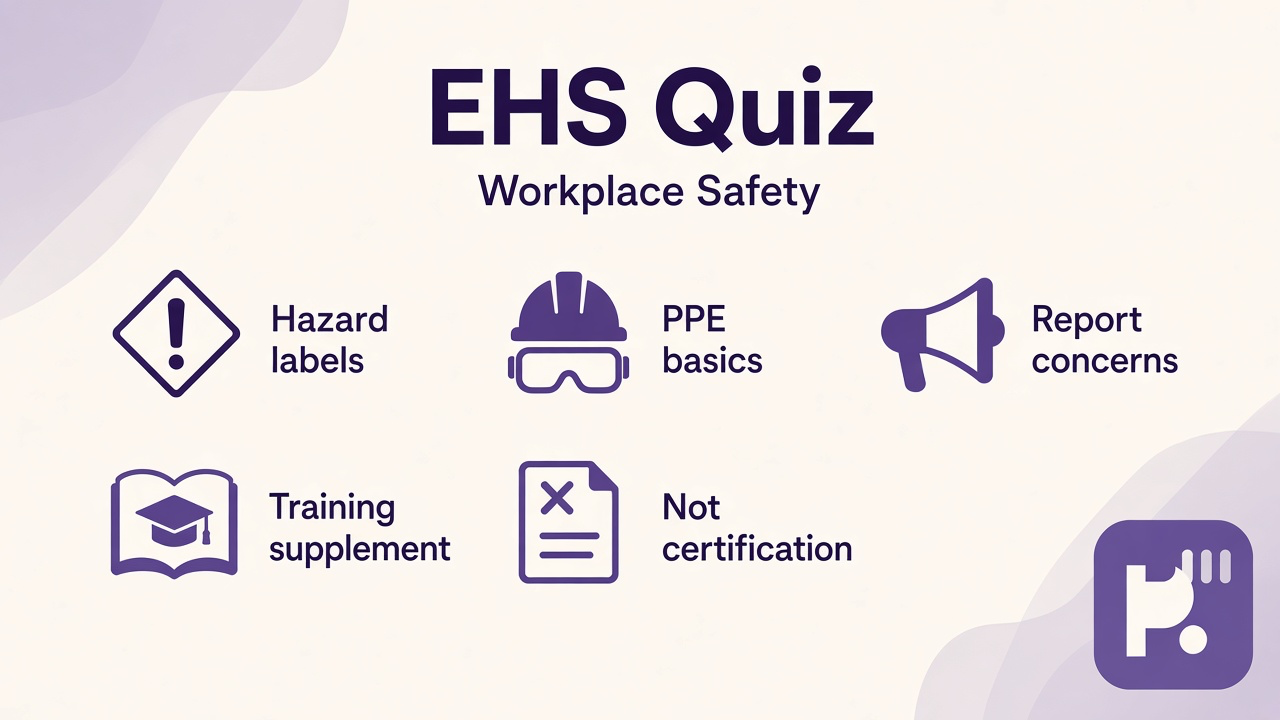
What this quiz can and cannot tell you
Can tell you
- Highlight label, PPE, and reporting habits worth revisiting before shift change
- Separate hazard awareness from employer certification fantasies without merging them into one trick lane
- Encourage near-miss reporting language for toolbox talks and onboarding buddies
- Spark better questions for supervisor chats, union safety reps, and refresher training
Cannot tell you
- Issue OSHA 10, OSHA 30, or state credential cards from one online screener
- Prove regulatory compliance, pass inspections, or replace written employer safety programs
- Replace licensed safety officers, industrial hygienists, medical providers, or legal counsel
- Turn literacy scores into harassment, blame for injuries, or fake compliance badges online
Workplace EHS literacy beyond badge collecting
Search traffic around EHS quizzes usually wants two things: sound informed in a safety meeting without sitting through a full regulatory course, and check whether label and PPE habits match what trainers repeat every quarter. Those goals help when readers notice that literacy starts conversations, not courtroom verdicts on who is the safest worker. They hurt when people treat bars like OSHA credentials, skip SDS lookup because a meme said gloves are gloves, or shame teammates who file near-miss reports.
Dr. James Whitfield reviews iq cognitive study screeners with a simple split: reward honest agreement with widely taught hazard communication and honest limits on certification hype at the same time. Hazard labels and signs tracks pictogram families, severity wording on posted signs, safety data sheet habits, and permit areas without pretending every drum is water when the tag is missing. PPE basics tracks matching eye, hand, and respiratory protection to the task, inspecting gear, and rejecting hard-hat-as-universal-armor myths. Report concerns keeps near misses, official channels, and stop-work respect visible beside production pressure that whispers close calls stay private. Training not certification keeps employer programs, licensed staff, and refusal to treat quiz scores like federal clearance visible beside LinkedIn badge fantasies.
Real readers mix bars. You might score high on PPE while keeping reporting moderate, which often describes careful personal gear with speak-up still building. You might score high on labels with moderate training-limit items, which can mean strong poster memory yet little exposure to how your plant stores SDS files. Reverse items catch sloppy answers: assuming unlabeled drums are water, claiming one hard hat replaces every other protector, hiding near misses because nobody bled, or treating a high index like automatic inspector approval should not inflate bars meant to track layered safety habits.
Pair results with siblings on this hub instead of forcing one workplace story. Our dosage calculation quiz leans clinical math literacy when your role mixes meds checks with safety culture. The economics quiz stays on scarcity and market study habits when you want cognitive warm-ups without chemical pictograms. Browse the IQ and cognitive test hub for more low stakes screeners. Caption shares as literacy practice and skip compliance dunking on crews who never asked for a pop quiz.
Sites change faster than break-room posters. New chemicals, borrowed contractors, and seasonal heat plans shift which PPE row matters. When you share results, say speak-up beats scoreboard. When you borrow label tips, credit trainers who teach kindly and respect people who report quietly. Retake after one employer refresher or one walkthrough with a safety rep and watch whether reporting bars rise even if label trivia bars lag, which often means you separated performative scoring from actual near-miss honesty.
| Test | Focus |
|---|---|
| Dosage calculation quiz | Clinical dose math habits rather than pictogram and PPE floor culture |
| Economics quiz | Intro scarcity and supply study rather than workplace hazard labels |
EHS Quiz FAQ
What does EHS Quiz measure?
It measures how much you agree with statements about hazard labels and signs, PPE basics, reporting concerns, and training-not-cert limits. You get an index from 0 to 100 plus four bars. It describes self-rated workplace safety literacy on this screener, not OSHA credentials, employer compliance, or proof you should skip posted procedures.
Is this OSHA 10 or OSHA 30 certification?
No. This page builds general literacy habits for reflection and study. Authorized OSHA outreach trainers and your employer program issue cards and site-specific training this screener cannot replace.
Does a high score mean my workplace passed inspection?
No. High bars mean you related to habit statements here. Inspectors, insurers, and safety officers evaluate real programs, records, and walkthroughs beyond any online agree quiz.
Why include near-miss and reporting items?
EHS culture depends on catching hazards before injuries. Reporting items stay separate from label trivia so results show whether speak-up habits match PPE memory.
Who reviewed this quiz?
Dr. James Whitfield, PhD reviewed the educational framing, training-not-cert limits, and result explanations. See our editorial policy for review standards.
Reviewed by