What the Dosage Calculation Quiz measures
This quiz does not prescribe medication, certify you for bedside administration, or replace pharmacy verification, pump programming training, or your instructor's rubric. It measures how much you agree with student-level dosage safety literacy grouped four ways: mg/kg and weight setup including pound-to-kilogram conversion; units and concentration habits that keep mg separate from mL; double-check safety including independent recalculation and speaking up when problems disagree; and study practice habits that treat drills as coursework support, not clinical license. You answer 22 statements from strongly disagree to strongly agree, with reverse-worded traps so agreeing with speed-over-check or mg-equals-mL shortcuts cannot inflate every bar. Your answers also feed a second chart on closeness and trust habits, because perfectionism and fear of looking unsure sometimes push students to hide math gaps instead of asking preceptors. The total becomes an index from 0 to 100 where higher means more reported safety literacy on this screener, not proof you may medicate patients independently.
Mg/kg and weight
Kilogram weights, mg/kg multiplication logic, rounding order, and setup before range checks.
Units and concentration
Mg versus mL, label strengths, mg/mL concentration language, and gram conversions.
Double-check safety
Second methods, five-rights habit training, rechecking against keys, and asking when ambiguous.
Study practice habits
Labeling steps, retakes after missed concepts, and unofficial practice,not prescribing authority.
How it works
Answer 22 agreement items
Rate each statement from Strongly disagree to Strongly agree. Tap Next after each answer.
Answers sort into four domains
Each answer feeds one of four safety-literacy groups, and every item also feeds a closeness and trust layer.
See your index and charts
You get a 0 to 100 index, a band, and two bar charts you can bring to study group or faculty prep.
Take the Dosage Calculation Quiz
Answer 22 short statements to see your dosage calculation safety literacy index, four domain bars, and a closeness and trust chart.
What your result means
Your index is the average of all 22 answers, scaled from 0 to 100, with reverse-worded items flipped first. Higher means more reported safety literacy on this screener. Read units and double-check bars together before you treat the total as clinical readiness.
| Band | Index range | Typical reading |
|---|---|---|
| Building dosage safety literacy | 0 to 35 | Fewer agreed habits on mg/kg setup, units, double-checks, or study limits on this screener. |
| Mixed dosage safety literacy | 36 to 65 | Solid habits in some domains with traps on units, speed, or license limits in others. |
| Strong dosage safety literacy | 66 to 100 | Frequent agreement with setup, unit, double-check, and study-limit habits on this screener. |
Tips at a glance
A quick takeaway graphic with topic tips (not your personal quiz scores). Start the quiz for your index, bands, and charts.
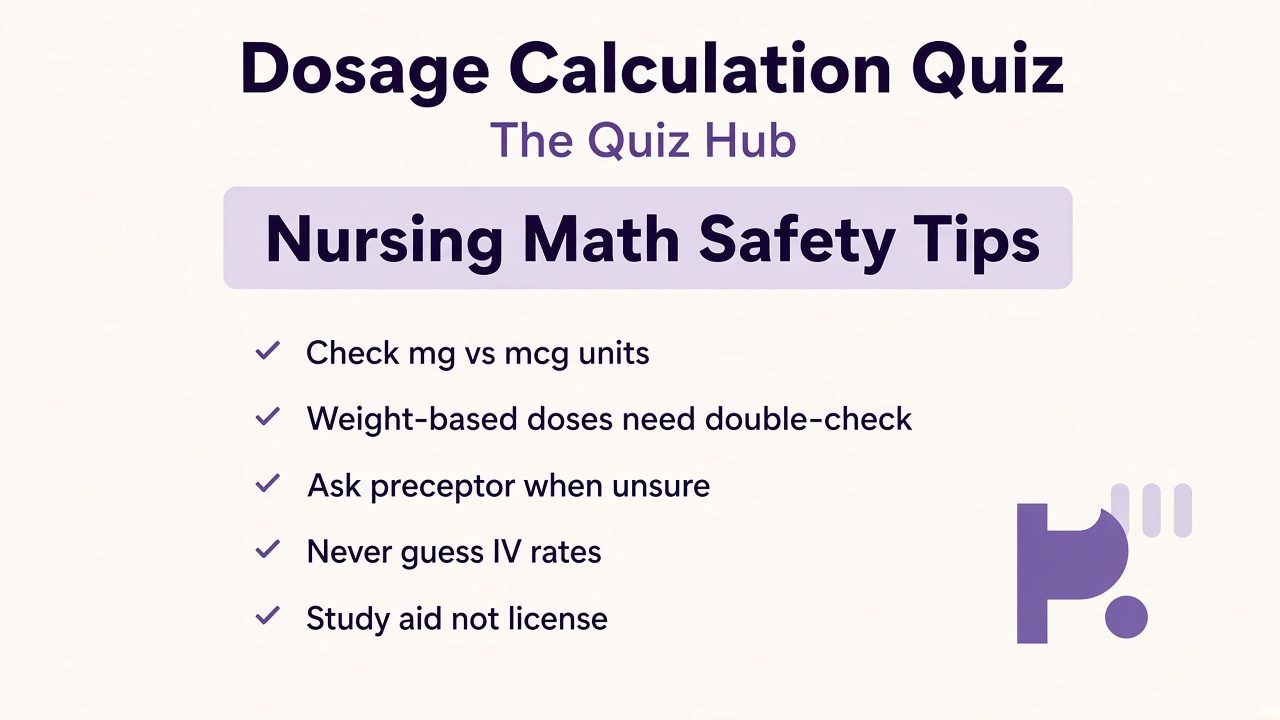
What this quiz can and cannot tell you
Can tell you
- Highlight mg/kg, unit, and double-check habits worth drilling before exams
- Separate student practice framing from prescribing or dispensing authority
- Encourage retake-and-review habits without shame
- Give language for skills-lab or faculty conversations about weak math areas
Cannot tell you
- Authorize prescribing, dispensing, or changing real patient medications
- Replace pharmacy verification, smart pumps, or institutional protocols
- Cover every drug class, infusion rate, or pediatric specialty rule
- Prove you will never make a calculation error under clinical time pressure
Dosage math as safety literacy, not a speed contest
Students search dosage calculation when pharmacology weeks stack mg/kg problems, liquid concentrations, and tablet strengths on the same worksheet. The math is often middle-school arithmetic wearing scrubs: multiply, divide, convert units, then ask whether the answer makes clinical sense. The failure mode is rarely long division; it is treating pounds as kilograms, swapping milligrams for milliliters, or rounding before the final step because the numbers feel familiar.
Weight-based dosing starts with a clear weight in kilograms. Pediatric and many critical-care examples express ordered dose as milligrams per kilogram. Total milligrams usually come from multiplying that rate by weight, then comparing against a reference range or dividing into per-dose amounts depending on the question stem. Writing mg/kg times kg equals mg on every line slows you down slightly and catches the majority of setup errors faculty see in office hours.
Units and concentration items remind you that labels matter more than memory. A vial strength in mg/mL tells you how many milligrams live in each milliliter drawn into a syringe for liquid problems; tablets still carry their own mg stamp. Gram and milligram conversions appear when strengths are written different ways in questions. Reverse traps on this screener flag the myth that mg and mL are interchangeable because both abbreviations start with m.
Double-check safety is how programs train culture before licensure. A second calculation path, a partner read-back in study group, or comparing against an instructor key after rechecking units mirrors bedside verify habits without pretending a quiz replaces sign-off. Speed without verification is a reverse item because timed tests reward fast hands but real safety rewards paused confirmation. Ambiguous stems are a feature of learning: asking preceptors or faculty is the correct clinical move, not a weakness.
Use this screener as a warm-up before skills lab or exams. Pair it with our medication administration quiz for route-and-rights recall, the fundamentals of nursing quiz for broader baseline review, and the dividing fractions quiz when rational-number steps tangle. Browse the IQ and cognitive test hub for more low-stakes study screeners. Retake after one focused review week and save your lowest bar as the topic you explain aloud with units on every line,literacy grows when verification becomes habit, not when you memorize one lucky final number.
| Test | Focus |
|---|---|
| Medication administration quiz | Administration and rights recall, not mg/kg setup or concentration math depth |
| Fundamentals of nursing quiz | Broader nursing baseline rather than calculation unit discipline |
Dosage Calculation Quiz FAQ
What does this quiz measure?
It measures how much you agree with student-level dosage safety literacy across mg/kg setup, units and concentration, double-check habits, and study limits. You get an index from 0 to 100 and four bars. It reflects self-reported habits on this screener, not clinical competency sign-off.
Can I give medication if my score is high?
No. This is an unofficial study aid. Only licensed teams following verified orders, institutional policy, and preceptor supervision may administer or prescribe medication.
Why are some statements worded as unsafe shortcuts?
Reverse-worded traps catch overconfidence. Agreeing that pounds need no conversion for mg/kg, that mg equals mL without reading strength, or that one fast pass beats double-check should not inflate your literacy index.
Does this quiz teach every infusion or pediatric rule?
No. It focuses on common student math habits: weight units, label units, verification, and practice-not-license framing. Specialty drips, pump libraries, and drug-specific maxima belong in your program materials.
Who reviewed this quiz?
Dr. Elena Vasquez, PhD reviewed the YMYL framing, medication safety limits, and student-not-prescriber language. See our editorial policy for review standards.
Reviewed by