
What Early Bird or Night Owl Quiz measures
This quiz does not diagnose insomnia, delayed sleep phase disorder, or sleep apnea, and it does not rank your character. It measures how much you agree with chronotype-related habits and literacy grouped four ways: morning-evening energy about when focus and wakefulness feel easiest; light and circadian cues about morning light, evening dimming, and weekend timing; caffeine and sleep hygiene about stimulant timing, wind-down routines, and scheduling hard work during sharper hours; and chronotype reality about shift work, flexible plans, and rejecting lazy night owl myths. You answer 22 statements from strongly disagree to strongly agree, with reverse-worded evening-leaning and virtue-trap items so one-sided agreeing cannot fake every bar. Your answers also feed a second chart on closeness and trust habits, because sleep shame or rigid routines can block asking for help. The total becomes a morningness habit index from 0 to 100 where higher means more reported morning-leaning habits on this screener, lower means more evening-leaning patterns, and neither pole is framed as morally better.
Morning-evening energy
Peak focus after waking versus after dark, alarm grogginess, and midnight stamina without caffeine crutches.
Light and circadian cues
Morning daylight, evening dimming, screen habits, and weekend timing that supports or fights your window.
Caffeine and sleep hygiene
Stimulant cutoffs, wind-down routines, meal and alcohol timing, and task placement on your sharp hours.
Chronotype reality
Shift work humility, habit adjustments, and rejecting virtue contests about who wakes first.
How it works
Answer 22 agreement items
Rate each statement from Strongly disagree to Strongly agree. Tap Next after each answer.
Answers sort into four domains
Each answer feeds one of four chronotype groups, and every item also feeds a closeness and trust layer.
See your index and charts
You get a 0 to 100 morningness index, a band, and two bar charts for reflection before you change routines.
Take the Early Bird or Night Owl Quiz
Answer 22 short statements to see your morningness index, four domain bars, and a closeness and trust chart.
What your result means
Your morningness habit index is the average of all 22 answers, scaled from 0 to 100, with reverse-worded items flipped first. Higher means more reported morning-leaning habits on this screener; lower means more evening-leaning patterns. Read light and caffeine bars together before you treat the total as proof you must become a 5 a.m. influencer or that night owls are lazy.
| Band | Index range | Typical reading |
|---|---|---|
| Evening chronotype leaning | 0 to 35 | More agreement with evening peak energy, slower mornings, or night-leaning habits on this screener. |
| Mixed chronotype habits | 36 to 65 | Morning and evening items both endorsed; hygiene or virtue myths may still snag one bar. |
| Morning chronotype leaning | 66 to 100 | More agreement with morning alertness, earlier light habits, and chronotype literacy on this screener. |
Tips at a glance
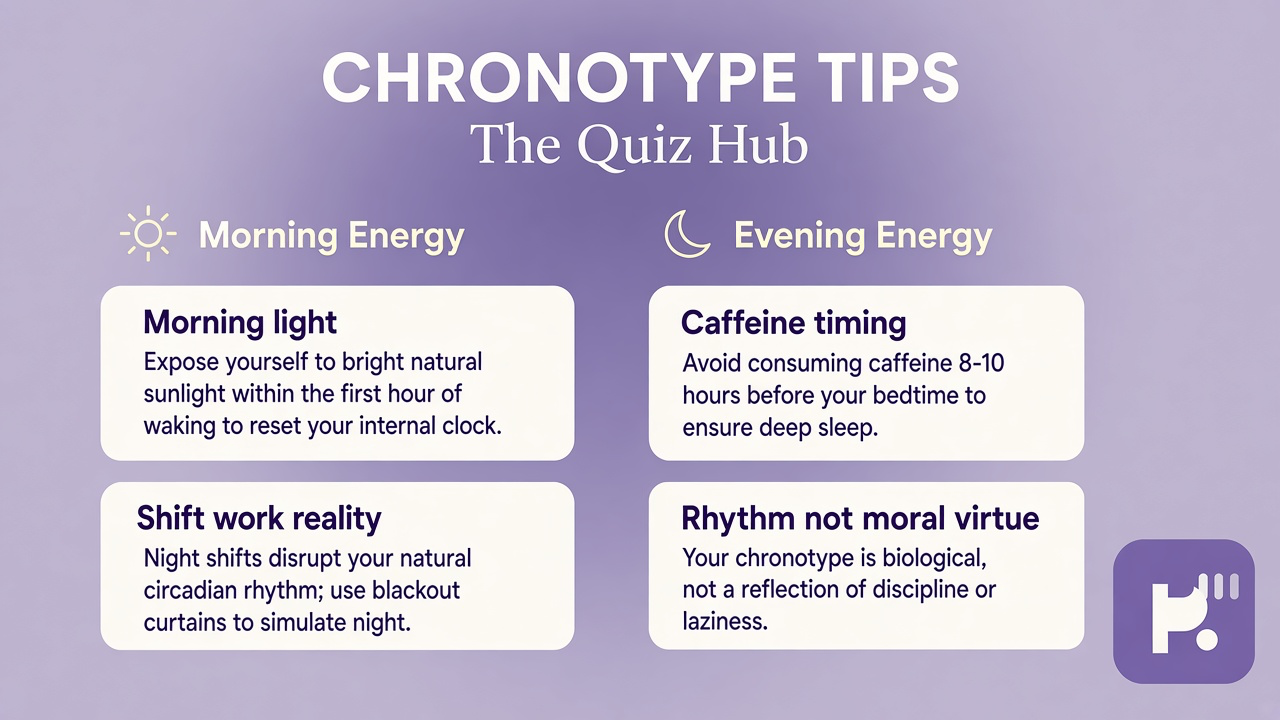
A quick takeaway graphic with topic tips (not your personal quiz scores). Start the quiz for your index, bands, and charts.
What this quiz can and cannot tell you
Can tell you
- Clarify morning versus evening peak energy in everyday language
- Highlight light, caffeine, and wind-down habits that support your rhythm
- Separate chronotype reflection from moral virtue or discipline scoring
- Give you a retake baseline when schedules, seasons, or caregiving shift
Cannot tell you
- Diagnose sleep disorders or measure melatonin from one online screener
- Replace actigraphy, sleep studies, or licensed clinical assessment
- Prove you should force a job schedule that ignores shift work reality
- Tell you whether you will thrive on every timezone or parenting season instantly
Chronotype habits beyond the virtue contest
People search early bird or night owl when a partner mocks their alarm, or when a job demands hours that fight their body clock. Chronotype describes when alertness and sleep pressure tend to land, with biology, age, light exposure, and schedules all in the mix. It is not a report card on discipline. Morning larks and night owls both need sleep quantity and quality; the useful question is which hours feel sharpest and how habits support that window.
Morning-evening energy is the felt experience. Some people clear fog within an hour of waking; others do their best thinking after sunset. Neither pattern automatically means you are broken. Mislabeling evening focus as laziness pushes people toward caffeine loops and shame instead of task timing. Notice your peak hours on rested weeks before you copy a stranger's 5 a.m. routine.
Light and circadian cues are the levers many quizzes skip. Morning outdoor light can nudge wake timing without moral speeches. Evening dimming and calmer screens help sleep onset even when your peak focus stays late. Weekend social jet lag is real: wildly different midpoints every Saturday can make Monday feel brutal. Small shifts beat heroic all nighters that pretend you can reset biology in one night.
Caffeine and sleep hygiene sit beside chronotype, not above it. Cutting stimulants early enough, keeping a simple wind down, and placing hard work on your sharp hours beats white-knuckling the wrong clock. Alcohol and heavy late meals can trash sleep quality regardless of labels. Hygiene supports every chronotype; it does not convert night owls into mascots for productivity culture.
Chronotype reality includes shift workers, parents, and students whose lives do not match textbook lark ideals. Flexible plans beat virtue contests. Use this tool as a warm-up, not a verdict. Pair it with our Horn Ostberg chronotype test (MEQ) when you want a second morningness lens, and browse the personality and psychology test hub for more low-stakes screeners. Retake after you try one week of morning light or one caffeine cutoff; habits change faster than online insults about who wakes first.
| Test | Focus |
|---|---|
| Horn Ostberg chronotype test (MEQ) | MEQ-inspired morning lark, intermediate, and night owl bands rather than hygiene virtue framing |
| Personality stability and change quiz | Trait stability versus change literacy rather than sleep timing habits |
Early Bird or Night Owl Quiz FAQ
What does this quiz measure?
It measures how much you agree with chronotype-related habits and literacy across four domains. You get a morningness habit index from 0 to 100 and four bars. Higher leans morning; lower leans evening on this screener. It is reflection, not a clinical chronotype lab result.
Does a high score mean I am morally better than night owls?
No. The quiz explicitly rejects virtue framing. A higher index means you reported more morning-leaning energy and habits here today. Late chronotypes are not lazy. Use bars to adjust routines, not to rank people.
Why do some statements sound like common sleep myths?
Reverse-worded traps catch shortcuts. Agreeing that late sleepers are lazy, that screens never affect sleep, that all nighters fix schedules, or that pulling virtue scores from quizzes should not inflate your morningness index.
Is this the same as a clinical sleep study?
No. This is a 22-item agree-or-disagree screener for curious readers and students. Formal chronotype and sleep disorder assessment uses validated instruments and clinicians, not a quick online habit quiz.
Who reviewed this quiz?
Dr. James Whitfield, PhD reviewed the educational framing, chronotype habit limits, and result explanations. See our editorial policy for review standards.
Reviewed by
