What Personality Stability and Change Quiz measures
This quiz does not diagnose disorders, sort job candidates, or prove you are stuck with one archetype forever. It measures how much you agree with introductory stability versus change literacy grouped four ways: rank-order stability about patterns across years without identical mood every day; context expression about roles, culture, and safety changing how traits show up; stress and age shifts about pressure weeks, life chapters, recovery, and normal development; and growth not fixed about practice, feedback, therapy, and quiz labels that are not destiny. You answer 22 statements from strongly disagree to strongly agree, with reverse-worded traps so agreeing with every fixed-trait shortcut cannot inflate every bar. Your answers also feed a second chart on closeness and trust habits, because hiding change or performing a rigid self can block vulnerability. The total becomes an index from 0 to 100 where higher means more reported stability literacy on this screener, not proof your traits are maximally flexible in every domain.
Rank-order stability
Tendencies across years, researcher language, and myths about frozen monthly ranks.
Context expression
Work, family, online tone, unsafe settings, and culture welcoming different sides of you.
Stress and age shifts
Pressure weeks, parenthood, careers, aging, burnout recovery, and normal evolution.
Growth not fixed
Micro-habits, therapy, feedback, and treating quiz stamps as entertainment not fate.
How it works
Answer 22 agreement items
Rate each statement from Strongly disagree to Strongly agree. Tap Next after each answer.
Answers sort into four domains
Each answer feeds one of four stability groups, and every item also feeds a closeness and trust layer.
See your index and charts
You get a 0 to 100 index, a band, and two bar charts you can use before a psychology unit.
Take the Personality Stability and Change Quiz
Answer 22 short statements to see your stability reflection index, four domain bars, and a closeness and trust chart.
What your result means
Your index is the average of all 22 answers, scaled from 0 to 100, with reverse-worded items flipped first. Higher means more reported stability literacy on this screener. Read growth not fixed and context expression bars together before you treat the total as proof you never act differently under stress.
| Band | Index range | Typical reading |
|---|---|---|
| Building stability literacy | 0 to 35 | Fewer agreed facts about rank-order patterns, context, stress shifts, or growth agency on this screener. |
| Mixed stability literacy | 36 to 65 | Solid ideas in some domains with traps on frozen ranks, party-versus-funeral faking, or stress never touching traits. |
| Strong stability literacy | 66 to 100 | Frequent agreement with rank-order framing, context expression, stress and age shifts, and growth myths on this screener. |
Tips at a glance
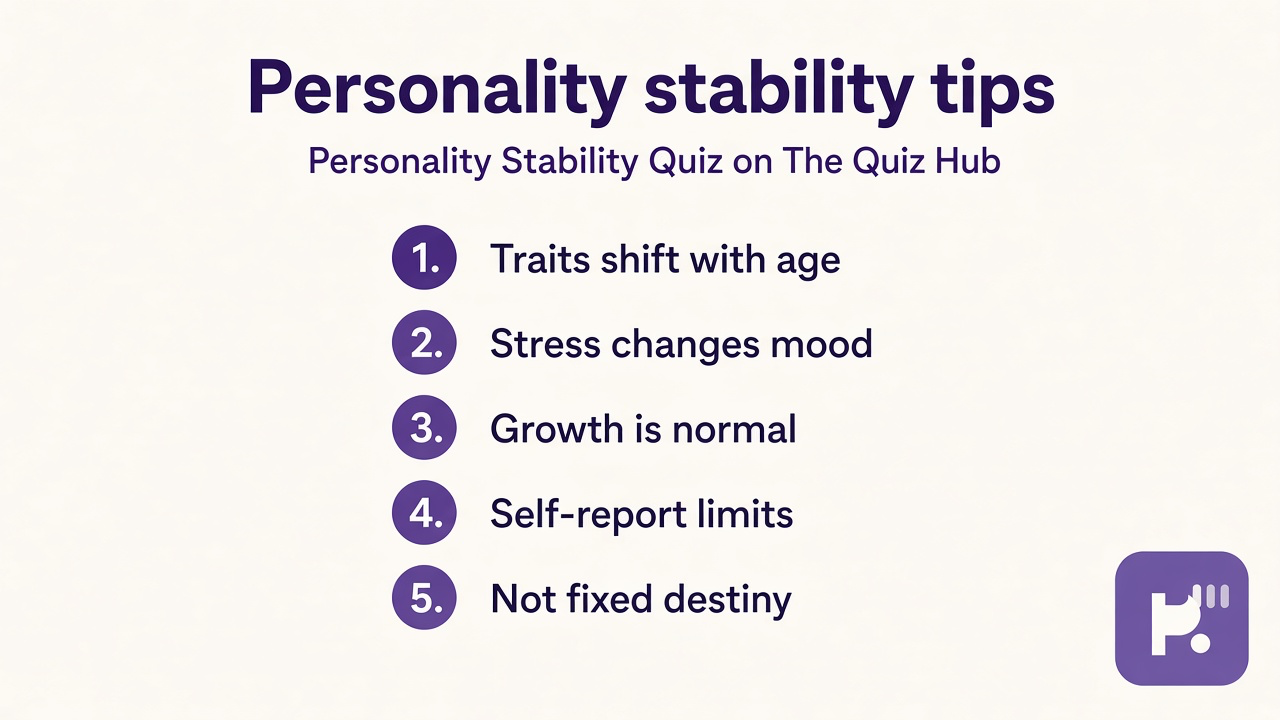
A quick takeaway graphic with topic tips (not your personal quiz scores). Start the quiz for your index, bands, and charts.
What this quiz can and cannot tell you
Can tell you
- Clarify rank-order stability versus daily mood swings in plain language
- Highlight how context and stress reshape trait expression without erasing history
- Separate reflection practice from clinical diagnosis or hiring sorting
- Give you a retake baseline during a personality or lifespan psychology unit
Cannot tell you
- Diagnose personality disorders or trauma responses from one online screener
- Replace longitudinal research batteries or licensed psychological assessment
- Cover every stability metric, such as full Big Five retest studies or clinician interviews
- Prove you will feel equally flexible in every relationship or culture instantly
Stability and change beyond the fixed-trait meme
People search personality stability when a friend insists they never change, or when they feel like a different person after burnout, parenthood, or moving cities. Researchers often describe rank-order stability: if you tend to be more conscientious than average, you may still look that way years later compared with peers, even as your absolute scores drift. That is not the same as feeling identical every Tuesday. Stability language describes patterns across time, not a statue that never reacts to context.
Context expression is the everyday proof. You might delegate at work, soften at home, and lurk quietly in a group chat while leading elsewhere. Culture tells you which traits are rewarded: assertiveness, modesty, humor, or emotional reserve. Unsafe rooms can shrink you without erasing the self you recover in trusted spaces. Calling those shifts faking confuses adaptation with fraud. The useful question is which settings bring out which habits, and whether you choose them consciously.
Stress and age add motion. Long pressure weeks can spike irritability, withdrawal, or scatter beyond your calm baseline. Major chapters reorder priorities: careers, caregiving, grief, recovery. Aging can soften sharp edges or deepen skills you practiced for decades. None of that requires throwing away your history. It does require updating the story you tell about what is normal development versus what needs clinical support when change feels stuck or frightening.
Growth not fixed is where literacy meets agency. Micro-habits, therapy, coaching, and honest feedback can reshape traits people once treated as destiny. Online quizzes that stamp permanent mascots are entertainment at best. Believing you cannot change often blocks the small experiments that actually move behavior. If you were shy at sixteen, you are not guaranteed to be equally shy in every room at forty, even if some tendencies remain familiar.
Use this tool as a warm-up, not a verdict. Pair it with one week of noticing context and our dominant character trait quiz when you want habit-cluster language beside stability framing. Browse the personality and psychology test hub for more low-stakes screeners that label themselves honestly. Retake after you log one stress week and one setting where you acted unlike your usual label; literacy grows when stability and change sit in the same sentence, not when feeds pick one pole and call it science.
| Test | Focus |
|---|---|
| Dominant character trait quiz | Leader, caregiver, analyst, and rebel habit clusters rather than stability literacy |
| Big Five personality test | Research-backed OCEAN trait percentiles rather than change-versus-fixed myths |
Personality Stability and Change Quiz FAQ
What does this quiz measure?
It measures how much you agree with introductory literacy about personality stability versus change across four domains. You get an index from 0 to 100 and four bars. It reflects self-reported agreement on this screener, not a clinical diagnosis or proof your traits are fixed.
Does a high score mean my personality never changes?
No. A higher literacy index means you agreed with accurate framing about patterns, context, stress, and growth on this tool today. People still shift with new chapters, support, and practice. Use the bars to guide reflection, not to claim total rigidity or total fluidity.
Why do some statements sound like common mistakes?
Reverse-worded traps catch shortcuts. Agreeing that monthly ranks never move, that context never matters, that stress never touches traits, or that shy at sixteen guarantees shy at forty should not inflate your literacy index.
Is this the same as a Big Five retest study?
No. This is agree-or-disagree literacy for students and curious readers. Formal stability research uses longitudinal designs and validated instruments administered by researchers, not a 22-item screener.
Who reviewed this quiz?
Dr. James Whitfield, PhD reviewed the educational framing, stability versus change limits, and result explanations. See our editorial policy for review standards.
Reviewed by