What the Ear Anatomy Quiz measures
This quiz does not otoscope your ear, certify you for clinical practice, or score your intelligence. It measures how much you agree with introductory ear anatomy literacy grouped four ways: outer ear about pinna, canal, wax, and sound entry; middle ear about the eardrum, ossicles, air space, and Eustachian tube; inner ear about cochlea, semicircular canals, hair cells, and auditory nerve pathways; and hearing safety and study habits about volume, breaks, diagram practice, and leaving diagnosis to professionals. You answer 22 statements from strongly disagree to strongly agree, with reverse-worded myths so agreeing with every shortcut cannot inflate every bar. Your answers also feed a second chart on closeness and trust habits, because health worry sometimes pushes people toward quick internet certainty. The total becomes an index from 0 to 100 where higher means more reported ear anatomy literacy on this screener, not proof you should skip care when symptoms scare you.
Outer ear
Pinna, canal, wax role, sound waves in air, and where the outer ear meets the eardrum.
Middle ear
Tympanic membrane, ossicle chain, air chamber, Eustachian tube, and clinician exam limits.
Inner ear
Cochlea, balance canals, hair cells, nerve signals, and vestibular dizziness context.
Hearing safety and study
Noise exposure, headphone habits, labeled diagrams, retakes, and no DIY diagnosis.
How it works
Answer 22 agreement items
Rate each statement from Strongly disagree to Strongly agree. Tap Next after each answer.
Answers sort into four domains
Each answer feeds one of four ear anatomy groups, and every item also feeds a closeness and trust layer.
See your index and charts
You get a 0 to 100 index, a band, and two bar charts you can use before a biology unit test.
Take the Ear Anatomy Quiz
Answer 22 short statements to see your ear anatomy literacy index, four domain bars, and a closeness and trust chart.
What your result means
Your index is the average of all 22 answers, scaled from 0 to 100, with reverse-worded items flipped first. Higher means more reported ear anatomy literacy on this screener. Read hearing safety and inner ear bars together before you treat the total as clinical expertise.
| Band | Index range | Typical reading |
|---|---|---|
| Building ear anatomy literacy | 0 to 35 | Fewer agreed facts on outer, middle, or inner ear paths or hearing safety habits on this screener. |
| Mixed ear anatomy literacy | 36 to 65 | Solid facts in some domains with myths about swabs, cochlea location, or quiz-based diagnosis. |
| Strong ear anatomy literacy | 66 to 100 | Frequent agreement with accurate ear path trivia and healthy study limits. |
Tips at a glance
A quick takeaway graphic with topic tips (not your personal quiz scores). Start the quiz for your index, bands, and charts.
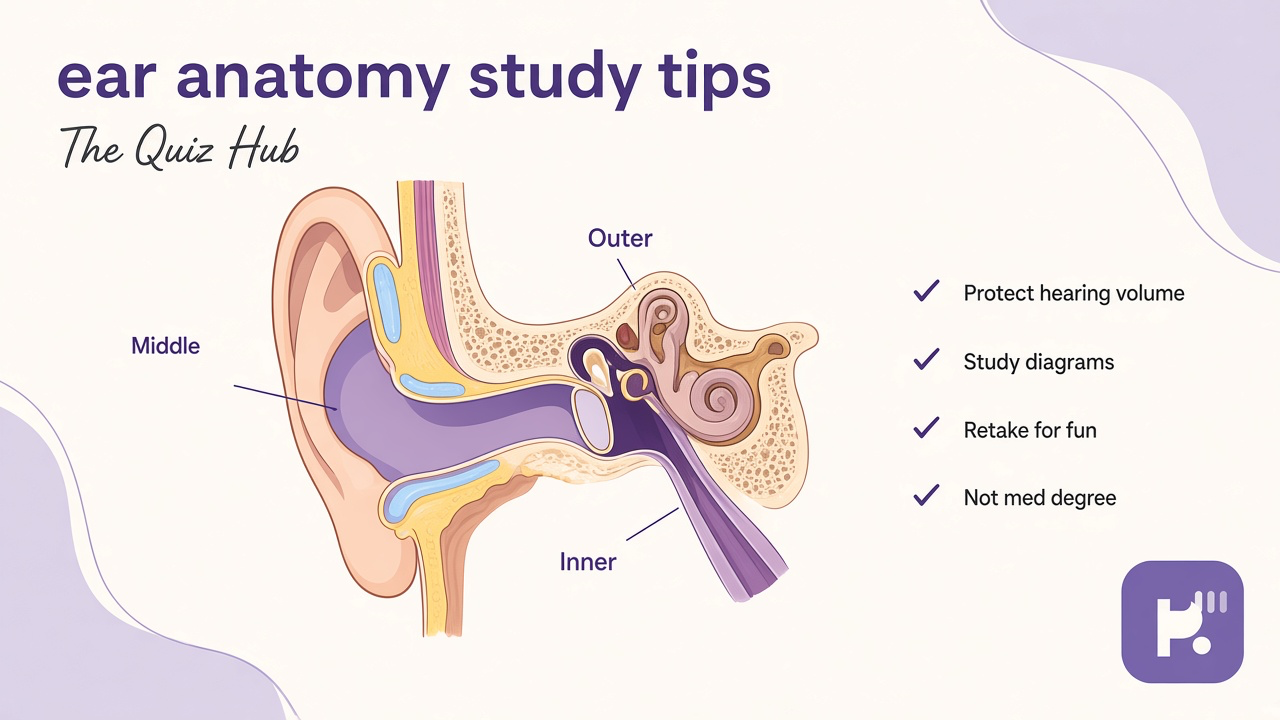
What this quiz can and cannot tell you
Can tell you
- Clarify outer, middle, and inner ear names in plain language
- Highlight common swab and cochlea-location myths worth unlearning
- Encourage diagram study and retake habits without shame
- Spark better questions during school hearing or anatomy units
Cannot tell you
- Diagnose infection, hearing loss, or vertigo from trivia answers
- Replace audiometry, imaging, or hands-on clinical exams
- Certify you for procedures, dosing, or medical licensing
- Prove your ears are healthy when ringing, pain, or sudden loss appears
Ear anatomy literacy beyond one labeled poster
Students search ear anatomy when a biology unit hands them a cross-section and every region blurs together. The outer ear is what you can mostly see and feel: pinna catching sound, canal carrying waves inward, wax helping trap debris before deeper structures. Sound is still air pressure at this stage. Mixing up canal-only hearing with the full path is a trap quizzes flag on purpose.
The middle ear is a small air-filled box behind the eardrum. The tympanic membrane vibrates, ossicles pass motion along a tiny chain, and the Eustachian tube links pressure to your throat so ears can pop on planes or elevators. Teachers love asking where the cochlea sits; it is inner ear, not middle ear beside the stapes. Clinicians look with lights and tools you cannot replicate from a phone photo.
The inner ear is where hearing and balance share real estate. The cochlea spirals like a snail shell and helps turn mechanical vibration into nerve signals. Semicircular canals track head rotation; vestibular signals partner with vision so dizziness sometimes points clinicians toward inner ear testing, not just stress alone. Hair cells are delicate; very loud concerts, sirens, and maxed headphones can damage them over time in ways rest may not fully fix.
Hearing safety is the fourth domain because anatomy units often skip daily habits. Volume breaks, quieter listening, and stepping away from sustained noise are study skills that protect the structures you just labeled. Retakes and flashcards are normal; they do not mean you are in medical school. Agreeing that a high quiz score replaces audiometry when ears ring is another myth worth rejecting.
Use this screener as a warm-up, not a verdict. Pair it with one labeled diagram from class and our domain and range quiz when you want a different structured literacy break. Browse the IQ and cognitive test hub for more low-stakes study games. Retake after you can trace sound from pinna to nerve without peeking; literacy grows when layers stay in order, not when you memorize that cochlea starts with c and hope the middle ear chapter never asks where it lives.
| Test | Focus |
|---|---|
| Domain and range quiz | Algebra function inputs and outputs, not ear cross-sections or hearing safety |
| Drama terms quiz | Theater vocabulary and stage directions, not pinna or cochlea labels |
Ear Anatomy Quiz FAQ
What does this quiz measure?
It measures how much you agree with introductory ear anatomy literacy across outer, middle, and inner ear basics plus hearing safety study habits. You get an index from 0 to 100 and four bars. It reflects self-reported knowledge on this screener, not a clinical skills exam or IQ score.
Is this quiz enough to diagnose hearing problems?
No. It is study trivia and care literacy. Ringing, sudden hearing loss, severe pain, or spinning dizziness need a clinician or audiologist, not a high score here.
Why are some statements worded as myths?
Reverse-worded myths catch overconfidence. Agreeing that deep cotton swabs are always safe, that the cochlea sits in the middle ear, that hearing happens only in the canal, or that trivia replaces audiometry should not inflate your literacy index.
Does this cover every ear disorder or surgical detail?
This screener stays at shared intro anatomy: regions, basic mechanics, balance context, and volume habits. Advanced pathology, implant surgery, and full audiology boards belong in dedicated courses.
Who reviewed this quiz?
Dr. James Whitfield, PhD reviewed the educational framing, anatomy literacy limits, and result explanations. See our editorial policy for review standards.
Reviewed by