What the Domain And Range Quiz measures
This quiz does not place you into a course level, grade your transcript, or replace worked examples from a teacher. It measures how much you agree with everyday domain-and-range literacy grouped four ways: domain basics about allowed inputs and context; range basics about outputs and graphs; division-by-zero and related restrictions for rationals, radicals, and logarithms; and interval notation for writing sets on the number line. You answer 22 statements from strongly disagree to strongly agree, with reverse-worded traps so agreeing with every shortcut cannot inflate every bar. Your answers also feed a second chart on closeness and trust habits, because math anxiety sometimes pushes people toward memorizing labels without asking why a value is excluded. The total becomes an index from 0 to 100 where higher means more reported domain-and-range literacy on this screener, not proof you will ace the next exam.
Domain basics
Allowed inputs, context restrictions, and when all real numbers work.
Range basics
Possible outputs, graphs, and why range is not the same as domain.
Division by zero
Denominators, radicals, logs, and holes after canceling factors.
Interval notation
Brackets, parentheses, infinity, and unions that exclude points.
How it works
Answer 22 agreement items
Rate each statement from Strongly disagree to Strongly agree. Tap Next after each answer.
Answers sort into four domains
Each answer feeds one of four algebra groups, and every item also feeds a closeness and trust layer.
See your index and charts
You get a 0 to 100 index, a band, and two bar charts you can use before a test review session.
Take the Domain And Range Quiz
Answer 22 short statements to see your domain and range literacy index, four domain bars, and a closeness and trust chart.
What your result means
Your index is the average of all 22 answers, scaled from 0 to 100, with reverse-worded items flipped first. Higher means more reported domain-and-range literacy on this screener. Read division-by-zero and interval notation bars together before you treat the total as exam readiness.
| Band | Index range | Typical reading |
|---|---|---|
| Building function literacy | 0 to 35 | Fewer agreed facts on domain, range, exclusions, or interval writing on this screener. |
| Mixed function literacy | 36 to 65 | Solid habits in some domains with traps on holes, range, or interval endpoints. |
| Strong function literacy | 66 to 100 | Frequent agreement with domain, range, exclusion, and interval habits on this screener. |
Tips at a glance
A quick takeaway graphic with topic tips (not your personal quiz scores). Start the quiz for your index, bands, and charts.
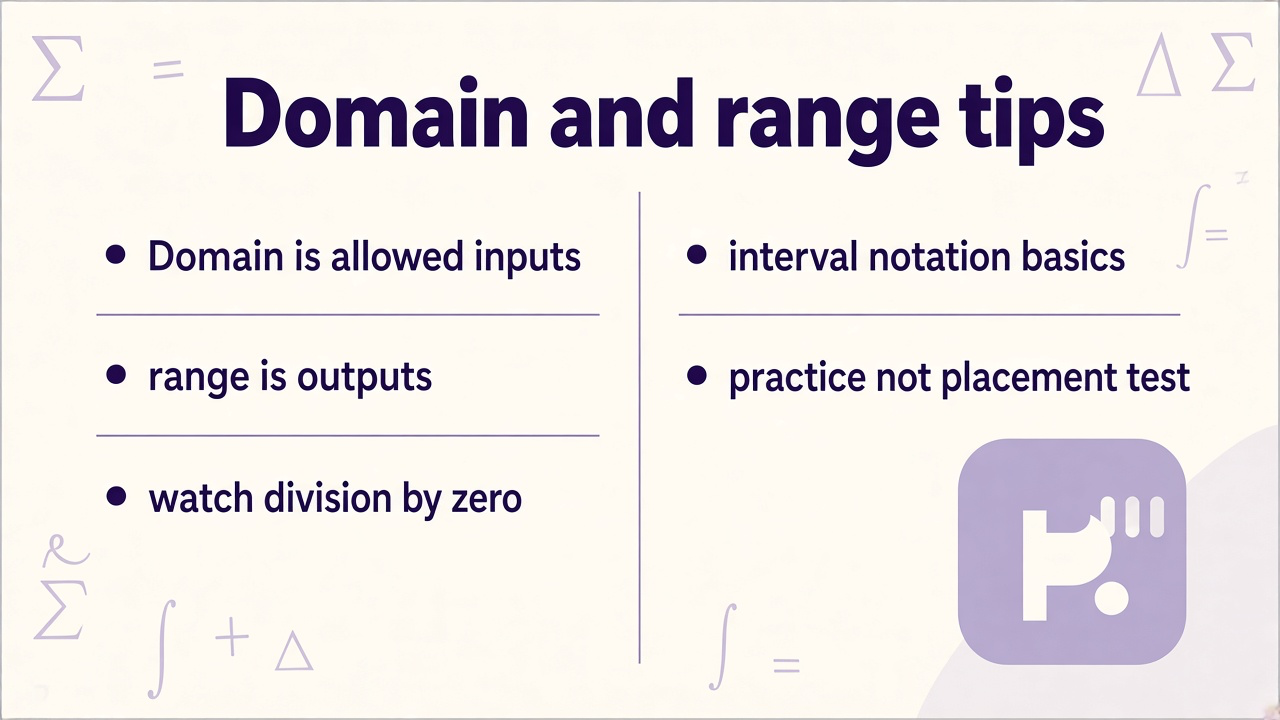
What this quiz can and cannot tell you
Can tell you
- Clarify domain versus range in plain language
- Highlight denominator, radical, and log restrictions worth checking
- Practice interval notation habits before homework submissions
- Give you a retake baseline during an algebra unit
Cannot tell you
- Place you into college algebra, calculus, or gifted programs
- Replace graded tests, proofs, or teacher rubrics
- Cover every function type, such as all piecewise or trigonometric rules
- Prove you will never make a notation typo under time pressure
Domain, range, and intuition beyond drill sheets
Students search domain and range when homework asks for interval notation and the textbook jumps from tables to rational functions in one page. The vocabulary is simple on purpose: domain is the set of inputs you are allowed to use, and range is the set of outputs the rule can produce. The difficulty is discipline. You must read the original expression, not the simplified one, and you must separate what x may be from what y can become.
Polynomials with no context often have domain all real numbers, but square roots demand nonnegative radicands on the reals, denominators forbid zeros, and logarithms demand positive arguments. Canceling (x - 3) in a fraction can hide a hole at x = 3 even when the reduced form looks like a plain line. Range questions push you toward graphs and estimates: parabolas that open upward cannot output arbitrarily negative y-values, while reciprocals skip zero in the output when zero is excluded from the input pattern. Confusing range with a single point such as the y-intercept is a common trap because intercepts are easy to spot on a grid while range is a set.
Interval notation is the shorthand teachers want on tests. Square brackets include endpoints; parentheses exclude them. Infinity always sits behind parentheses because it is not a number you touch. Unions stitch allowed pieces together, which is how you write all real numbers except one hole. When you practice, say the set in words first, then translate to symbols; that order catches bracket mistakes faster than copying from a friend's paper.
Use this screener as a warm-up, not a verdict. Pair it with graph paper, a few worked examples from class, and our dividing fractions quiz when rational rules feel tangled. Browse the IQ and cognitive test hub for more low-stakes study games. If you want imagery-style reflection after heavy algebra weeks, the words versus pictures quiz is a different kind of break, still not an IQ score.
Retake after you mark every denominator zero on a homework set. Save your lowest bar as the one topic you explain aloud to a study partner. Literacy grows when exclusions become habits, not when you memorize that domain starts with d and hope the rest follows on test day.
| Test | Focus |
|---|---|
| Dividing fractions quiz | Fraction division recall, not function domain or range notation |
| Do you think in words or pictures quiz | Cognitive style self-report, not algebra sets or interval notation |
Domain And Range Quiz FAQ
What does this quiz measure?
It measures how much you agree with domain-and-range literacy across inputs, outputs, exclusion habits, and interval notation. You get an index from 0 to 100 and four bars. It reflects self-reported habits on this screener, not a course grade.
Is this a placement test for college algebra?
No. It builds intuition and notation habits for practice. Schools use their own placement instruments; this quiz does not report to any institution.
Why do some statements sound like common mistakes?
Reverse-worded traps catch shortcuts. Agreeing that domain and range are the same word, or that canceled factors erase holes, should not inflate your literacy index.
Do I need to know piecewise and trig functions here?
This screener stays at intro algebra habits: polynomials, rationals, radicals, logs, and interval notation. Piecewise and trigonometric domains belong in class examples beyond these 22 items.
Who reviewed this quiz?
Dr. James Whitfield, PhD reviewed the educational framing, algebra limits, and result explanations. See our editorial policy for review standards.
Reviewed by