What the Drama Terms Quiz measures
This quiz does not cast you in a professional production, replace your director, or score your charisma under lights. It measures how much you agree with introductory theater literacy grouped four ways: stage vocabulary about the house, deck, wings, apron, and curtain areas; stage directions about actor-facing left and right, upstage and downstage, and blocking notation; staging formats about proscenium, thrust, and arena layouts plus fourth-wall habits; and rehearsal and study habits about call times, script marks, questions, and ensemble respect. You answer 22 statements from strongly disagree to strongly agree, with reverse-worded traps so agreeing with every shortcut cannot inflate every bar. Your answers also feed a second chart on closeness and trust habits, because performance classes sometimes push people toward performing confidence instead of asking for clearer blocking. The total becomes an index from 0 to 100 where higher means more reported theater literacy on this screener, not proof you will book paid work tomorrow.
Stage vocabulary
House, wings, apron, proscenium, onstage versus backstage, and blackout cues.
Stage directions
Actor-facing left and right, upstage and downstage, crosses, and script notation.
Staging formats
Proscenium picture frame, thrust three-sided seating, arena in the round, fourth wall.
Rehearsal and study
Punctuality, marked scripts, clear questions, warm-ups, and ensemble respect.
How it works
Answer 22 agreement items
Rate each statement from Strongly disagree to Strongly agree. Tap Next after each answer.
Answers sort into four domains
Each answer feeds one of four theater groups, and every item also feeds a closeness and trust layer.
See your index and charts
You get a 0 to 100 index, a band, and two bar charts you can use before a blocking rehearsal.
Take the Drama Terms Quiz
Answer 22 short statements to see your theater literacy index, four domain bars, and a closeness and trust chart.
What your result means
Your index is the average of all 22 answers, scaled from 0 to 100, with reverse-worded items flipped first. Higher means more reported theater literacy on this screener. Read stage directions and staging format bars together before you treat the total as audition readiness.
| Band | Index range | Typical reading |
|---|---|---|
| Building theater literacy | 0 to 35 | Fewer agreed facts on vocabulary, directions, staging formats, or rehearsal habits on this screener. |
| Mixed theater literacy | 36 to 65 | Solid habits in some domains with traps on facing rules, format differences, or rehearsal shortcuts. |
| Strong theater literacy | 66 to 100 | Frequent agreement with vocabulary, directions, staging formats, and rehearsal habits on this screener. |
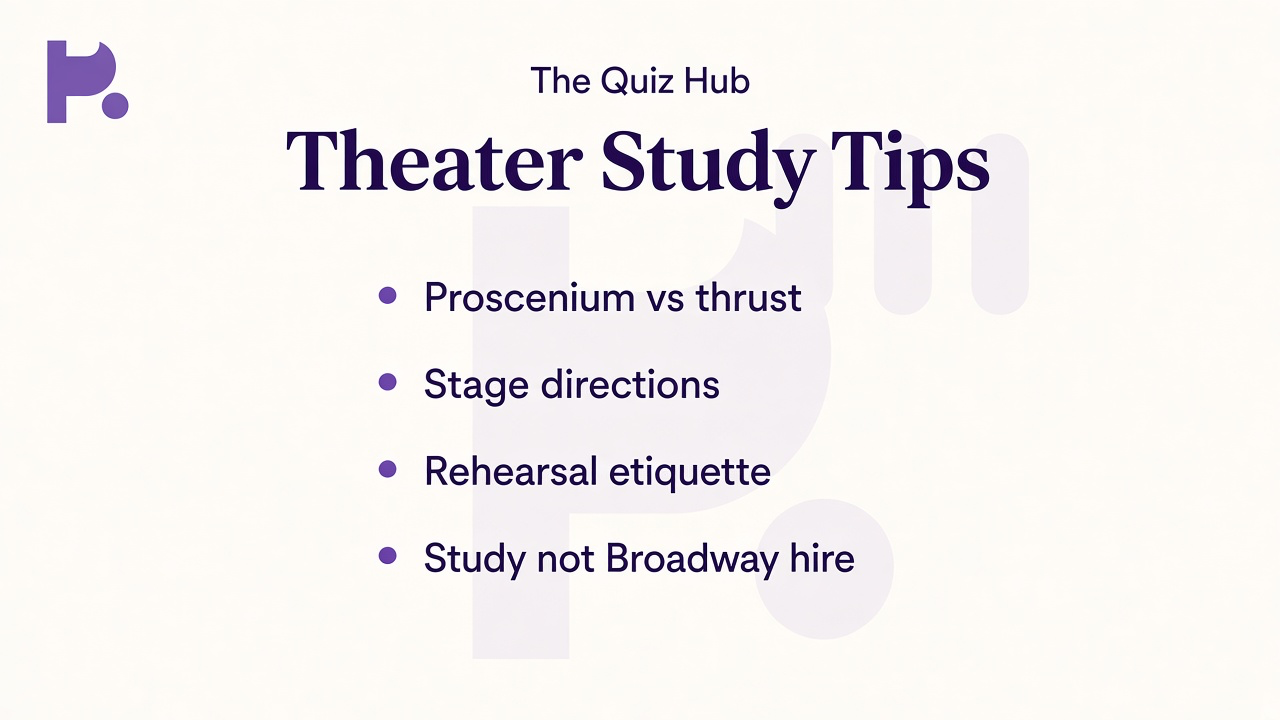
Tips at a glance
A quick takeaway graphic with topic tips (not your personal quiz scores). Start the quiz for your index, bands, and charts.
What this quiz can and cannot tell you
Can tell you
- Clarify beginner theater vocabulary in plain language
- Highlight actor-facing stage direction habits worth checking on scripts
- Separate proscenium, thrust, and arena sight-line differences
- Give you a retake baseline during an intro drama unit
Cannot tell you
- Cast you in professional productions or union contracts
- Replace director notes, fight call, or graded performance rubrics
- Cover every style, such as promenade staging or full technical design tracks
- Prove you will never confuse stage left under pressure on opening night
Theater literacy beyond glossary flashcards
Students search drama terms when the first script lands and everyone assumes you already know why the director keeps saying downstage center. Theater literacy is spatial and social: the house sits opposite the deck, wings hide waits and quick changes, and the proscenium arch frames many school shows like a movable painting. Agreeing that backstage equals onstage is a trap; one is visible to the audience and the other is where crews and actors prepare out of sight.
Stage directions exist so ensembles share one map. Stage left and stage right come from the actor facing the house, which is the opposite of the audience member pointing to their own left from the seats. Upstage and downstage describe depth toward the rear wall or toward the footlights, not moral judgment about your talent. Downstage often reads clearer because you are closer to listeners. Reverse items catch the habit of turning to your own left without translating to the script's actor-facing labels.
Staging formats change the same monologue. A proscenium layout keeps most viewers on one side of the fourth wall, the imaginary line between played reality and spectators. A thrust pushes action into the room with seating on three sides, so stillness upstage center may not exist the same way. Arena or in-the-round work demands constant awareness of every quadrant. Blocking that works on a picture-frame stage may need adjustment when the audience wraps around you.
Rehearsal literacy is where vocabulary meets respect. Call times, marked scripts, and clear questions protect the ensemble's time. Warm-ups and safety notes are not optional filler before the fun scenes. Agreeing that only lines matter is another trap; partners need predictable crosses, prop handoffs, and listening even while you are off script. Directors coach growth; quizzes only screen whether you recognize the words they use.
Use this screener as a warm-up, not a verdict. Pair it with one labeled diagram from class and our domain and range quiz when you want a different kind of structured literacy break. Browse the IQ and cognitive test hub for more low-stakes study games. Retake after you mark entrances on a short scene; literacy grows when stage directions become movement, not when you memorize that proscenium starts with p and hope blocking follows on show night.
| Test | Focus |
|---|---|
| Domain and range quiz | Algebra function inputs and outputs, not stage directions or blocking |
| Double entry accounting quiz | Bookkeeping debits and credits, not theater vocabulary or rehearsal etiquette |
Drama Terms Quiz FAQ
What does this quiz measure?
It measures how much you agree with introductory theater literacy across vocabulary, stage directions, staging formats, and rehearsal study habits. You get an index from 0 to 100 and four bars. It reflects self-reported habits on this screener, not a course grade or professional hire decision.
Is this a Broadway or union audition test?
No. It builds drama class vocabulary and rehearsal habits for study practice. Professional casting uses sides, callbacks, and director teams beyond this screener.
Why do some statements sound like common mistakes?
Reverse-worded traps catch shortcuts. Agreeing that backstage equals onstage, that stage left is your own left without actor-facing rules, or that only lines matter in rehearsal should not inflate your literacy index.
Does this cover lighting design, costumes, or stage management tracks?
This screener stays at shared intro vocabulary: directions, basic layout terms, format differences, and rehearsal etiquette. Design and crew specialties belong in dedicated units and courses.
Who reviewed this quiz?
Dr. James Whitfield, PhD reviewed the educational framing, theater literacy limits, and result explanations. See our editorial policy for review standards.
Reviewed by