What the Dyscalculia Test measures
This quiz does not diagnose dyscalculia, math learning disorder, or any other condition, and it does not measure IQ. Only a qualified professional using interview methods, school records or work history, and standardized learning tests when appropriate can determine whether a math learning difference fits your profile. It measures how often you have noticed habit patterns educators and clinicians discuss when number sense, time and money tasks, math-related anxiety, and delayed help-seeking shape day-to-day life, grouped four ways: estimating and comparing quantities, managing clocks and money, reacting to school or work math demands, and pursuing formal evaluation or accommodations when problems repeat. You answer 22 how-often statements about the past six months, with reverse-worded items so one good week cannot hide frequent strain across other days. Your responses also feed a second chart on closeness and trust habits, because shame about struggling and fear of being judged often travel together. The total becomes an index from 0 to 100 where higher means more frequent reported math-related strain on this screener, not proof you lack ability.
Number sense
How often quantities, symbols, or mental steps felt slippery compared with routine weeks.
Time and money tasks
How often clocks, schedules, change, or bills demanded extra checks or drained focus.
School or work math anxiety
How often tests, grades, or visible math moments triggered panic, hiding, or avoidance.
Help-seeking limits
How often you delayed tutors, accommodations, or formal learning evaluation while patterns returned.
How it works
Answer 22 frequency items
Rate each statement from Never to Very often for the past six months. Tap Next after each answer.
Answers sort into four domains
Each answer feeds one of four math strain groups, and every item also feeds a closeness and trust layer.
See your index and charts
You get a 0 to 100 index, a band, and two bar charts you can bring to a school or clinical intake.
Take the Dyscalculia Test
Answer 22 short statements to see your math and number strain index, four domain bars, and a closeness and trust chart.
What your result means
Your index is the average of all 22 answers, scaled from 0 to 100, with reverse-worded items flipped first. Higher means more frequent reported math strain on this screener. Read school or work math anxiety and help-seeking limits bars together before the total, since panic can look moderate while avoided evaluation keeps support out of reach.
| Band | Index range | Typical reading |
|---|---|---|
| Lower reported math strain | 0 to 35 | Fewer frequent number sense, time or money, anxiety, or help-avoidance patterns in the past six months. |
| Mixed reported math strain | 36 to 65 | Some domains spike while number sense, time tasks, or help-seeking look steadier on better weeks. |
| Higher reported math strain | 66 to 100 | Frequent number, time, money, anxiety, or help-avoidance strain; consider formal learning evaluation. |
Tips at a glance
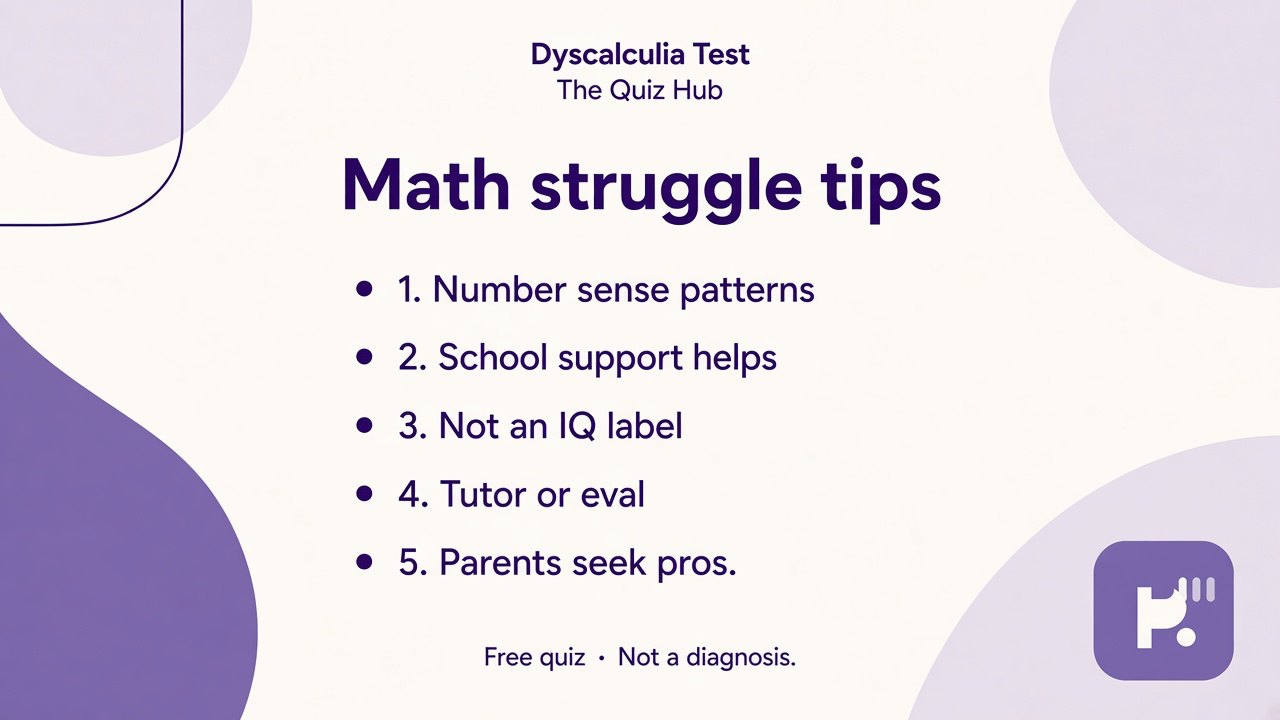
A quick takeaway graphic with topic tips (not your personal quiz scores). Start the quiz for your index, bands, and charts.
What this quiz can and cannot tell you
Can tell you
- Organize habits into number sense, time and money, anxiety, and help-seeking buckets
- Give you language for school psychologist or clinical learning evaluation intake
- Highlight when repeated strain may warrant formal testing rather than more willpower lectures
- Offer a baseline if you retake after tutoring or accommodations start
Cannot tell you
- Diagnose dyscalculia or math learning disorder without professional evaluation
- Replace psychoeducational batteries administered by qualified examiners
- Measure IQ, working memory capacity, or every cause of math difficulty on its own
- Prove you should skip school testing because one online score looked low or high
Dyscalculia signs, number sense, and when to seek evaluation
Dyscalculia refers to persistent difficulty with number sense, math reasoning, and related tasks that is not explained by lack of instruction alone. Social posts often mix math anxiety with learning differences or treat any bad grade as proof of a disorder. Frequency across months matters because two people can both dislike homework while one rarely misreads clocks or quantities and the other checks bills three times to feel safe.
Number sense items on this screener ask about estimating, comparing, and holding digits in mind during ordinary tasks. Trouble telling which price is larger or mixing up heard numbers does not prove dyscalculia in one afternoon, but patterns that repeat in shopping, cooking, and work data may deserve documentation. Time and money items connect to real life: analog clocks, due dates, and making change still show up in jobs and parenting even when phones calculate tips.
School or work math anxiety items focus on body stress, hiding mistakes, and avoiding numeric roles. Anxiety can amplify errors without being the whole story; clinicians often look at both emotional and skill profiles. Help-seeking items ask whether shame delayed tutors, accommodations, or psychoeducational testing while the same errors returned. Adults and parents both benefit when qualified evaluators interpret history instead of algorithms assigning labels.
The American Psychiatric Association includes specific learning disorder with impairment in mathematics among diagnosable conditions, but diagnosis requires structured assessment, not a free quiz. Schools in many regions offer evaluation pathways when learning problems affect education; private clinicians serve adults and homeschool families too. Our dyslexia test screens reading and phonology strain that sometimes co-occurs with math difficulty. The analog clock quiz emphasizes clock reading habits without full number sense coverage.
Higher scores mean more frequent self-reported strain on this tool, not a lower IQ. Pair changes with tutors, accommodations, and professional evaluation when patterns persist. Our am I good at math quiz leans toward confidence and enjoyment rather than six-month frequency of number habits. Use them for reflection alongside this screener, not instead of school or clinical testing when support decisions matter. Retake after one semester of targeted help and compare domain bars, not only the total.
| Test | Focus |
|---|---|
| Dyslexia test | Reading accuracy, fluency, and phonology strain rather than number sense and math anxiety frequency |
| Analog clock quiz | Wall-clock reading confidence without full time, money, and help-seeking domains |
| Am I good at math quiz | Math confidence and enjoyment rather than six-month frequency of number and evaluation habits |
Dyscalculia Test FAQ
What does this quiz measure?
It measures how often you noticed number sense strain, time or money friction, school or work math anxiety, and delayed help-seeking in the past six months. You get an index from 0 to 100 plus four domain bars. It reports self-reported frequency, not a clinical diagnosis.
Is this an IQ test or dyscalculia diagnosis?
No. It does not measure IQ and cannot diagnose dyscalculia. Formal diagnosis or school identification requires evaluation by qualified professionals using appropriate tests and history.
What should parents do if a child struggles with math?
Document examples, talk with teachers, and request school psychoeducational evaluation when strain is steady. Avoid telling children they are lazy; ask what support and instruction they need.
What should I do if my score is high?
Bring this snapshot to a school psychologist, learning specialist, or clinician. Consider tutoring and accommodations while you pursue formal testing, not instead of it.
Who reviewed this quiz?
Dr. Elena Vasquez, PhD reviewed the YMYL framing, evaluation-not-diagnosis limits, and help-seeking guidance. See our editorial policy for review standards.
Reviewed by