What the Double Entry Accounting Quiz measures
This quiz does not prepare you for the CPA exam, file taxes, or replace graded assignments from an instructor. It measures how much you agree with introductory double-entry literacy grouped four ways: double-entry basics about two-sided records and the balance sheet model; debits and credits about T-accounts, normal balances, and equal entry totals; balancing about the accounting equation and trial balance limits; and accounts and journal about common account types and chronological first recording. You answer 22 statements from strongly disagree to strongly agree, with reverse-worded traps so agreeing with every shortcut cannot inflate every bar. Your answers also feed a second chart on closeness and trust habits, because money topics sometimes push people toward guessing instead of checking that debits equal credits. The total becomes an index from 0 to 100 where higher means more reported bookkeeping literacy on this screener, not proof you will pass a professional licensing exam.
Double-entry basics
Two accounts per transaction, equation structure, and period versus snapshot accounts.
Debits and credits
Column meaning, left-right T-accounts, and which accounts debits and credits increase.
Balancing
Assets equal liabilities plus equity, trial balance checks, and what balance does not prove.
Accounts and journal
Cash, payables, equipment, expenses, and chronological journal recording.
How it works
Answer 22 agreement items
Rate each statement from Strongly disagree to Strongly agree. Tap Next after each answer.
Answers sort into four domains
Each answer feeds one of four bookkeeping groups, and every item also feeds a closeness and trust layer.
See your index and charts
You get a 0 to 100 index, a band, and two bar charts you can use before a chapter review session.
Take the Double Entry Accounting Quiz
Answer 22 short statements to see your double-entry bookkeeping literacy index, four domain bars, and a closeness and trust chart.
What your result means
Your index is the average of all 22 answers, scaled from 0 to 100, with reverse-worded items flipped first. Higher means more reported bookkeeping literacy on this screener. Read debits-credits and balancing bars together before you treat the total as exam readiness.
| Band | Index range | Typical reading |
|---|---|---|
| Building bookkeeping literacy | 0 to 35 | Fewer agreed facts on double-entry rules, debits and credits, balancing, or journal habits on this screener. |
| Mixed bookkeeping literacy | 36 to 65 | Solid habits in some domains with traps on debits, trial balance meaning, or one-sided entries. |
| Strong bookkeeping literacy | 66 to 100 | Frequent agreement with double-entry, debit-credit, balancing, and journal habits on this screener. |
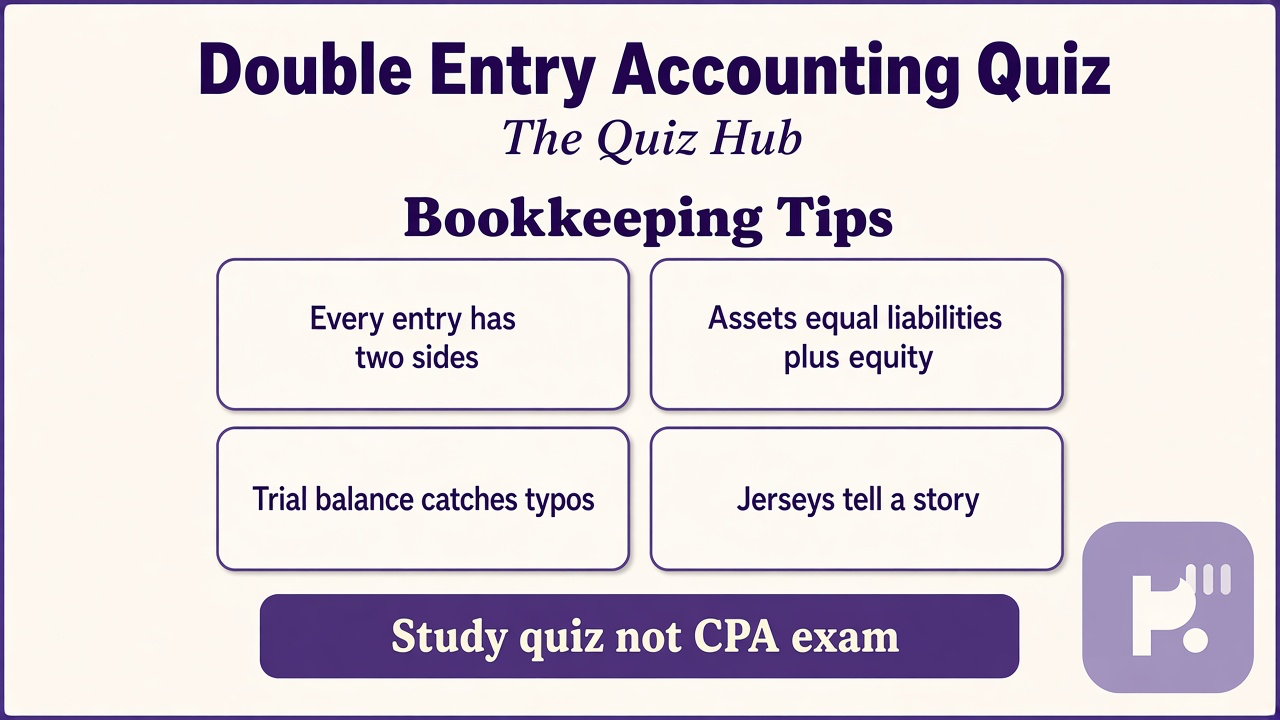
Tips at a glance
A quick takeaway graphic with topic tips (not your personal quiz scores). Start the quiz for your index, bands, and charts.
What this quiz can and cannot tell you
Can tell you
- Clarify double-entry vocabulary in plain language
- Highlight debit-credit and equal-total habits worth checking on homework
- Separate trial balance arithmetic from classification accuracy
- Give you a retake baseline during an intro accounting unit
Cannot tell you
- Prepare you for the CPA exam or other professional licensure
- Replace tax, audit, or instructor-graded problem sets
- Cover every standard, such as all adjusting entries or consolidated statements
- Prove you will never post an unbalanced entry under time pressure
Double-entry literacy beyond debit-credit flashcards
Students search double entry when the first homework set asks for journal entries and the textbook assumes everyone already knows why cash can be credited. Double-entry bookkeeping is a discipline: every transaction changes at least two accounts, and the debit amounts must equal the credit amounts for that entry. The method exists so the accounting equation, Assets = Liabilities + Equity, stays coherent as you record loans, sales, expenses, and owner investments.
Debit and credit are placement words, not moral judgments and not synonyms for deposit and withdrawal. In typical U.S. intro courses, debits increase assets and expenses while credits increase liabilities, equity, and revenue. T-accounts put debits on the left and credits on the right so you can see running balances. Agreeing that any debit must mean money came in is a trap; paying cash for supplies debits expense and credits cash. The story is in the accounts affected, not the English connotations of the labels.
Balancing is where structure meets arithmetic. After posting, a trial balance lists accounts and checks that total debits equal total credits. That catches many posting mistakes early. It does not prove you chose the right revenue account or that no transaction was omitted entirely. Net income from revenues minus expenses flows into equity in the basic model, which is why closing concepts later in the course matter even when the trial balance already looks tidy.
The general journal is the chronological first home for entries: date, accounts, debits, credits, and a short memo. Cash, accounts receivable, and equipment sit with other assets; accounts payable sits with liabilities; owner capital sits with equity; rent and utilities sit with expenses. A credit purchase of equipment increases equipment and accounts payable together; skipping the credit side breaks double-entry on purpose in reverse items so the screener can catch one-sided habits.
Use this screener as a warm-up, not a verdict. Pair it with your textbook's first journal set and our domain and range quiz when you want a different kind of structured literacy break. Browse the IQ and cognitive test hub for more low-stakes study games. Retake after you mark debit and credit totals on every homework entry; literacy grows when equal totals become automatic, not when you memorize that assets start with a and hope the rest follows on test day.
| Test | Focus |
|---|---|
| Domain and range quiz | Algebra function inputs and outputs, not ledger debits or credits |
| Dividing fractions quiz | Fraction division recall, not bookkeeping or journal entries |
Double Entry Accounting Quiz FAQ
What does this quiz measure?
It measures how much you agree with introductory double-entry literacy across two-sided entries, debits and credits, balancing, and journal habits. You get an index from 0 to 100 and four bars. It reflects self-reported habits on this screener, not a course grade or CPA readiness.
Is this CPA exam preparation?
No. It builds bookkeeping vocabulary and balancing habits for study practice. CPA candidates need formal review courses, ethics requirements, and board exams beyond this screener.
Why do some statements sound like common mistakes?
Reverse-worded traps catch shortcuts. Agreeing that bank statements replace ledgers, that debits always mean cash in, or that a balanced trial balance proves perfect classification should not inflate your literacy index.
Does this cover adjusting entries and financial statement analysis?
This screener stays at intro literacy: journal entries, normal balances, the accounting equation, and trial balance purpose. Adjusting entries, depreciation methods, and ratio analysis belong in later chapters and courses.
Who reviewed this quiz?
Dr. James Whitfield, PhD reviewed the educational framing, bookkeeping limits, and result explanations. See our editorial policy for review standards.
Reviewed by