What Dog Quiz Questions measures
This quiz does not certify you as a dog trainer or grade your dog. It measures how much you agree with beginner-friendly dog trivia grouped four ways: body language about tails, ears, and stress signals; walk safety about leashes, heat, and passing dogs; socialization about calm exposures and consent; and positive training about rewards, timing, and patience instead of intimidation. You answer 22 statements from strongly disagree to strongly agree, with reverse-worded myths so one lucky guess cannot inflate every bar. Your answers also feed a second chart on closeness and trust habits, because pet worry sometimes pushes people toward quick internet certainty. The total becomes an index from 0 to 100 where higher means more reported trivia literacy on this screener, not proof you should skip a trainer when behavior feels unsafe.
Body language
Tail wags, calming signals, relaxed versus tense posture, and growling as information.
Walk safety
Leashes, pavement heat, water breaks, recall planning, and polite passing.
Socialization
Puppy and adult exposures, dog-park limits, and reading meet-greet body language.
Positive training
Reward timing, short sessions, and skipping dominance myths for skill-building.
How it works
Answer 22 agreement items
Rate each statement from Strongly disagree to Strongly agree. Tap Next after each answer.
Answers sort into four domains
Each answer feeds one of four trivia groups, and every item also feeds a closeness and trust layer.
See your index and charts
You get a 0 to 100 index, a band, and two bar charts you can use to pick what to study next.
Take the Dog Quiz Questions
Answer 22 short statements to see your general dog trivia index, four domain bars, and a closeness and trust chart.
What your result means
Your index is the average of all 22 answers, scaled from 0 to 100, with reverse-worded items flipped first. Higher means more reported trivia literacy on this screener. Read positive training and body language bars together before you treat the total as expertise.
| Band | Index range | Typical reading |
|---|---|---|
| Building dog trivia literacy | 0 to 35 | Fewer agreed facts on body language, walks, socialization, or training mindset on this screener. |
| Mixed dog trivia literacy | 36 to 65 | Solid facts in some domains with myths or overconfidence in others. |
| Strong dog trivia literacy | 66 to 100 | Frequent agreement with accurate trivia and healthy learning limits. |
Tips at a glance
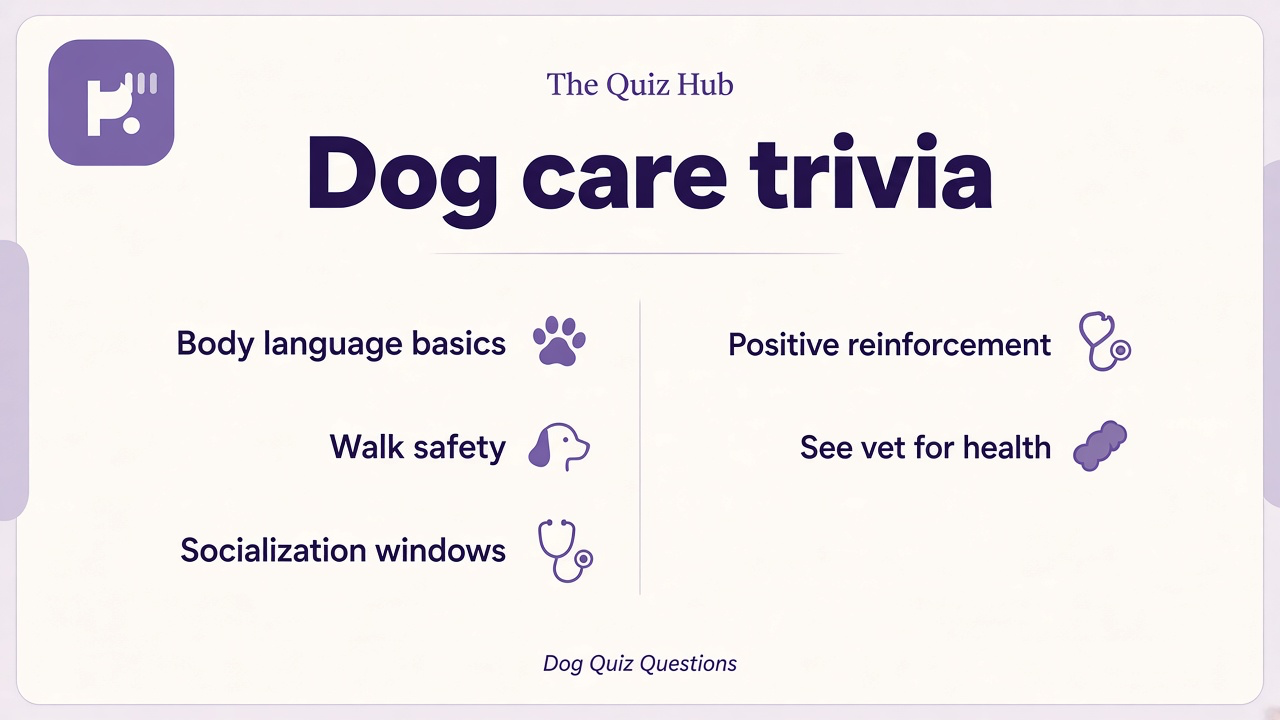
A quick takeaway graphic with topic tips (not your personal quiz scores). Start the quiz for your index, bands, and charts.
What this quiz can and cannot tell you
Can tell you
- Highlight body language and walk facts worth revisiting
- Separate socialization myths from everyday meet-greet choices
- Encourage study-and-retake habits without shame
- Spark better conversations with trainers and veterinarians
Cannot tell you
- Certify you for professional dog training or behavior cases
- Replace hands-on help for aggression, bites, or panic
- Diagnose illness from posture or a single walk incident
- Prove your dog is safe off leash when recall is untested
Why general dog trivia helps owners stay curious
People open a dog quiz for the same reason they watch slow-motion tail videos: they want language for what they already see on walks. Dogs speak with ears, weight shifts, and micro-pauses long before they growl. A loose wag is not a universal green light; a stiff tail can still mean keep your distance. Learning those labels does not make you a behaviorist; it makes you a safer neighbor on the sidewalk and a calmer reader of training blogs.
Walk safety grounds the silly memes. Leashes are not shame tools; they are steering wheels near traffic and surprise bikes. Summer pavement burns pads before you feel it in sandals. Tight-leash frustration between two dogs is a trivia fact and a real fight risk. When quizzes slip in reverse items about off-leash roads or hugging every wagging dog, they are guarding you from the worst of pet social media medicine.
Socialization is where trivia meets empathy. Good exposure pairs novelty with choice and treats, not forced crowds. Dog parks are not universal puppy vaccines for manners. Adult dogs can still learn, just often slower than a well-planned eight-week-old week. Reading stiff bodies and offering space is social literacy, not spoiling your dog.
Positive training is the fourth domain on purpose. Rewards timed close to the behavior you want beat delayed scolding for most pet skills. Short sessions beat one angry hour. Dominance myths still clog comment sections; agreeing with them should not inflate your literacy index. Pair this quiz with our dog anatomy quiz when you want skeleton and organ trivia instead of walk habits, or browse fun and novelty tests for more low-stakes pet games. When worry turns clinical, use the does my dog have anxiety quiz for reflection, still not a substitute for a hands-on plan.
Save your lowest bar as a single study topic this week. Name one calming signal, one walk rule, and one reward timing tip. Retake, and notice which myths no longer trick you. Trivia literacy is a leash you hold on knowledge, not a license to delay help when your gut says something is wrong.
| Test | Focus |
|---|---|
| Dog anatomy quiz | Skeleton and organ trivia, not walk safety or training timing |
| Does my dog have anxiety quiz | Fear and panic patterns when symptoms worry you, not general trivia labels |
Dog Quiz Questions FAQ
What does this quiz measure?
It measures how much you agree with beginner general dog trivia across body language, walk safety, socialization, and positive training. You get an index from 0 to 100 and four bars. It reflects self-reported knowledge on this screener, not a professional certification exam.
Is this quiz enough to fix aggression or fear?
No. It is fun trivia and care literacy. Bites, sustained panic, or shutdown on walks need a certified trainer, behavior consultant, or veterinarian, not a high score here.
Why are some statements worded as myths?
Reverse-worded myths catch overconfidence. Agreeing that every wag invites hugs, that dog parks suit every puppy, or that dominance explains all misbehavior should not inflate your literacy index.
I got a low score. Should I feel bad?
No. The index shows gaps to study, not your value as an owner. Retake after a short lesson from a reputable trainer resource and treat wrong answers as normal.
Who reviewed this quiz?
Dr. Rachel Kim, PhD reviewed the fun-only framing, force-free training notes, and limits on DIY behavior plans. See our editorial policy for review standards.
Reviewed by