What the Dog Anatomy Quiz measures
This quiz does not X-ray your dog or grade you for vet school. It measures how much you agree with beginner-friendly anatomy trivia grouped four ways: skeleton knowledge about bones, joints, and gait; organ basics about heart, gut, cooling, and senses; breed body differences about skull shape, chest depth, and proportions; and learning mindset about studying, retakes, and leaving diagnosis to clinicians. You answer 22 statements from strongly disagree to strongly agree, with reverse-worded myths so one lucky guess cannot inflate every bar. Your answers also feed a second chart on closeness and trust habits, because pet worry sometimes pushes people toward quick internet certainty. The total becomes an index from 0 to 100 where higher means more reported anatomy literacy on this screener, not proof you should skip the vet when something hurts.
Skeleton knowledge
Bones, spine regions, paws, and how the skeleton supports movement.
Organ basics
Heart, stomach, cooling, liver-kidney limits, and nose-led scent anatomy.
Breed body differences
How muzzle length, chest shape, and size change outside appearance and risk context.
Learning mindset
Curiosity, retakes, vet respect, and refusing photo-based diagnosis fantasies.
How it works
Answer 22 agreement items
Rate each statement from Strongly disagree to Strongly agree. Tap Next after each answer.
Answers sort into four domains
Each answer feeds one of four anatomy groups, and every item also feeds a closeness and trust layer.
See your index and charts
You get a 0 to 100 index, a band, and two bar charts you can use to pick what to study next.
Take the Dog Anatomy Quiz
Answer 22 short statements to see your canine anatomy literacy index, four domain bars, and a closeness and trust chart.
What your result means
Your index is the average of all 22 answers, scaled from 0 to 100, with reverse-worded items flipped first. Higher means more reported anatomy literacy on this screener. Read learning mindset and organ basics bars together before you treat the total as expertise.
| Band | Index range | Typical reading |
|---|---|---|
| Building anatomy literacy | 0 to 35 | Fewer agreed facts on skeleton, organs, breeds, or study mindset on this screener. |
| Mixed anatomy literacy | 36 to 65 | Solid facts in some domains with myths or overconfidence in others. |
| Strong anatomy literacy | 66 to 100 | Frequent agreement with accurate trivia and healthy learning limits. |
Tips at a glance
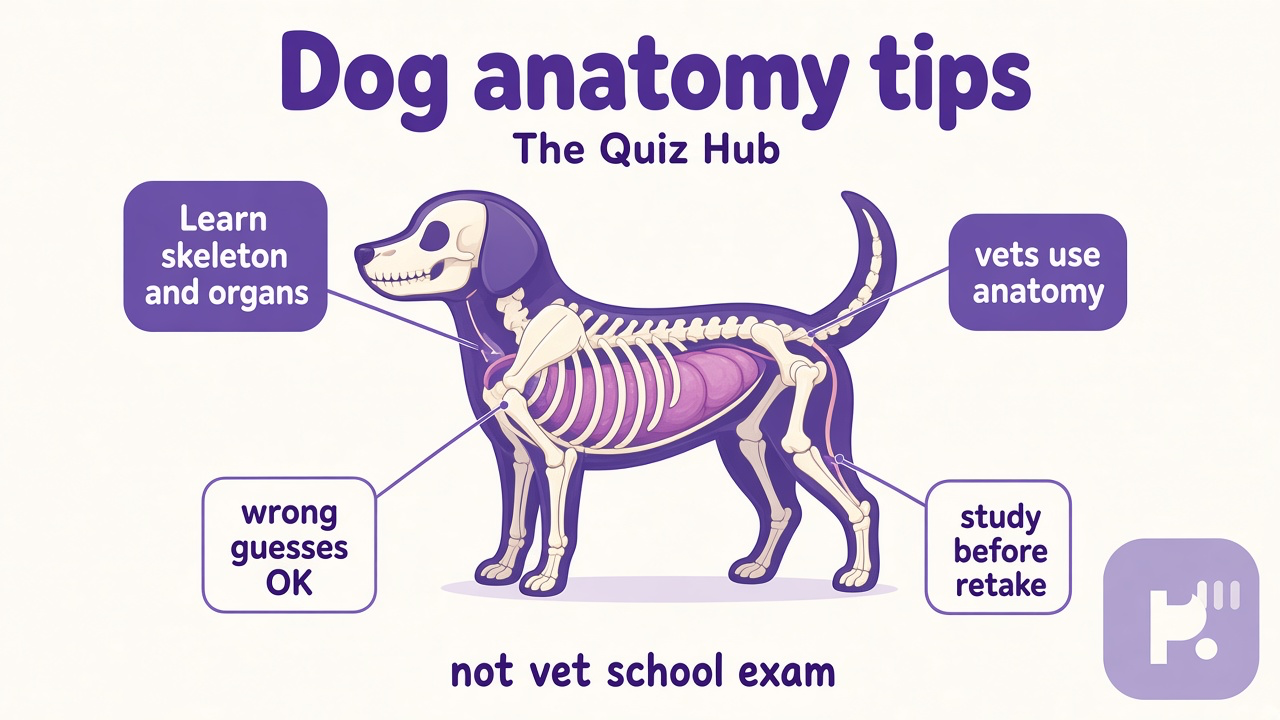
A quick takeaway graphic with topic tips (not your personal quiz scores). Start the quiz for your index, bands, and charts.
What this quiz can and cannot tell you
Can tell you
- Highlight skeleton and organ facts worth revisiting
- Separate breed-shape trivia from everyday care questions
- Encourage study-and-retake habits without shame
- Spark better conversations with your veterinarian
Cannot tell you
- Diagnose illness from posture or photos
- Replace hands-on veterinary exams or imaging
- Certify you for clinical procedures or dosing
- Prove your dog is healthy when symptoms are present
Why dog anatomy trivia helps owners stay curious
People open a dog anatomy quiz for the same reason they open a breed poster: they want language for what they already love looking at. Dogs are digitigrade walkers, which means the foot you see on the ground is not a flat human-style sole. Spine regions have names that sound clinical until you map them on a wagging tail. Learning those labels does not make you a surgeon; it makes you a faster reader of vet blogs and a calmer guest in the exam room.
Organ basics ground the silly memes. Dogs pant because skin sweat glands are limited compared with ours. Hearts still have four chambers. Stomach and intestines do real work you cannot judge from a cute sit photo. Noses house scent tissue that turns walks into novels. When quizzes slip in reverse items about diagnosing kidney failure from posture alone, they are guarding you from the worst of pet TikTok medicine.
Breed body differences are where trivia meets empathy. Brachycephalic skulls change airflow anatomy. Deep chests shift conversation about certain emergencies veterinarians monitor. Long backs carry different spinal load than square builds. None of that is an insult to your dog's beauty; it is context for exercise, heat, and when to call for help. Giant puppies and toy puppies share organ names but not growth timelines.
Learning mindset is the fourth domain on purpose. Wrong guesses are data. Retakes are allowed. Veterinarians train on cadaver labs, imaging, and supervised clinics while you train on flashcards and fetch breaks. Pair this quiz with our does my dog love me quiz when you want bond behaviors instead of bone names, or browse fun and novelty tests for more low-stakes pet games. When symptoms are scary, use the does my dog have anxiety quiz for reflection, still not a substitute for a hands-on exam.
Save your lowest bar as a single study topic this week. Label one diagram, retake, and notice which myths no longer trick you. Anatomy literacy is a leash you hold on knowledge, not a license to delay care when your gut says something is wrong.
| Test | Focus |
|---|---|
| Does my dog love me quiz | Bond and affection behaviors, not bone and organ trivia |
| Does my dog have anxiety quiz | Fear and panic patterns when symptoms worry you, not anatomy labels |
Dog Anatomy Quiz FAQ
What does this quiz measure?
It measures how much you agree with beginner dog anatomy trivia across skeleton, organs, breed shapes, and learning mindset. You get an index from 0 to 100 and four bars. It reflects self-reported knowledge on this screener, not a clinical skills exam.
Is this quiz enough to diagnose my dog?
No. It is fun trivia and care literacy. Pain, breathing trouble, repeated vomiting, or collapse need a veterinarian, not a high score here.
Why are some statements worded as myths?
Reverse-worded myths catch overconfidence. Agreeing that rib count alone separates dogs from humans, or that photos diagnose organ failure, should not inflate your literacy index.
I got a low score. Should I feel bad?
No. The index shows gaps to study, not your value as an owner. Retake after a diagram or short lesson and treat wrong answers as normal.
Who reviewed this quiz?
Dr. Rachel Kim, PhD reviewed the fun-only framing, breed-context notes, and limits on DIY diagnosis. See our editorial policy for review standards.
Reviewed by