What the Does My Dog Love Me Quiz measures
This quiz does not scan your dog's heart. It measures how you rate everyday attachment behaviors that trainers and ethologists often discuss: choosing your company, greeting you, inviting play, showing relaxed trust, and exchanging affection like licks or toy gifts. You answer 22 statements from strongly disagree to strongly agree, with reverse-worded items so wishful thinking cannot inflate every line. Your answers also feed a second chart on closeness and trust habits, because humans sometimes read independence as rejection when a dog is simply resting. The total becomes an index from 0 to 100 where higher means more reported bond behaviors on this screener, not proof your dog loves you more than another family member.
Proximity seeking
How much your dog chooses to be near you, lean on you, or stay in your room.
Greeting ritual
How much they celebrate your return, bring a toy, or check your face.
Play and trust
How much they invite play, relax near you, or accept calm handling.
Affection exchange
How much they lick, share soft eye contact, or bring social gifts.
How it works
Answer 22 agreement items
Rate each statement from Strongly disagree to Strongly agree. Tap Next after each answer.
Answers sort into four domains
Each answer feeds one of four bond groups, and every item also feeds a closeness and trust layer.
See your index and charts
You get a 0 to 100 index, a band, and two bar charts you can laugh over or use as a baseline.
Take the Does My Dog Love Me Quiz
Answer 22 short statements to see your canine attachment index, four bond bars, and a closeness and trust chart.
What your result means
Your index is the average of all 22 answers, scaled from 0 to 100, with reverse-worded items flipped first. Higher means more reported bond behaviors. Read play and trust bars together before you interpret the total.
| Band | Index range | Typical reading |
|---|---|---|
| Subtle or distant bond cues | 0 to 35 | Few proximity, greeting, play, or affection rituals toward you. |
| Mixed bond cues | 36 to 65 | Warm moments mixed with aloof or food-driven contact. |
| Strong bond cues | 66 to 100 | Frequent proximity, greetings, play, and affection rituals. |
Tips at a glance
A quick takeaway graphic with topic tips (not your personal quiz scores). Start the quiz for your index, bands, and charts.
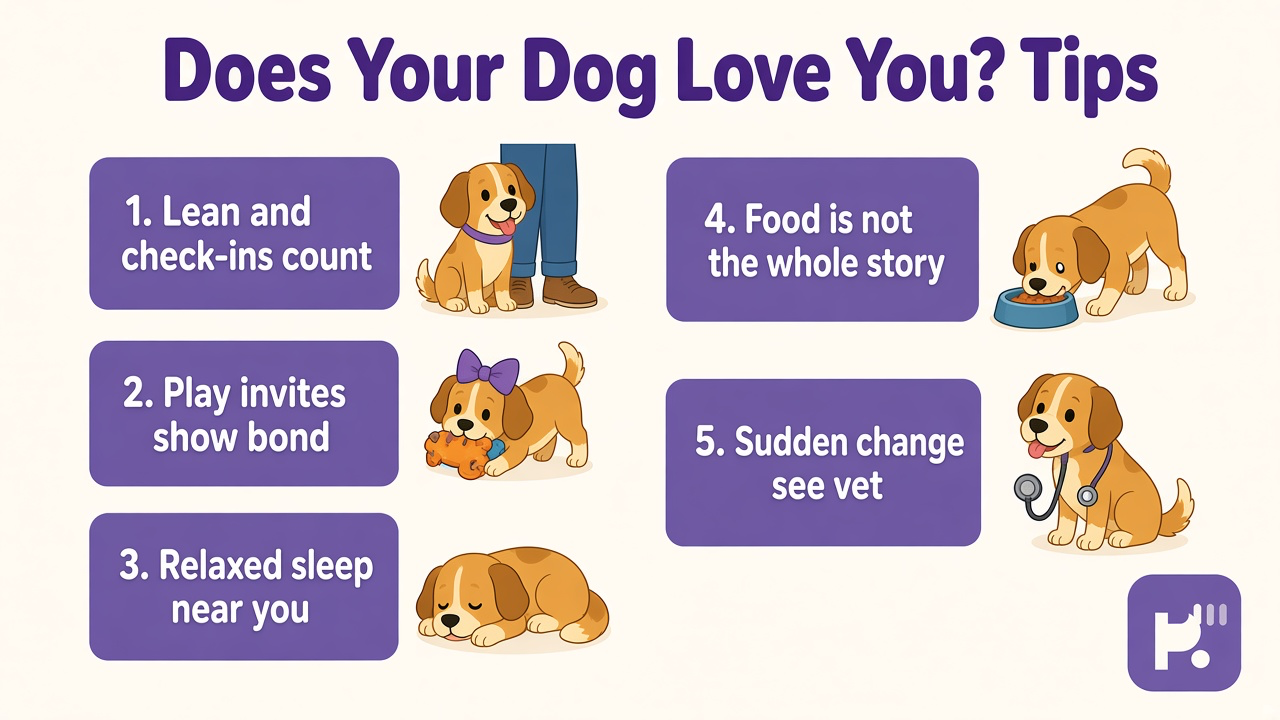
What this quiz can and cannot tell you
Can tell you
- Name behaviors you might be overlooking or misreading
- Separate food-driven contact from trust signals
- Give you a playful baseline to retake after a move or new pet
- Spark better play and rest habits together
Cannot tell you
- Prove love in a scientific or comparative sense
- Rank your dog against other dogs or owners
- Diagnose anxiety, pain, or behavioral disorders
- Replace vet care when behavior changes suddenly
How dogs show love in everyday motion
People land on this quiz with a goofy, tender question. You walk, feed, and throw balls, yet the dog seems obsessed with the mail carrier and only mildly interested in you. Love in dogs is a chain of choices: following you room to room, leaning on your shin during TV time, or bringing a slobbery toy to your lap. Cultural jokes call dogs unconditional; real dogs are social mammals who bond when safety, play, and predictability line up.
Attachment research on dogs shows many form secure bonds with caregivers, though expression varies by breed, history, and age. Proximity matters. A dog who shadows you is not always anxious; they may be keeping contact while staying ready to sniff. Greetings at the door are high-signal because they interrupt nap time for you. Toy carrying without a fetch demand is a social ritual some trainers call a "present."
Trust looks like a loose body: play bows, sprawled sleep, accepting brief handling for nails or ears. Affection exchange includes licks, soft eye contact, and object sharing. Reverse items flag food-only interest so a hungry stare does not fake a whole romance. Sudden clinginess or new avoidance can mean pain, nausea, or stress; affection scores are not a substitute for a vet exam.
If your score is low, try play first, petting second. Short chase games build partnership without grabbing. End touch before stiffness shows. Offer a comfy bed near you so closeness is optional. If your score is high, enjoy it and still watch for change. Our does my cat love me quiz is a sibling species lens. The does my dog have anxiety quiz fits better if panic on departures dominates, not everyday warmth.
Retake after you change one habit, such as a daily five-minute play ritual. Compare bars, not vanity. Your dog may never become a lap dog and still be bonded. Love here means they keep choosing you in a world full of interesting smells.
| Test | Focus |
|---|---|
| Does my cat love me quiz | Feline bond behaviors, not your dog's greeting style |
| Does my dog have anxiety quiz | Fear and panic triggers, not everyday affection rituals |
Does My Dog Love Me Quiz FAQ
What does this quiz measure?
It measures how you rate your dog's attachment behaviors across proximity, greetings, play, trust, and affection rituals. You get an index from 0 to 100 and four bars. It reflects your observations, not a lab test on your dog.
My dog only cuddles when I have treats. Does that count?
Treat-motivated contact is real contact, but reverse items help separate food drive from broader bond signs. Note which domain bars stay high without snacks.
Does a low score mean my dog hates me?
No. It means you reported fewer classic bond behaviors on this screener. Some dogs are independent or still adjusting. Behavior change plus illness signs need a vet, not shame.
Why are some items worded negatively?
Reverse-worded statements help balance optimism. Agreeing that your dog ignores you unless food is involved should not inflate a love score.
Who reviewed this quiz?
Dr. Rachel Kim, PhD reviewed the framing, the fun-only limits, and the result explanations. See our editorial policy for review standards.
Reviewed by