What the Does My Mom Love Me Quiz measures
This quiz does not diagnose your mother or decide whether your family is healthy. It measures how often you have noticed love-related behaviors grouped four ways: acts of care like food and rides, warm words like pride and I love you, emotional presence when she listens and shows up, and cold distance cues like silence, snaps, or fear at home. You answer 22 how-often statements about the past month, with reverse-worded items so one good weekend cannot erase a scary pattern. Your answers also feed a second chart on closeness and trust habits, because family distance sometimes overlaps with difficulty asking for help elsewhere. The total becomes an index from 0 to 100 where higher means more reported love signals on this screener, not proof she loves you perfectly or that abuse is okay if meals appear. Fear, threats, and violence need trusted adults and resources, not reinterpretation as style.
Acts of care
How often she helps with food, rides, money, or practical support.
Warm words
How often she says love, pride, or kindness without cruel comparisons.
Emotional presence
How often she listens, attends your events, and checks in with you.
Cold distance
How often silence, yelling, eggshells, or threats leave you hurting or afraid.
How it works
Answer 22 frequency items
Rate each statement from Never to Very often for the past month. Tap Next after each answer.
Answers sort into four domains
Each answer feeds one of four love pattern groups, and every item also feeds a closeness and trust layer.
See your index and charts
You get a 0 to 100 index, a band, and two bar charts you can share with a counselor if you choose.
Take the Does My Mom Love Me Quiz
Answer 22 short statements to see your parent love index, four pattern bars, and a closeness and trust chart.
What your result means
Your index is the average of all 22 answers, scaled from 0 to 100, with reverse-worded items flipped first. Higher means more reported love signals. Read cold distance alongside acts of care before you interpret the total.
| Band | Index range | Typical reading |
|---|---|---|
| Few love signals | 0 to 35 | Few acts, words, or presence; cold distance may be elevated. |
| Mixed love signals | 36 to 65 | Care or warmth some days; cold or fear other days. |
| Several love signals | 66 to 100 | Steady care, words, or presence; cold distance mostly lower. |
Tips at a glance
A quick takeaway graphic with topic tips (not your personal quiz scores). Start the quiz for your index, bands, and charts.
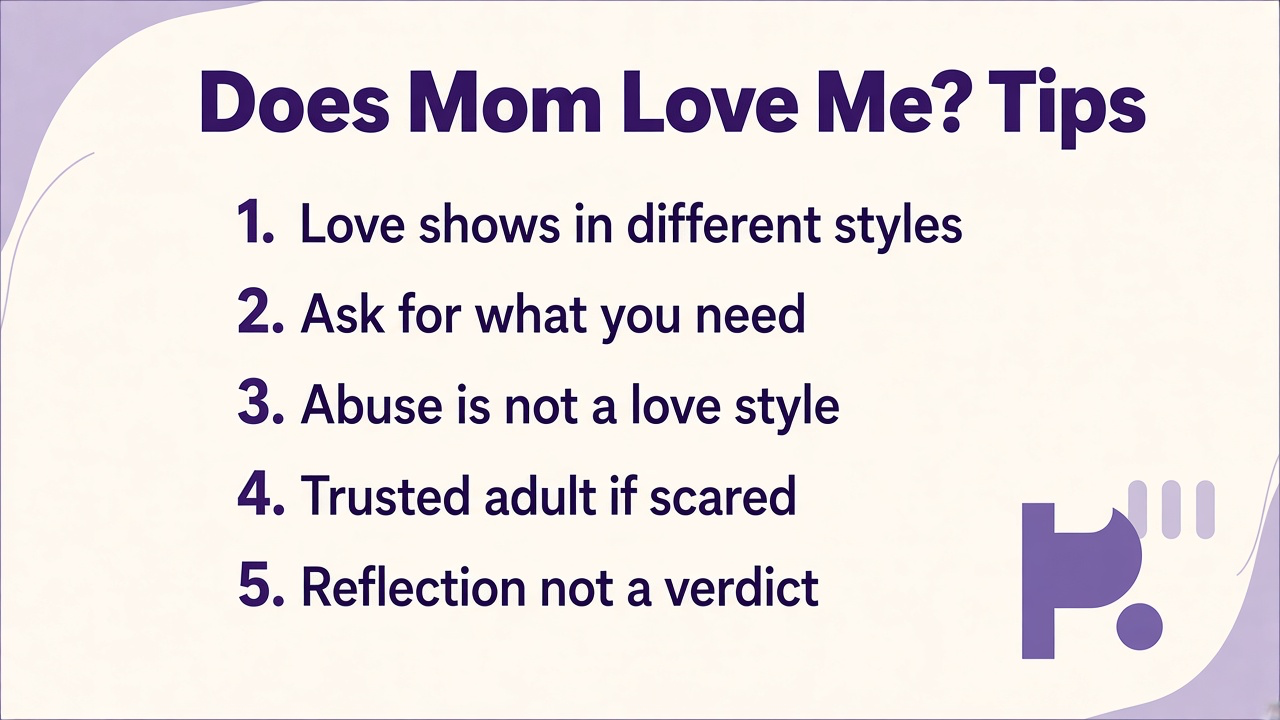
What this quiz can and cannot tell you
Can tell you
- Separate acts of care from words you still crave
- Give you language for a counselor or trusted adult conversation
- Highlight when fear matters more than love style debate
- Track whether patterns shift after a known stressor passes
Cannot tell you
- Prove whether your mom loves you or label her abusive
- Replace therapy, mediation, or child protective services
- Excuse violence as cultural love style
- Force your parent to change without their participation
How moms show love when words run short
Kids and teens search does my mom love me when affection arrives as packed lunches but never hugs, or when warmth follows criticism so fast you feel dizzy. Love and showing love are not always the same skill. This quiz separates acts of care, warm words, emotional presence, and cold distance so you can see which bar is empty, not only whether one fight felt fatal.
Dr. Priya Sharma reviews family reflection tools with a safety-first lens. Some mothers express love through logistics learned from their own childhood. That can be real care and still leave you hungry for words. You are allowed to want both. Asking for what you need in plain language is fair when home is emotionally safe enough to try.
Cold distance is its own bar for a reason. Silent treatment, scary yelling, and walking on eggshells hurt even when groceries still appear. Abuse is not a love style. Cultural pressure sometimes tells children to reinterpret fear as discipline. If you dread going home, tell a school counselor or relative outside the house. Warm moments do not cancel danger.
Comparing siblings is a trap search engines love. Fairness is not identical treatment; it is whether each kid gets dignity. If you are the only one who gets searched backpacks or screamed at for grades, say so to someone outside the family. Our does my dad hate me quiz uses a parallel distance frame when the other parent feels harder to read.
Retake after a known change like therapy, a new job, or a family agreement month. Progress might look like shorter yelling, not instant hugs. If cold distance stays high while fear spikes, let that data override guilt. Support exists even when family repair is slow or impossible.
| Test | Focus |
|---|---|
| Does my dad hate me quiz | Parent distance and fear framing when dad is the focus |
| Does my husband love me anymore quiz | Spousal bond signals, not parent-child dynamics |
Does My Mom Love Me Quiz FAQ
What does this quiz measure?
It measures how often you notice acts of care, warm words, emotional presence, and cold distance at home over the past month. You get an index from 0 to 100 and four bars. It describes your experience, not your mom's secret heart.
Does a low score mean my mom does not love me?
It means you reported fewer love signals on this screener lately. She may show love in ways you did not score, or she may be distant because of stress. Fear or threats deserve adult help regardless of the score.
Can she love me and still scare me sometimes?
People can behave badly and still care in broken ways, but fear is never something you must accept as style. Tell a trusted adult if home feels unsafe.
What if she shows love only through money or food?
Acts of care count on this quiz. If you still need words or time, you can ask for that too when it is safe to talk.
Who reviewed this quiz?
Dr. Priya Sharma, PhD reviewed the family reflection limits, the abuse-is-not-style note, and the result explanations. See our editorial policy for review standards.
Reviewed by