What the Does My Husband Love Me Anymore Quiz measures
This quiz does not read his mind or decide whether you should stay married. It measures how often you have noticed behaviors spouses commonly cite when they wonder if love is still active, grouped four ways: everyday affection habits, repair after conflict instead of silent cold wars, language and actions that point toward a shared future, and distance signals such as withdrawal or canceled quality time versus healthy space that returns with warmth. You answer 22 how-often statements about the past month, with reverse-worded items so one good weekend cannot hide a month of loneliness. Your answers also feed a second chart on closeness and trust habits, because fear of abandonment and fear of intimacy can both make distance feel louder than it is. The total becomes an index from 0 to 100 where higher means more reported positive bond signals on this screener, not a guarantee he will never leave or that you must stay. If control, threats, or violence appear in your marriage, this tool is not enough. Reach for professional or community support first.
Affection habits
How often daily warmth, touch, and kind words match what you used to rely on.
Repair after conflict
How often he apologizes, checks in, and resets after tension.
Shared future
How often he includes you in plans, decisions, and "we" language beyond this week.
Distance versus space
How often withdrawal or irritability leaves you feeling shut out versus healthy alone time.
How it works
Answer 22 frequency items
Rate each statement from Never to Very often for the past month. Tap Next after each answer.
Answers sort into four domains
Each answer feeds one of four bond groups, and every item also feeds a closeness and trust layer.
See your index and charts
You get a 0 to 100 index, a band, and two bar charts you can compare over time if you retake.
Take the Does My Husband Love Me Anymore Quiz
Answer 22 short statements to see your marital bond index, four relationship bars, and a closeness and trust chart.
What your result means
Your index is the average of all 22 answers, scaled from 0 to 100, with reverse-worded items flipped first. Higher means more reported positive bond signals. Read distance versus space alongside affection habits before you decide what the total means.
| Band | Index range | Typical reading |
|---|---|---|
| Few active bond signs | 0 to 35 | Low affection, repair, or future talk; distance signals elevated. |
| Mixed bond signs | 36 to 65 | Warm days mixed with withdrawal or future avoidance. |
| Several active bond signs | 66 to 100 | Steady affection and repair; distance mostly low or explained. |
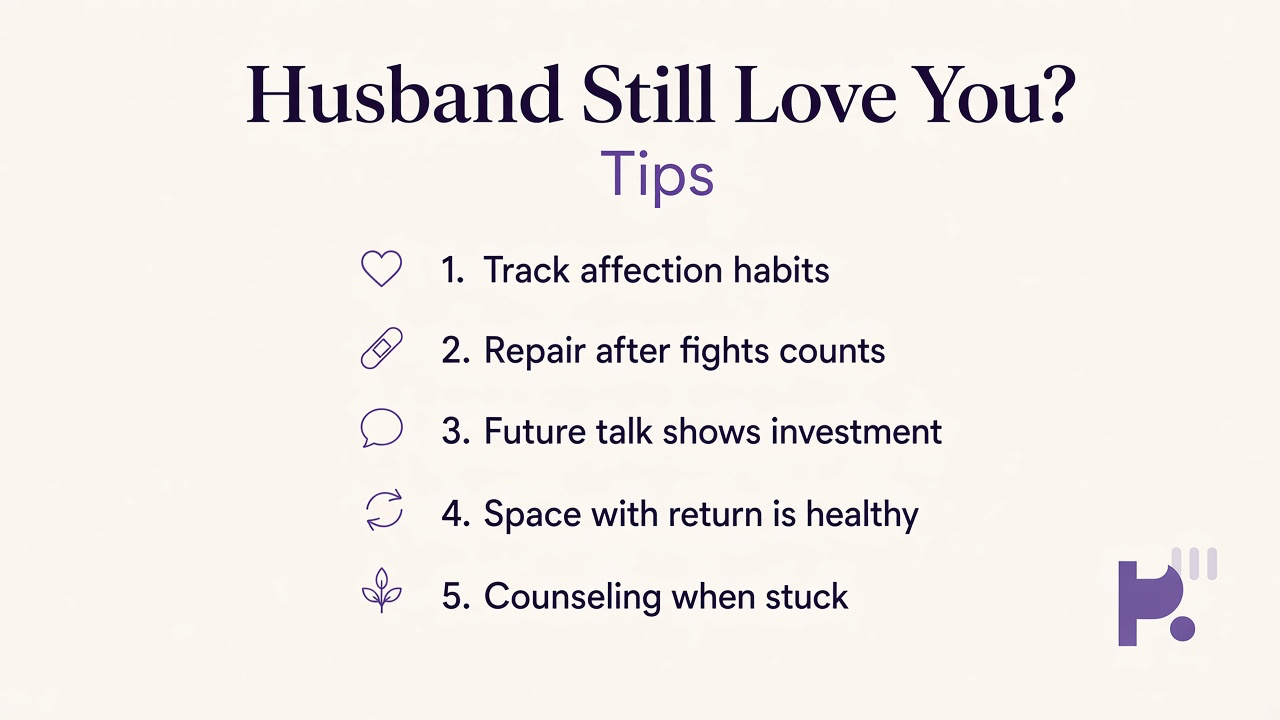
Tips at a glance
A quick takeaway graphic with topic tips (not your personal quiz scores). Start the quiz for your index, bands, and charts.
What this quiz can and cannot tell you
Can tell you
- Organize lonely mixed feelings into four clear domains
- Give you language for a needs-based conversation
- Highlight when counseling might help more than silent waiting
- Offer a baseline to retake after you try one repair ritual
Cannot tell you
- Prove whether he still loves you or predict divorce
- Replace couples therapy, medical advice, or safety planning
- Detect abuse or coercion on its own
- Tell you whether you should stay or leave
When marriage feels distant: love, space, and repair
"Does my husband love me anymore?" often arrives after a season of shorter texts, fewer kisses, or plans that stop at next Tuesday. Love rarely disappears in one dramatic scene; it often thins through busy jobs, new parenthood, grief, or conflict that never quite gets repaired. This quiz separates affection habits, repair after conflict, shared future talk, and distance versus healthy space so you can see whether the gap is about touch, recovery, planning, or withdrawal.
Healthy space includes explanation and return. A husband who needs an evening alone to decompress can still love you; a husband who punishes you with days of silence may feel like abandonment. Reverse-worded items help balance memory, but your gut sense of safety still matters more than any index. If you walk on eggshells, that is not a low score problem; that is a support problem.
Repair after conflict is where many marriages quietly lose love. Apologies, check-ins, and small resets teach the nervous system that rupture is not permanent. Shared future talk shows up in booking holidays together, saying "we" about finances, and getting excited about your promotion. When future talk vanishes but logistics stay efficient, many spouses feel married to a roommate.
If your score is low, schedule a conversation before you schedule a lawyer. Name one behavior you miss and one you can offer. If repair repeats and fails, couples counseling is a tool, not an admission of defeat. Our does he still love me quiz uses a partner-neutral lens when you want parallel wording. The does my husband respect me quiz separates respect from warmth when contempt is the louder fear.
High warmth never excuses control. Monitoring, jealousy traps, or violence mean you deserve help beyond this page. Retake after a month of intentional connection and compare bars instead of treating one argument as prophecy.
| Test | Focus |
|---|---|
| Does he still love me quiz | Partner-neutral bond signals after emotional distance |
| Does my husband respect me quiz | Respect, boundaries, and contempt cues, not affection alone |
Does My Husband Love Me Anymore Quiz FAQ
What does this quiz measure?
It measures how often you have noticed bond-related behaviors in the past month across affection, repair, future talk, and distance signals. You get an index from 0 to 100 and four bars. It reflects your observations, not his secret intentions.
Does a low score mean he does not love me anymore?
Not automatically. It means you reported fewer positive signals lately. Stress, depression, or unresolved conflict can cause that. Use the result to start a specific conversation, or seek support if you feel unsafe.
How is this different from the does he still love me quiz?
The still love quiz uses partner-neutral wording. This version names husband and marriage context for searchers who want that frame, with similar domains and limits.
Can we be fine if distance signals scored high?
High distance signals deserve attention. Occasional withdrawal happens; repeated coldness without repair often erodes trust. Compare that bar with affection habits and what happens after conflict.
Who reviewed this quiz?
Dr. Priya Sharma, PhD reviewed the relationship framing, safety notes, and result explanations. See our editorial policy for review standards.
Reviewed by