What the Does My Dad Hate Me Quiz measures
This quiz does not diagnose your father or decide whether your family is broken. It measures how often you have noticed patterns that teens describe when they wonder if a parent hates them, grouped four ways: cold tone and sharp words, warmth glimmers that still appear, availability gaps when he is home but not emotionally present, and fear cues like walking on eggshells. You answer 22 how-often statements about the past month, with reverse-worded warmth items so one good weekend cannot erase a scary pattern. Your answers also feed a second chart on closeness and trust habits, because family distance sometimes overlaps with difficulty asking for help elsewhere. The total becomes an index from 0 to 100 where higher means more reported emotional distance or fear on this screener, not proof that he hates you as a person or that you failed as a kid.
Cold tone
How often he sounds irritated, dismissive, or insulting in daily talk.
Warmth glimmers
How often care still shows up through help, pride, or awkward affection.
Availability gap
How often he is physically present yet emotionally absent or unreliable.
Fear at home
How often you brace for yelling, threats, or relief when he leaves.
How it works
Answer 22 frequency items
Rate each statement from Never to Very often for the past month. Tap Next after each answer.
Answers sort into four domains
Each answer feeds one of four family pattern groups, and every item also feeds a closeness and trust layer.
See your index and charts
You get a 0 to 100 index, a band, and two bar charts you can share with a counselor if you choose.
Take the Does My Dad Hate Me Quiz
Answer 22 short statements to see your parent distance index, four pattern bars, and a closeness and trust chart.
What your result means
Your index is the average of all 22 answers, scaled from 0 to 100, with reverse-worded items flipped first. Higher means more reported distance or fear. Read warmth glimmers and fear-at-home bars before the total.
| Band | Index range | Typical reading |
|---|---|---|
| Lower reported distance | 0 to 35 | More warmth glimmers than cold or fearful patterns. |
| Mixed distance and hurt | 36 to 65 | Hot-and-cold parenting that leaves you confused. |
| Higher distance or fear | 66 to 100 | Frequent coldness or fear cues; prioritize safety and trusted adults. |
Tips at a glance
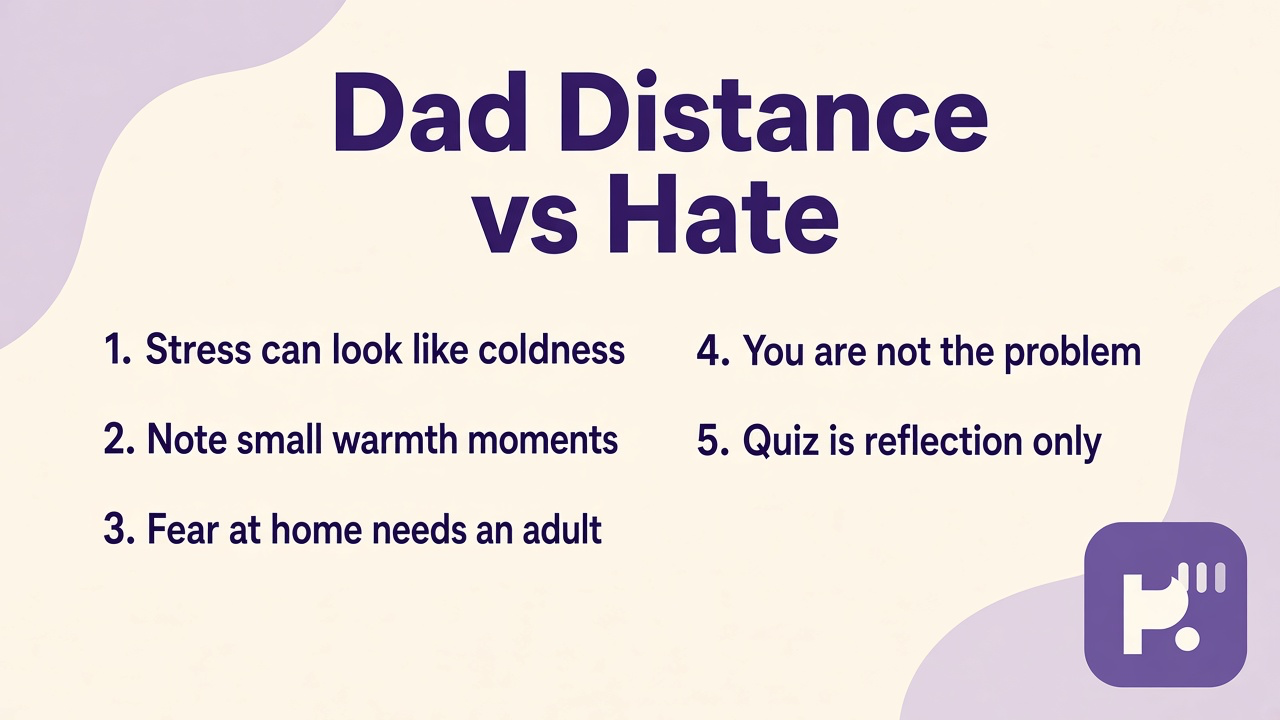
A quick takeaway graphic with topic tips (not your personal quiz scores). Start the quiz for your index, bands, and charts.
What this quiz can and cannot tell you
Can tell you
- Sort cold tone from absence from outright fear cues
- Give you language for a counselor or trusted adult conversation
- Highlight when safety planning matters more than family debate
- Track whether patterns shift after a known stressor passes
Cannot tell you
- Prove whether your dad hates you or label him abusive
- Replace therapy, mediation, or child protective services
- Account for every cultural difference in how fathers show love
- Force your parent to change without their participation
When dads feel distant: hate, stress, and what helps
Teens search does my dad hate me during fights that last ten minutes and during years of slow silence. Both hurt. Internet listicles rarely distinguish a stressed parent from a frightening one, and they almost never say that confusion is normal when love and criticism come from the same person. This quiz separates cold tone, warmth glimmers, availability gaps, and fear at home so you can see which bar drives your sleepless nights.
Dr. Priya Sharma reviews family reflection tools with a safety-first lens. Distance often tracks work pressure, depression, divorce tension, or generational habits that never included emotional vocabulary. A dad who fixes your car but never says proud may feel hateful when you needed words. That gap is real pain and it is not always the same as danger.
Warmth glimmers matter statistically and emotionally. If help still shows up sometimes, you are allowed to hold both truths: he can care and still harm you with words. If warmth is gone and fear is high, prioritize adults who can help you plan next steps. School counselors hear this weekly. You are not dramatic for wanting calm at home.
Comparing siblings is a trap search engines love. Fairness is not identical treatment; it is whether each kid gets dignity. If you are the only one who gets searched backpacks or screamed at for grades, say so to someone outside the house. Our does my mom love me quiz uses a parallel frame if the other parent feels safer to rate.
Retake after a known change like a new job, sobriety stretch, or family therapy month. Progress might look like shorter yelling, not instant hugs. If retakes stay high on fear at home, let that data override guilt. You did not cause adult choices. Support exists even when family repair is slow or impossible.
| Test | Focus |
|---|---|
| Does my mom love me quiz | Parallel parent bond reflection when the other parent is the focus |
| Does he still love me quiz | Partner distance signals, not parent-child dynamics |
Does My Dad Hate Me Quiz FAQ
What does this quiz measure?
It measures how often you notice cold tone, warmth glimmers, emotional absence, and fear cues at home over the past month. You get an index from 0 to 100 and four bars. It describes your experience, not your dad's secret thoughts.
Does a high score mean my dad hates me?
It means you reported frequent distance or fear patterns on this screener. Many parents sound hateful when they are stressed or emotionally limited. Fear or threats deserve adult help regardless of the label hate.
What if he is nice sometimes?
That is why warmth glimmers is its own bar. Mixed patterns are common. Note whether fear spikes around specific triggers like drinking or grades.
Should I show him my results?
Only if you feel safe. Many teens share snapshots with counselors first. If confrontation could escalate risk, skip showing him and focus on support.
Who reviewed this quiz?
Dr. Priya Sharma reviewed the family reflection limits, the teen safety notes, and the crisis guidance. See our editorial policy for review standards.
Reviewed by