What the Does My Friend Like Me Quiz measures
This quiz does not eavesdrop on their group chat or predict a perfect rom-com ending. It measures how often you have noticed behaviors people often read as romantic interest from a friend: seeking solo time, flirtation cues, jealousy when you date, and contrast cues that look plainly platonic. You answer 22 how-often statements about the past few weeks, with reverse-worded items so one friendly hug cannot hide a month of group-only hangouts. Your answers also feed a second chart on closeness and trust habits, because fear of rejection can make friendly warmth feel like a secret crush. The total becomes an index from 0 to 100 where higher means more reported romantic-interest signals on this screener, not permission to kiss them without words. Consent still requires a real conversation.
One-on-one priority
How often they chose solo hangouts or date-like plans with you.
Flirtation cues
How often compliments, jokes, or touch felt romantic rather than buddy-like.
Jealousy of dates
How often your dating life seemed to change their mood or questions.
Platonic signals
How often they treated you like one friend among many with clear boundaries.
How it works
Answer 22 frequency items
Rate each statement from Never to Very often for the past few weeks. Tap Next after each answer.
Answers sort into four domains
Each answer feeds one of four signal groups, and every item also feeds a closeness and trust layer.
See your index and charts
You get a 0 to 100 index, a band, and two bar charts you can compare if you retake after a talk.
Take the Does My Friend Like Me Quiz
Answer 22 short statements to see your friend romantic interest index, four signal bars, and a closeness and trust chart.
What your result means
Your index is the average of all 22 answers, scaled from 0 to 100, with reverse-worded items flipped first. Higher means more reported romantic-interest signals. Read platonic signals alongside flirtation before you interpret the total.
| Band | Index range | Typical reading |
|---|---|---|
| Few romantic signals | 0 to 35 | Mostly platonic group vibe; little flirtation or jealousy of your dates. |
| Mixed romantic signals | 36 to 65 | Warm one-on-one time mixed with platonic or unclear boundaries. |
| Several romantic signals | 66 to 100 | Frequent solo priority, flirtation, or jealousy of your dating life. |
Tips at a glance
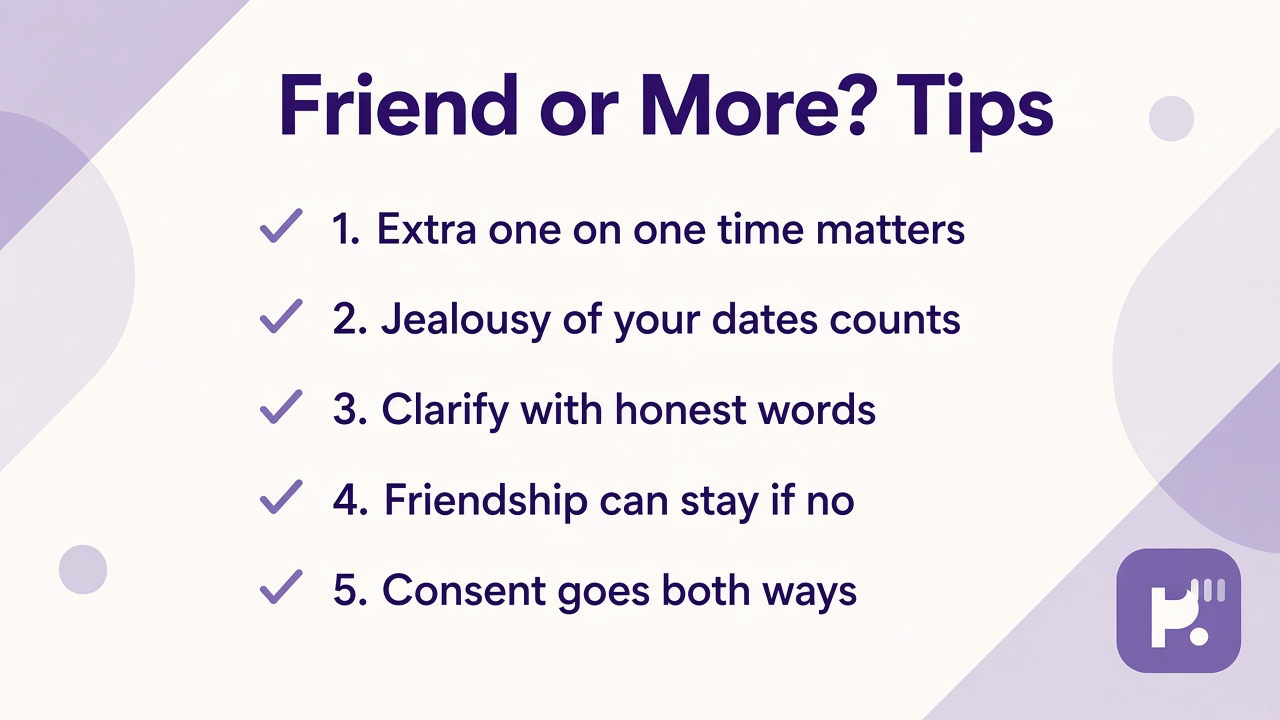
A quick takeaway graphic with topic tips (not your personal quiz scores). Start the quiz for your index, bands, and charts.
What this quiz can and cannot tell you
Can tell you
- Sort confusing warmth into four observable domains
- Give you language for a kind clarity conversation
- Highlight when friendship boundaries look healthy
- Offer a baseline to retake after you set expectations
Cannot tell you
- Prove romantic intent or mutual compatibility
- Replace direct consent and honest words
- Detect harassment or coercion on its own
- Tell you whether to date or stay friends
When friendship starts to feel like something more
The question usually shows up after a late-night talk, a jealous comment about your date, or a hangout that felt oddly couple-like. Friends can be affectionate without romance; romance can grow from years of trust. This quiz separates one-on-one priority, flirtation cues, jealousy of your dating life, and platonic signals so you are reacting to patterns, not one vivid memory.
One-on-one priority matters because time is scarce. Choosing you alone, rescheduling for you, or sharing news privately first can signal interest, especially paired with flirtation. Flirtation cues include appearance compliments, charged touch, pet names, and jokes about dating each other. Culture and personality vary; some people flirt platonically. That is why reverse platonic items ask about group comfort and easy introductions to your partners.
Jealousy of dates is a loud but messy signal. A friend who sulks when you like someone may be romantically interested, or afraid of losing your attention. Compare jealousy with how they act when you are single. Mixed bars mean you need words, not more Instagram decoding.
If your score is low, you may still have a great friendship worth protecting. If your score is high, decide what you want before you escalate. Mutual interest deserves a direct, kind conversation in a neutral setting. Unrequited interest deserves honesty without punishment. Our does my crush like me quiz fits when the person is not already a close friend. The does my coworker like me quiz adds workplace boundary framing when the blur is professional.
Retake after you talk and compare bars. Friendship can survive a no if both people respect boundaries. Romance needs consent in both directions, not only a high index on a screen.
| Test | Focus |
|---|---|
| Does my crush like me quiz | Crush signals when you are not already close friends |
| Does my coworker like me quiz | Workplace crush cues with professional boundary limits |
Does My Friend Like Me Quiz FAQ
What does this quiz measure?
It measures how often you have noticed possible romantic-interest signals from a friend in the past few weeks across solo time, flirtation, jealousy of dates, and platonic cues. You get an index from 0 to 100 and four bars. It reflects your observations, not their secret diary.
We hug like friends. Does that mean they like me?
Some friend groups are physically affectionate. Compare touch with flirtation, jealousy, and whether they treat you differently from other friends.
Does a high score mean we should date?
No. It means you reported more flirtation-style cues. Dating still needs mutual interest, timing, and a direct conversation.
What if I only want friendship?
Name that kindly early. Clear boundaries protect both of you better than hoping they will guess.
Who reviewed this quiz?
Dr. James Whitfield, PhD reviewed the relationship framing, consent notes, and result explanations. See our editorial policy for review standards.
Reviewed by