What the Does My Coworker Like Me Quiz measures
This quiz does not read your coworker's mind or speak for human resources. It measures how often you have noticed behaviors people list when they wonder if a colleague likes them romantically, grouped four ways: professional warmth that feels targeted, one-on-one time beyond what the job requires, office gossip and hint culture that substitutes for direct words, and workplace boundaries that show whether respect and policy still hold. You answer 22 how-often statements about recent weeks, with reverse-worded items so one dramatic lunch cannot inflate your score. Your responses also feed a second chart on closeness and trust habits, because workplace crushes often overlap with fear of rejection or worry about reputation. The total becomes an index from 0 to 100 where higher means more reported signals on this screener, not permission to pursue a relationship or ignore harassment.
Professional warmth
How often greetings, recall, and praise feel personally aimed at you.
One-on-one time
How often meals, projects, or rides happen without the wider team.
Office gossip
How often rumors and hints substitute for their direct words.
Workplace boundaries
How often respect, policy, and your no still govern their behavior.
How it works
Answer 22 frequency items
Rate each statement from Never to Very often for recent weeks at work. Tap Next after each answer.
Answers sort into four domains
Each answer feeds one of four signal groups, and every item also feeds a closeness and trust layer.
See your index and charts
You get a 0 to 100 index, a band, and two bar charts you can compare with a friend outside the office.
Take the Does My Coworker Like Me Quiz
Answer 22 short statements to see your workplace crush signal index, four domain bars, and a closeness and trust chart.
What your result means
Your index is the average of all 22 answers, scaled from 0 to 100. Higher means more reported signals. Read the four bars before the total, since gossip can spike while boundaries still look solid.
| Band | Index range | Typical reading |
|---|---|---|
| Few workplace crush signs | 0 to 35 | Little extra warmth, solo time, or gossip fuel beyond normal collegiality. |
| Mixed workplace crush signs | 36 to 65 | Warm moments without steady respect or clear words. |
| Several workplace crush signs | 66 to 100 | Repeated warmth and solo time; still choose policy-safe next steps. |
Tips at a glance
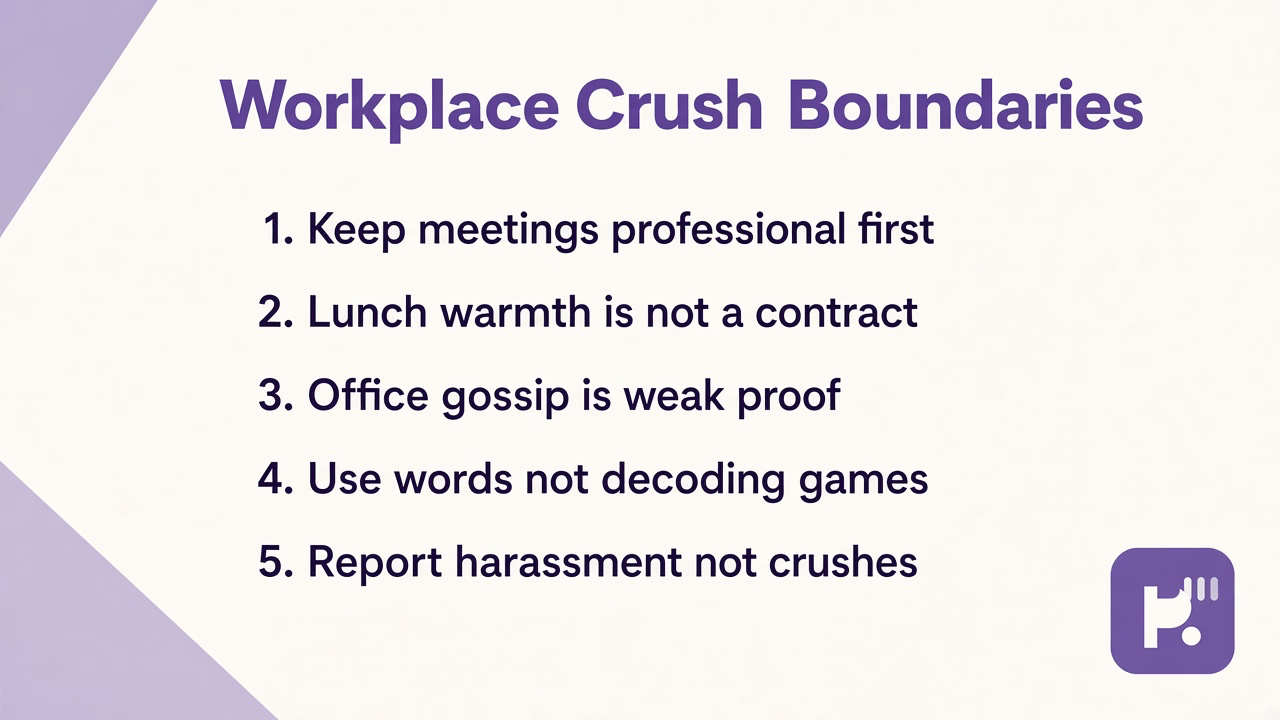
A quick takeaway graphic with topic tips (not your personal quiz scores). Start the quiz for your index, bands, and charts.
What this quiz can and cannot tell you
Can tell you
- Organize mixed office moments into four clear domains
- Prompt you to review handbook rules on relationships and reporting
- Highlight when boundary items deserve HR or manager input
- Offer a baseline to retake after a project ends or roles change
Cannot tell you
- Prove whether your coworker likes you or will ask you out
- Replace HR, legal, or employee assistance guidance
- Tell you to date at work without disclosing when policy requires it
- Separate friendly culture from harassment with certainty
Workplace crushes: signals, gossip, and boundaries
Work crushes thrive on proximity: shared deadlines, lunch routines, and inside jokes that never happen on weekends. The question is not whether butterflies are real; they are. The question is whether warmth is collegial, romantic, or coercive, and whether company policy gets a vote. This quiz separates targeted warmth, solo time, gossip fuel, and boundary respect so you can think clearly before your next elevator ride.
Professional tone still matters when interest might be mutual. Compliments on your ideas are different from comments on your body. Remembering your kid's soccer game is different from monopolizing your calendar. One-on-one coffee can be mentorship or a date audition; context and repetition tell the story. Reverse-worded items keep one great project week from dominating, but they cannot replace your memory of how they act when you say no.
Gossip is the weakest evidence in the building. Break-room jokes feel exciting because they make you the main character, yet they rarely come with consent or clarity. Direct words beat decoding Slack reactions. If you want to know, a calm, policy-aware conversation beats asking the office oracle. If you do not want romance, clear limits plus documentation protect you when someone keeps pushing after hours.
Harassment is not a crush with bad timing. Power gaps, quid pro quo hints, and retaliation after rejection belong with HR or a trusted manager, not with quiz bands. Many employers require disclosure before dating coworkers; some ban it between certain ranks. Read your handbook before you plan a secret relationship. Compare your results with our does my friend like me quiz if the line between platonic and romantic blur outside work.
If the crush is mutual and policy allows, move slowly and keep work quality visible. If it is one-sided, kindness is not a contract. Retake after a reorg or remote stretch and watch whether bars flatten when proximity drops. That pattern often tells you how much was chemistry versus convenience.
| Test | Focus |
|---|---|
| Does my friend like me quiz | Platonic versus romantic blur without workplace policy stakes |
| Fear of intimacy quiz | Your own closeness pull-back habits, not reading coworker cues |
Does My Coworker Like Me Quiz FAQ
What does this quiz measure?
It measures how often you have noticed warmth, one-on-one time, gossip hints, and boundary patterns at work. You get an index from 0 to 100 and four bars. It reports what you have seen, not HR findings.
Should I date a coworker if my score is high?
Not automatically. Check company policy, power dynamics, and whether respect holds when you set limits. High scores describe signals you noticed, not a recommendation to date.
Is office gossip reliable?
Usually no. Gossip is weak proof. Direct conversation, when safe and professional, beats rumors.
When should I talk to HR?
When behavior feels coercive, retaliatory, sexualized, or tied to work favors. HR is for safety and policy, not crush decoding.
Who reviewed this quiz?
Dr. James Whitfield, PhD reviewed the framing, workplace boundary limits, and harassment-aware disclaimer. See our editorial policy for review standards.
Reviewed by