
What the Does My Crush Like Me Quiz measures
This quiz does not read your crush's mind. It measures how often you have noticed behaviors that people commonly list when they wonder if interest goes both ways, grouped four ways: in-person energy when you share space, digital warmth on apps and messages, effort and respect including boundaries, and social hints from friends or mutual circles. You answer 22 how-often statements about recent weeks, with reverse-worded items so wishful thinking alone cannot inflate your score. Your answers also feed a second chart on closeness and trust habits, because crush anxiety sometimes overlaps with fear of rejection or rushing intimacy before you are ready. The total becomes an index from 0 to 100 where higher means more reported signals on this screener, not a promise that they will ask you out or that you should chase anyone who ignores your comfort.
In-person energy
How often they lean into face-to-face time, eye contact, and solo conversations.
Digital warmth
How often they reply, reach out first, and react to you online with real engagement.
Effort and respect
How often they remember you, show up, and honor your limits without pressure.
Social hints
How often friends tease, whisper, or act like they know something you do not.
How it works
Answer 22 frequency items
Rate each statement from Never to Very often for recent weeks. Tap Next after each answer.
Answers sort into four domains
Each answer feeds one of four signal groups, and every item also feeds a closeness and trust layer.
See your index and charts
You get a 0 to 100 index, a band, and two bar charts you can compare with a friend who knows the situation.
Take the Does My Crush Like Me Quiz
Answer 22 short statements to see your crush reciprocation index, four signal bars, and a closeness and trust chart.
What your result means
Your index is the average of all 22 answers, scaled from 0 to 100. Higher means more reported signals. Read the four bars before the total, since many crushes show up in chats but not in person.
| Band | Index range | Typical reading |
|---|---|---|
| Few reciprocation signs | 0 to 35 | Little in-person energy, digital warmth, or social buzz lately. |
| Mixed reciprocation signs | 36 to 65 | Hot-and-cold moments without a steady pattern yet. |
| Several reciprocation signs | 66 to 100 | Repeated signals across settings; still confirm with words when you can. |
Tips at a glance
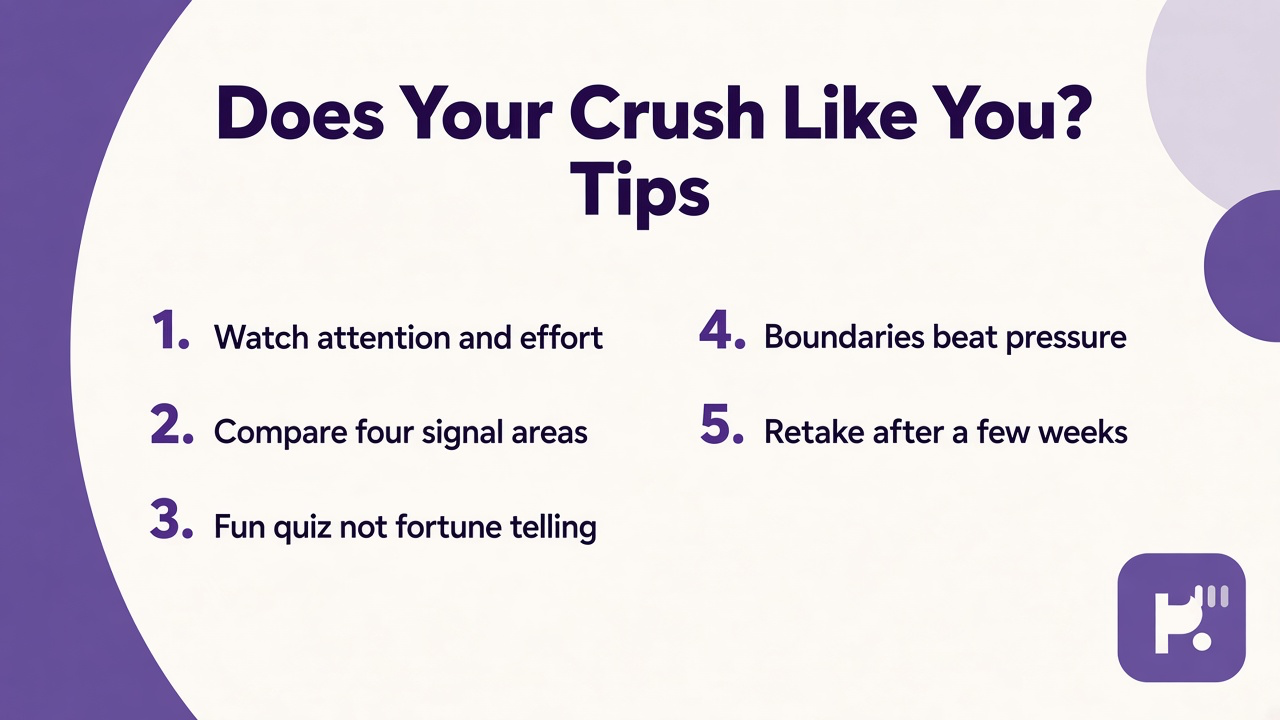
A quick takeaway graphic with topic tips (not your personal quiz scores). Start the quiz for your index, bands, and charts.
What this quiz can and cannot tell you
Can tell you
- Organize mixed signals into four clear domains
- Give you language for talking with a friend or trusted adult
- Highlight when attention might deserve a direct conversation
- Offer a fun baseline to retake after your situation changes
Cannot tell you
- Prove whether your crush likes you or predict their next move
- Replace consent, boundaries, or safety planning for meetups
- Account for every cultural difference in how people show interest
- Tell you whether you should date them
Crush signals: what helps beyond guessing
Search results for crush quizzes are full of thin listicles that treat every smile as proof and every delayed text as rejection. Real life is messier. Someone who likes you might stare at the floor instead of asking you out. Someone who is only friendly might reply fast because group chats are their social oxygen. That is why this quiz separates in-person energy, digital warmth, effort and respect, and social hints instead of handing you a single yes or no.
Dr. James Whitfield studies how young adults interpret ambiguous social cues. His review standard for recreational screeners is simple: name the behavior domains, add reverse-worded items, and repeat that no quiz replaces a conversation. Hope can make a borrowed charger feel romantic; embarrassment can make a missed wave feel like doom. Your notes about whether they listen when you say no still matter more than any index.
Digital warmth matters early now. Many people coordinate crushes through shared playlists, story replies, and game lobbies before they coordinate face-to-face plans. A quick reply might mean interest, boredom, or politeness. In-person energy still counts: choosing the seat beside you, laughing at your stories, finding reasons for a two-person walk. Social hints are the weakest evidence alone, because friends enjoy teasing, yet repeated comments from people who actually know your crush can be worth hearing.
If your score is high, enjoy the possibility and still use your voice. A simple invite to study, walk, or grab food tells you more than another week of decoding. If your score is low, you are allowed to move on without a speech from them. Crushes pass, and your energy can go toward friends, hobbies, sleep, and goals instead of replaying one hallway moment.
If their attention ever ignores your no, mocks you publicly, or pushes for secrets you are not ready to keep, talk to someone you trust. Mutual liking should feel exciting, not scary. Compare your results with our does he like me quiz if your crush is a guy and you want parallel wording, or with does my crush hate me quiz if cold behavior is what keeps you up at night. Neither page is fortune-telling; both are mirrors for patterns you already half see.
| Test | Focus |
|---|---|
| Does he like me quiz | General crush signals when you already know the person is a guy |
| Does my crush hate me quiz | Cold or distant behavior when you fear dislike more than mutual interest |
Does My Crush Like Me Quiz FAQ
What does this quiz measure?
It measures how often you have noticed crush-style behaviors across in-person energy, digital warmth, effort and respect, and social hints. You get an index from 0 to 100 and four bars. It reports what you have seen, not what your crush secretly feels.
Does a high score mean they will ask me out?
No. It means you reported several signals lately. They might still be shy, unsure, or friendly without romantic intent. A calm conversation or shared activity is still the clearest step.
What if they are warm online but cold in person?
That is common. Compare your digital warmth and in-person energy bars. Some people flirt only on screens; others only face to face. Look for respect in both places.
Can I retake after we start dating?
Yes. Retakes are useful when your relationship stage changes. Early dating should still feel respectful; a high flirt score does not excuse pressure.
Who reviewed this quiz?
Dr. James Whitfield reviewed the framing, the boundary notes, and the result explanations. See our editorial policy for review standards.
Reviewed by
