What the Does My Dog Have ADHD Quiz measures
This quiz does not diagnose ADHD in dogs because that human label does not map cleanly onto veterinary medicine. It measures how often you notice high-drive behaviors owners describe when they joke that their dog has ADHD, grouped four ways: impulsive body habits like jumping and zoomies, sniff hyperfocus that hijacks walks, training drift when distractions win, and rest resistance when the household tries to wind down. You answer 22 how-often statements about a typical week, with reverse-worded items so one wild guest visit cannot dominate. Your answers also feed a second chart on closeness and trust habits, because frustrated owners sometimes misread hyper dogs as disobedient when they are under-exercised or in pain. The total becomes an index from 0 to 100 where higher means more reported hyperactivity strain on this screener, not proof of a disorder or a reason to punish.
Impulse body
How often jumping, mouthing, bolting, or zoomies outrun your cues.
Sniff hyperfocus
How often scent trails freeze walks and block recall until the nose finishes.
Training drift
How often known cues fall apart when distractions appear.
Rest resistance
How often they pace, whine, or demand play instead of settling.
How it works
Answer 22 frequency items
Rate each statement from Never to Very often for a typical week. Tap Next after each answer.
Answers sort into four domains
Each answer feeds one of four behavior groups, and every item also feeds a closeness and trust layer.
See your index and charts
You get a 0 to 100 index, a band, and two bar charts you can share with a vet or trainer.
Take the Does My Dog Have ADHD Quiz
Answer 22 short statements to see your canine hyperactivity index, four behavior bars, and a closeness and trust chart.
What your result means
Your index is the average of all 22 answers, scaled from 0 to 100, with reverse-worded items flipped first. Higher means more reported strain. Pair high rest-resistance scores with a vet visit if the pattern is new.
| Band | Index range | Typical reading |
|---|---|---|
| Lower hyper strain | 0 to 35 | Typical young-dog energy or good-enough settle skills. |
| Mixed hyper strain | 36 to 65 | Some impulse or sniff fixation without constant chaos. |
| Higher hyper strain | 66 to 100 | Frequent impulse and focus strain; vet and trainer, not a human label. |
Tips at a glance
A quick takeaway graphic with topic tips (not your personal quiz scores). Start the quiz for your index, bands, and charts.
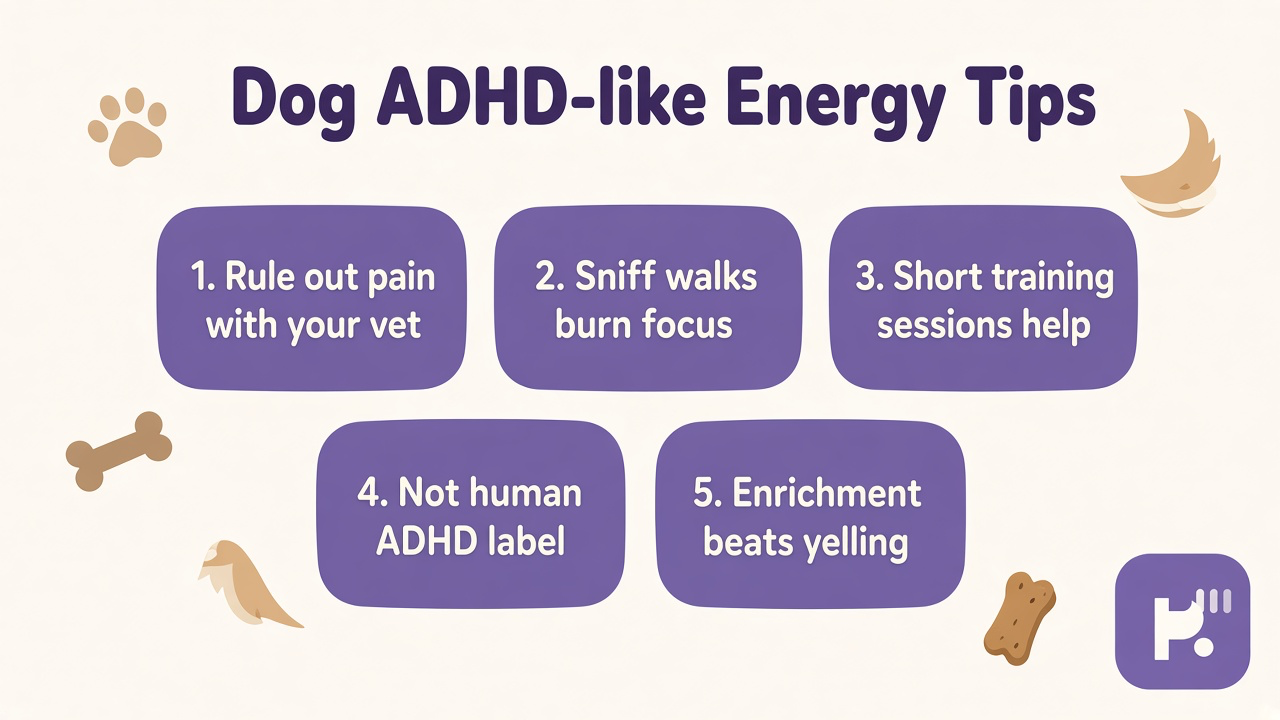
What this quiz can and cannot tell you
Can tell you
- Separate zoomies from sniff lock-in from training drift
- Give you vocabulary for a vet or trainer consult
- Highlight when pain rule-out should come before labels
- Track whether enrichment weeks change your bars
Cannot tell you
- Diagnose ADHD, hyperkinesis, or any medical problem in dogs
- Recommend medications or supplements
- Replace professional training or behavior modification
- Predict whether your dog will calm down at a specific age
Hyper dogs: labels, sniffing, and vet-first steps
Social media loves the phrase dog ADHD because it names the chaos you feel when a Labrador launches off the couch at doorbell number four. Veterinarians and trainers are more careful. Dogs can show hyperkinesis or anxiety-driven motion, but copying human ADHD checklists skips the first question: is this breed, age, pain, or panic?
Dr. Elena Vasquez reviews pet reflection quizzes with a medical rule-out standard. Impulse jumping often improves with consistent cues and less accidental rewarding of paws on people. Sniff hyperfocus is usually normal canine work; many so-called hyper dogs simply need longer decompression walks where the nose leads. Rest resistance after adequate exercise deserves a physical exam before you blame attitude.
The four bars mirror owner language. Impulse body covers zoomies and bolting. Sniff hyperfocus covers the dog who cannot hear you over a grass patch. Training drift covers the dog who knows sit in the kitchen and forgets at the soccer field. Rest resistance covers the dog who paces at 9 p.m. even after fetch. High scores in one bar suggest targeted fixes, not a personality verdict.
Enrichment beats shame. Scatter feeding, sniff mats, flirt pole sessions with rules, and short training games build an off-switch. Punishment for hyper behavior often increases adrenaline. If your score is high, film a week of triggers and bring the clip to your vet. Our does my dog have anxiety quiz fits better if trembling and hiding dominate more than joy zoomies. The does my dog love me quiz helps when you wonder whether energy is bond seeking or boredom.
Retake after four weeks of added nose work and a trainer consult. Celebrate shorter zoomies, not only a dog who looks sedated. A tired dog is not always a healthy dog if exhaustion comes from fear. Let your vet translate behavior into biology before you share a label online.
| Test | Focus |
|---|---|
| Does my dog have anxiety quiz | Fear, panting, and triggers more than joy hyperactivity |
| Does my dog love me quiz | Attachment warmth, not impulse control |
Does My Dog Have ADHD Quiz FAQ
What does this quiz measure?
It measures how often you notice high-drive behaviors in four areas: impulsive body habits, sniff hyperfocus, training drift, and rest resistance. You get an index from 0 to 100 and four bars.
Can dogs have ADHD like humans?
Veterinarians do not use human ADHD the same way psychiatrists do. Some dogs have clinically discussed hyperkinesis or overlapping anxiety. This quiz is a reflection tool, not that diagnosis.
Should I ask my vet about medication?
Only after an exam and history review. Medication decisions belong with your veterinarian, not a web quiz.
My puppy is always wild. Is that ADHD?
Most puppies are wild. Compare your score after age-appropriate exercise and training. Sudden changes in adults matter more than normal puppy zoomies.
Who reviewed this quiz?
Dr. Elena Vasquez reviewed the framing, the veterinary referral notes, and the limits on diagnosis. See our editorial policy for review standards.
Reviewed by