What the Does My Child Have OCD Quiz measures
This quiz does not diagnose obsessive compulsive disorder. Only a qualified clinician using interview methods and history can do that. It measures how often you have noticed patterns that specialists discuss when pediatric OCD is on the worry list, grouped four ways: unwanted thoughts that bother your child, visible compulsions such as washing or checking, distress when rituals are blocked, and time stolen from school or sleep. You answer 22 how-often statements about the past two weeks, with reverse-worded items so neatness alone cannot inflate the score without distress. Your responses also feed a second chart on closeness and trust habits, because shame about rituals sometimes makes parents hide symptoms or fight alone. The total becomes an index from 0 to 100 where higher means more frequent concern on this screener, not confirmed OCD.
Intrusive thoughts
How often sticky scary or perfection thoughts upset your child despite their dislike of them.
Compulsions
How often washing, checking, counting, ordering, or repeating became a must-do rule.
Distress when blocked
How often stopping rituals led to panic, meltdowns, or secret workarounds.
Time impact
How often routines made the family late, extended homework, or shrank meals and sleep.
How it works
Answer 22 frequency items
Rate each statement from Never to Very often for the past two weeks. Tap Next after each answer.
Answers sort into four domains
Each answer feeds one of four pattern groups, and every item also feeds a closeness and trust layer.
See your index and charts
You get a 0 to 100 index, a band, and two bar charts you can bring to a specialist.
Take the Does My Child Have OCD Quiz
Answer 22 short statements to see your OCD concern index, four domain bars, and a closeness and trust chart.
What your result means
Your index is the average of all 22 answers, scaled from 0 to 100. Higher means more frequent reported concerns on this screener. Read the domain bars before the total, since time impact can be severe while thoughts stay private.
| Band | Index range | Typical reading |
|---|---|---|
| Lower reported concern | 0 to 35 | Fewer frequent stuck thoughts, rituals, or time-loss worries in the past two weeks. |
| Mixed reported concern | 36 to 65 | Some ritual domains spike while others look typical. |
| Higher reported concern | 66 to 100 | Frequent rituals or distress; seek specialized evaluation, not a web label. |
Tips at a glance
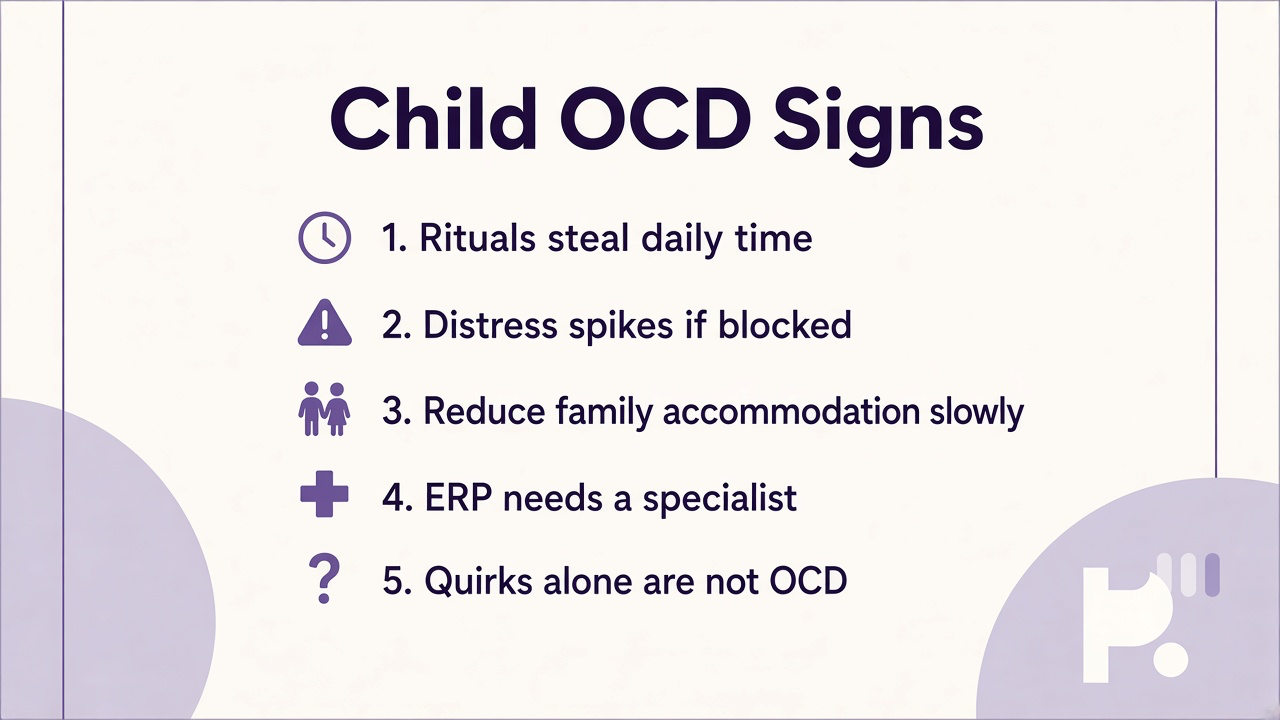
A quick takeaway graphic with topic tips (not your personal quiz scores). Start the quiz for your index, bands, and charts.
What this quiz can and cannot tell you
Can tell you
- Organize symptoms into thoughts, rituals, distress, and time buckets
- Give you language for pediatrician or ERP therapist intake
- Highlight when family accommodation may be growing rituals
- Offer a baseline if you retake during therapy
Cannot tell you
- Diagnose OCD, tic disorders, or autism-related rigidity without evaluation
- Replace the Y-BOCS or other clinician rating tools
- Tell you to force stop rituals without therapeutic plan
- Distinguish OCD from trauma reactions without professional history
OCD worries in children: what helps beyond labels
Obsessive compulsive disorder is not the same as liking things tidy. OCD pairs unwanted thoughts or urges with rituals or mental acts meant to reduce fear, and the loop steals time or causes meltdowns when interrupted. Parents search when hand washing bleeds into homework, or when a child confesses the same worry hourly. Perfectionism can hurt without being OCD; clinicians look for distress, repetition, and impairment. Even young children can describe rituals with simple words when adults listen without joking.
The International OCD Foundation family resources explain that accommodation, such as answering reassurance forever or performing rituals for a child, often grows symptoms. The American Academy of Child and Adolescent Psychiatry OCD fact sheet for families urges early specialized care. Neither source supports diagnosing from internet lists alone. School staff training can reduce shame when bathroom breaks stretch long.
This quiz separates thoughts, visible compulsions, blocking distress, and schedule impact so you can describe patterns without guessing Latin terms. Sudden explosive OCD after illness may need pediatric review for infection-associated triggers in some cases. Evidence-based exposure and response prevention teaches children to tolerate anxiety without rituals, usually with therapist coaching for parents on reducing accommodation. Medication sometimes supports ERP when symptoms are severe, but prescribing belongs to clinicians who monitor growth and mood.
Bring videos only if your child consents; otherwise describe duration and examples. Note school clues like erasing holes in paper or tardy arrivals from bathroom routines. If your pediatrician lacks OCD referrals, ask university clinics or hospital child psychiatry programs. Teachers sometimes confuse OCD with defiance when a child freezes; share that fear drives the loop, not laziness. Our does my child have anxiety quiz fits broader worry without ritual focus; use it for reflection, not instead of OCD evaluation when compulsions dominate.
Parent guilt is common when you realize you helped check locks a hundred times. Change is gradual with therapy, not punishment. If shame keeps you silent, tell a clinician; secrecy feeds rituals. Siblings may need their own short explanation so they do not mimic rituals for attention. Retake this screener mid-treatment if you want to track whether reported frequency eases as ERP progresses.
| Test | Focus |
|---|---|
| Does my child have anxiety quiz | General worry and avoidance without compulsive ritual and time-loss emphasis |
| Does my child have PDA quiz | Demand avoidance and panic at requests rather than contamination or checking loops |
Does My Child Have OCD Quiz FAQ
What does this quiz measure?
It measures how often you have noticed intrusive thoughts, compulsions, blocking distress, or time loss in the past two weeks. You get an index from 0 to 100 plus four domain bars. It reports parent observation frequency, not a clinical diagnosis.
Is picky eating or neatness the same as OCD?
Not always. OCD involves fear-driven rituals or thoughts that feel mandatory and impair life. Neatness without distress or time loss is different. Share duration and meltdowns when blocked with a clinician.
Can this quiz diagnose OCD in my child?
No. OCD diagnosis requires professional evaluation, often using structured interviews. This tool organizes parent concerns for that conversation.
What is family accommodation?
Accommodation means joining rituals, giving endless reassurance, or changing home rules to prevent panic. It is understandable and often makes OCD grow. Therapists coach gradual reduction alongside ERP.
Who reviewed this quiz?
Dr. Elena Vasquez, PhD reviewed the YMYL framing, medical limits, and pediatric OCD guidance. See our editorial policy for review standards.
Reviewed by