What the Does My Child Have PDA Quiz measures
This quiz does not diagnose pathological demand avoidance, autism, or oppositional defiant disorder. Only a qualified clinician who gathers developmental history, school reports, and observation can interpret those questions. It measures how often you have noticed patterns discussed in PDA-informed parenting and autism literature, grouped four ways: panic or shutdown when everyday demands feel like orders, indirect control and negotiation tactics, stronger refusal at home than teachers see, and worse outcomes from reward-punishment charts than from low-demand scaffolding. You answer 22 how-often statements about the past two weeks, with reverse-worded items so one cooperative weekend cannot hide daily after-school collapse. Your responses also feed a second chart on closeness and trust habits, because demand conflict sometimes isolates parents from co-parents or schools. The total becomes an index from 0 to 100 where higher means more frequent concern on this screener, not a confirmed profile.
Demand panic
How often ordinary requests triggered rage, shutdown, or long recovery.
Control and negotiation
How often cooperation required indirect framing, games, or delays.
Social masking
How often school compliance hid home explosions or homework panic.
Support needs
How often traditional discipline backfired while flexible approaches helped.
How it works
Answer 22 frequency items
Rate each statement from Never to Very often for the past two weeks. Tap Next after each answer.
Answers sort into four domains
Each answer feeds one of four pattern groups, and every item also feeds a closeness and trust layer.
See your index and charts
You get a 0 to 100 index, a band, and two bar charts you can bring to assessment.
Take the Does My Child Have PDA Quiz
Answer 22 short statements to see your demand-avoidance index, four domain bars, and a closeness and trust chart.
What your result means
Your index is the average of all 22 answers, scaled from 0 to 100. Higher means more frequent reported concerns on this screener. Read the domain bars before the total, since masking can hide demand panic until homework time.
| Band | Index range | Typical reading |
|---|---|---|
| Lower reported concern | 0 to 35 | Fewer frequent demand panic or masking worries in the past two weeks. |
| Mixed reported concern | 36 to 65 | Some demand domains spike while others look typical. |
| Higher reported concern | 66 to 100 | Frequent demand panic; seek informed assessment, not a web label. |
Tips at a glance
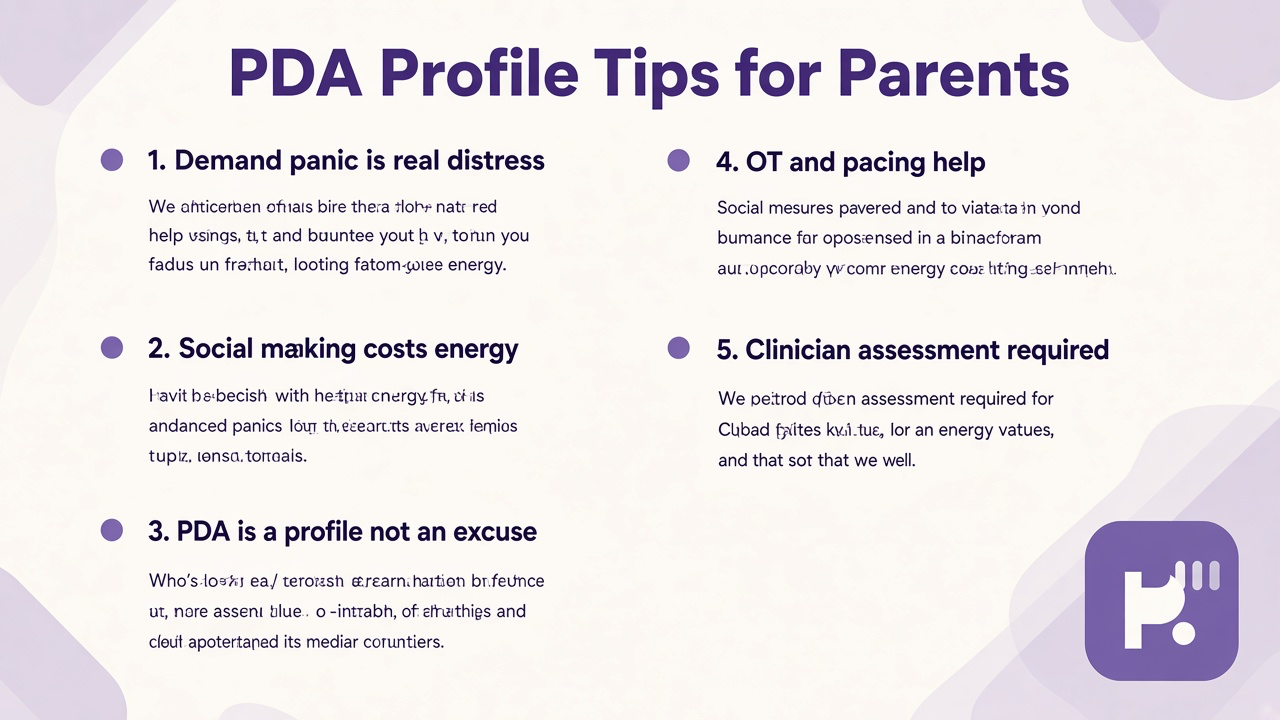
A quick takeaway graphic with topic tips (not your personal quiz scores). Start the quiz for your index, bands, and charts.
What this quiz can and cannot tell you
Can tell you
- Organize patterns into panic, control, masking, and support buckets
- Give you vocabulary for autism or OT referrals
- Show where reward charts may be backfiring
- Offer a baseline if strategies change
Cannot tell you
- Diagnose PDA, autism, ADHD, or conduct problems alone
- Replace ADOS, developmental interviews, or school observation
- Excuse unsafe behavior toward self or others
- Tell you to abandon all expectations without professional planning
Pathological demand avoidance profile: what parents should know
Pathological demand avoidance, often shortened to PDA, names a pattern where ordinary requests feel threatening and a child may use social strategies, distraction, or panic to escape them. It is discussed mainly in the United Kingdom and among some autism communities as a profile, not as a prescription medication and not as a free pass to harm others. Parents search when direct commands fail but novelty or indirect invites work, and when teachers insist everything is fine while home feels like a battlefield. The profile does not replace empathy for exhausted parents or valid rules about safety.
The National Autistic Society PDA guidance emphasizes anxiety-driven avoidance and flexible support rather than escalating punishment. Research literature continues to debate whether PDA belongs inside autism spectrum disorder or as a separate concept; your local clinic may use different words. What stays constant is the need for professional assessment instead of internet labeling.
This quiz groups parent reports into demand panic, negotiation tactics, masking, and support reactions so you can describe life without a viral checklist alone. Sensory overload, language delays, trauma, and mood disorders can overlap, which is why evaluation gathers school data and developmental history. Low-demand communication, predictable downtime, and occupational therapy for regulation appear in many support plans, always paired with clear safety limits. What works Tuesday may fail Friday; patterns over weeks matter more than one good day.
Bring kind emails from teachers plus honest home logs. Note phrases that trigger shutdown versus cooperation. If standard behavior charts increased meltdowns, say so; clinicians need that detail. Our does my child have anxiety quiz explores worry and somatic fear; our child development quiz offers broader reflection, neither replaces autism assessment when demand avoidance dominates daily life.
Parent burnout is real when every sock becomes a negotiation. Respite, co-parent alignment, and disability-informed school plans matter as much as home phrasing. If shame keeps you from asking for help, tell a clinician; isolation worsens cycles. Document what teachers see so assessments do not dismiss you as too permissive. Retake this screener after new supports if you want to track whether reported frequency shifts.
| Test | Focus |
|---|---|
| Does my child have anxiety quiz | Worry and somatic anxiety rather than demand-specific panic and masking split |
| Child development quiz | General development reflection without demand-avoidance profile framing |
Does My Child Have PDA Quiz FAQ
What does PDA mean in this quiz?
PDA means pathological demand avoidance, a behavioral profile where everyday demands trigger intense avoidance or panic. It is not a prescription drug name. This quiz reflects parent observations, not a formal diagnosis.
Is PDA the same as autism?
Clinicians often discuss PDA as a profile seen within or alongside autism spectrum presentations, but labels vary by country and team. Assessment determines what fits your child.
Can this quiz diagnose PDA?
No. Diagnosis and profile discussions require professional evaluation with history and school input. This tool organizes concerns for that conversation.
Should we stop all rules if our score is high?
No. Safety, kindness, and gradual growth still matter. Many families use low-demand language and sensory supports while clinicians help plan boundaries that do not fuel panic.
Who reviewed this quiz?
Dr. Elena Vasquez, PhD reviewed the YMYL framing, profile-not-medication clarity, and neurodevelopmental referral guidance. See our editorial policy for review standards.
Reviewed by