What the Does My Child Have Anxiety Quiz measures
This quiz does not diagnose anxiety disorders. Only a clinician who evaluates your child, often with your report and school input, can do that. It measures how often you have noticed patterns that parents and pediatricians often discuss when childhood anxiety is on the worry list, grouped four ways: repetitive worry and reassurance seeking, physical complaints that track with stress, avoidance of school or activities, and mood or sleep changes tied to fear. You answer 22 how-often statements about the past two weeks, with reverse-worded items so a string of never cannot hide a cluster of very often answers. Your responses also feed a second chart on closeness and trust habits, because child health fear sometimes makes it hard to ask for help or share worries with a co-parent. The total becomes an index from 0 to 100 where higher means more frequent concern on this screener, not a confirmed disorder.
Worry thoughts
How often what-ifs, reassurance loops, or catastrophic predictions dominated conversation.
Body symptoms
How often headaches, stomach pain, tension, or nurse visits tracked with stress.
Avoidance
How often fear led to school refusal, skipped activities, or clingy separations.
Mood and sleep
How often irritability, nightmares, or insomnia paired with worry.
How it works
Answer 22 frequency items
Rate each statement from Never to Very often for the past two weeks. Tap Next after each answer.
Answers sort into four domains
Each answer feeds one of four sign groups, and every item also feeds a closeness and trust layer.
See your index and charts
You get a 0 to 100 index, a band, and two bar charts you can bring to a clinician.
Take the Does My Child Have Anxiety Quiz
Answer 22 short statements to see your child anxiety index, four domain bars, and a closeness and trust chart.
What your result means
Your index is the average of all 22 answers, scaled from 0 to 100. Higher means more frequent reported concerns on this screener. Read the domain bars before the total, since stomach symptoms can dominate while worry thoughts look quieter.
| Band | Index range | Typical reading |
|---|---|---|
| Lower reported concern | 0 to 35 | Fewer frequent worry, body, avoidance, or sleep signs in the past two weeks. |
| Mixed reported concern | 36 to 65 | Some domains spike while others look typical on good days. |
| Higher reported concern | 66 to 100 | Frequent worry or avoidance; book evaluation, not a web diagnosis. |
Tips at a glance
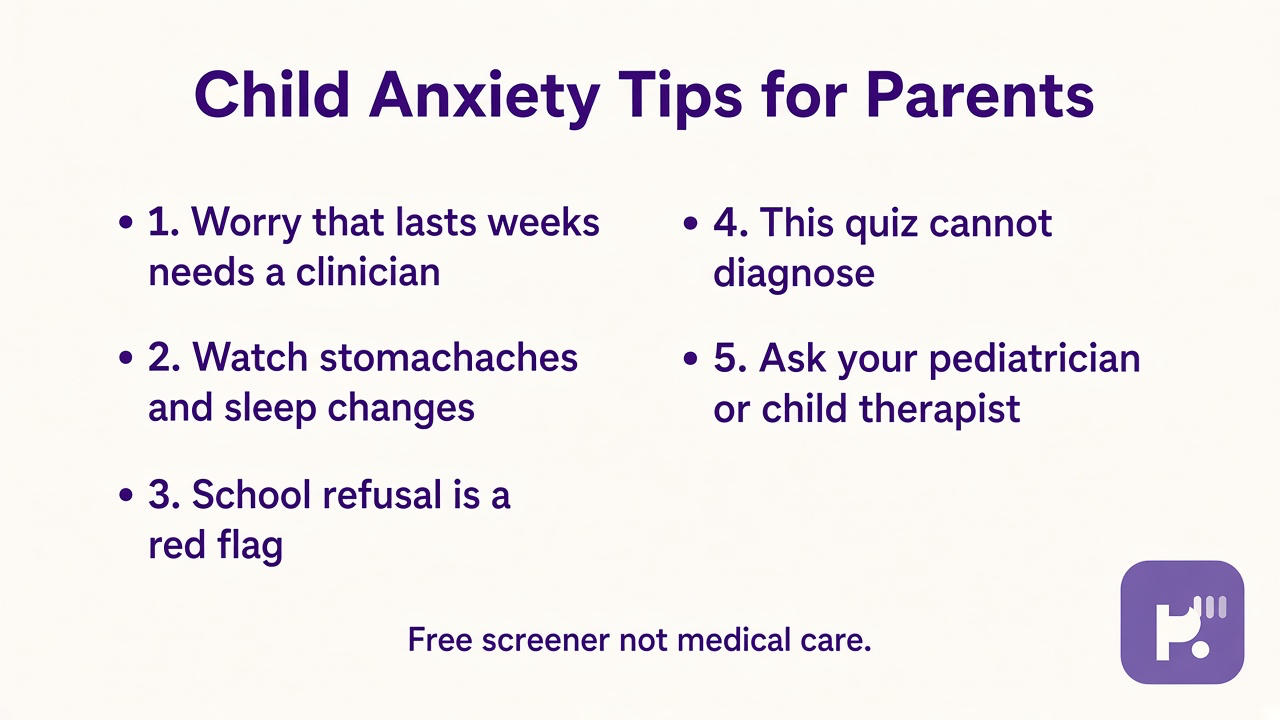
A quick takeaway graphic with topic tips (not your personal quiz scores). Start the quiz for your index, bands, and charts.
What this quiz can and cannot tell you
Can tell you
- Organize worries into thought, body, avoidance, and sleep buckets
- Give you language for a pediatric or therapy visit
- Show which domain feels heaviest this fortnight
- Offer a baseline if you retake after treatment starts
Cannot tell you
- Diagnose generalized anxiety disorder, panic disorder, or any mental health condition
- Replace interview with your child, school records, or standardized screening tools
- Tell whether symptoms are anxiety versus medical illness without exam
- Delay care because a score was low once
Child anxiety worries: what parents can do next
Childhood anxiety is common and often invisible until it hits attendance, sleep, or friendships. Parents who search this question are usually tracking Monday stomachaches, long goodbyes at drop-off, or a kid who asks the same reassurance question ten times. Fear is normal after moves or bullying, and so is the need to separate typical stress from patterns that persist for weeks across settings. One hard week before a recital does not equal an anxiety disorder; repeated avoidance that shrinks your child's life usually deserves professional eyes.
The American Academy of Pediatrics publishes mental health guidance for families that encourages pediatricians to screen and refer when worry impairs function. The National Institute of Mental Health anxiety disorder information likewise stresses evaluation when physical symptoms and fear persist. Neither source invites parents to label disorders from a checklist alone. They invite conversation with clinicians who hear your child's words, not only yours.
This quiz groups parent reports the way many intakes start: worry loops, somatic complaints, avoidance, and sleep strain. Reflux, anemia, bullying, and learning disorders can mimic anxiety, which is why a high index here means schedule an evaluation, not announce a diagnosis at the dinner table. Cognitive behavioral therapy for children, school accommodations, and sometimes medication after assessment are paths families discuss with licensed providers. Reducing accommodations that accidentally shrink exposure, while staying kind, is part of many treatment plans.
Bring a short log to appointments: time of stomachaches, nurse visits, bedtime duration, and phrases your child uses. Ask teachers whether participation or friendships changed. If your pediatrician is reassuring but your worry persists, a child psychologist or psychiatrist consult is reasonable. You can also try our child anxiety scale for a different self-report angle, or the social anxiety test if fear of judgment dominates, still not substitutes for care.
Caregiver stress counts too. Watching a child suffer shrinks your patience and sleep, which can increase reassurance loops that feed anxiety. If your own anxiety is overwhelming daily life, tell your clinician; parent support is part of child care. Retake this screener after a visit if you want to track whether reported frequency eases once you have a plan.
| Test | Focus |
|---|---|
| Child anxiety scale | Broader child anxiety self-report framing without parent frequency domains used here |
| Social anxiety test | Fear of judgment and social avoidance rather than whole-child worry and somatic school patterns |
Does My Child Have Anxiety Quiz FAQ
What does this quiz measure?
It measures how often you have noticed worry, body complaints, avoidance, or sleep strain in the past two weeks. You get an index from 0 to 100 plus four domain bars. It reports parent observation frequency, not a clinical diagnosis.
Can this quiz tell me if my child has an anxiety disorder?
No. Anxiety disorders are diagnosed by a qualified clinician after evaluation, often including your report and school input. This tool helps you organize concerns to discuss with your pediatrician or therapist.
How is this different from normal back-to-school nerves?
Brief jitters before a new year are common. This screener looks at frequency across two weeks, including somatic complaints and avoidance that repeat. Persistent school refusal or daily misery deserves professional review even if the calendar explains part of it.
When should I call for urgent help?
Call emergency services or a crisis line if your child talks about suicide, self-harm, or cannot breathe during a panic spell. Call your pediatrician soon for frequent refusal to attend school, weight loss, or panic that will not settle.
Who reviewed this quiz?
Dr. Elena Vasquez, PhD reviewed the YMYL framing, medical limits, and child mental health guidance. See our editorial policy for review standards.
Reviewed by