What this am I in love with my boyfriend quiz measures
This do I love my boyfriend quiz estimates how often you notice love-style signals in yourself toward your boyfriend. Twenty-three original items group into five feeling domains that go deeper than crush excitement and use relationship-specific wording. Results show a reflective band and domain bars. No quiz can decide whether you love your boyfriend; only you can weigh your experience over time.
Emotional depth
Deep warmth, lasting resonance, and feelings that go beyond surface attraction toward your boyfriend.
Commitment pull
Orientation toward loyalty, working through conflict, and building something lasting as partners.
Vulnerability
Willingness to share fears, show your real self, and trust your boyfriend with emotional honesty.
Future together
Imagining shared milestones, long-term routines, and a life that includes your boyfriend.
Prioritizing your boyfriend
Choosing him, protecting his wellbeing, and weighing how your decisions affect him in the relationship.
Three reflective bands
Growing feelings, Real love signals, and Deep attachment with compassionate next steps, not certainty claims.
How it works
Three steps from first question to your boyfriend love signal snapshot. Click Start Quiz to open the interactive modal.
Rate your feelings 23 times
Answer how often each statement about your boyfriend applies from Never to Almost always. There is no timer and no auto-advance.
Items map to five domains
Your answers accumulate percentages for emotional depth, commitment pull, vulnerability, future together, and prioritizing your boyfriend.
View band and next steps
Results show Growing feelings, Real love signals, or Deep attachment with domain bars and reflection prompts.
Take the do I love my boyfriend quiz
Rate 23 love-oriented statements about your boyfriend on a five-point frequency scale. Your answers produce a love signal index, five domain scores, and a reflective band with plain-language next steps.
Opens in a focused modal. No account required. Results stay on screen.
What your result means
Your overall love signal index is the average of all five domain scores, each normalized to 0 through 100. Higher percentages mean more frequent endorsement of love-style items about your boyfriend (and less frequent endorsement of reverse-scored indifference items). Domain bars show whether depth, commitment, vulnerability, future vision, or prioritizing him drives your band.
| Love signal band | Score range | Typical reading |
|---|---|---|
| Growing Feelings | 0 to 35% | Affection forming toward your boyfriend; worth noticing whether depth and commitment grow over time |
| Real Love Signals | 36 to 65% | Recognizable love pattern with mixed intensity; common when feelings are real but one domain runs ahead |
| Deep Attachment | 66 to 100% | Frequent depth, commitment, vulnerability, future, and prioritizing signals; meaningful data, still not a verdict |
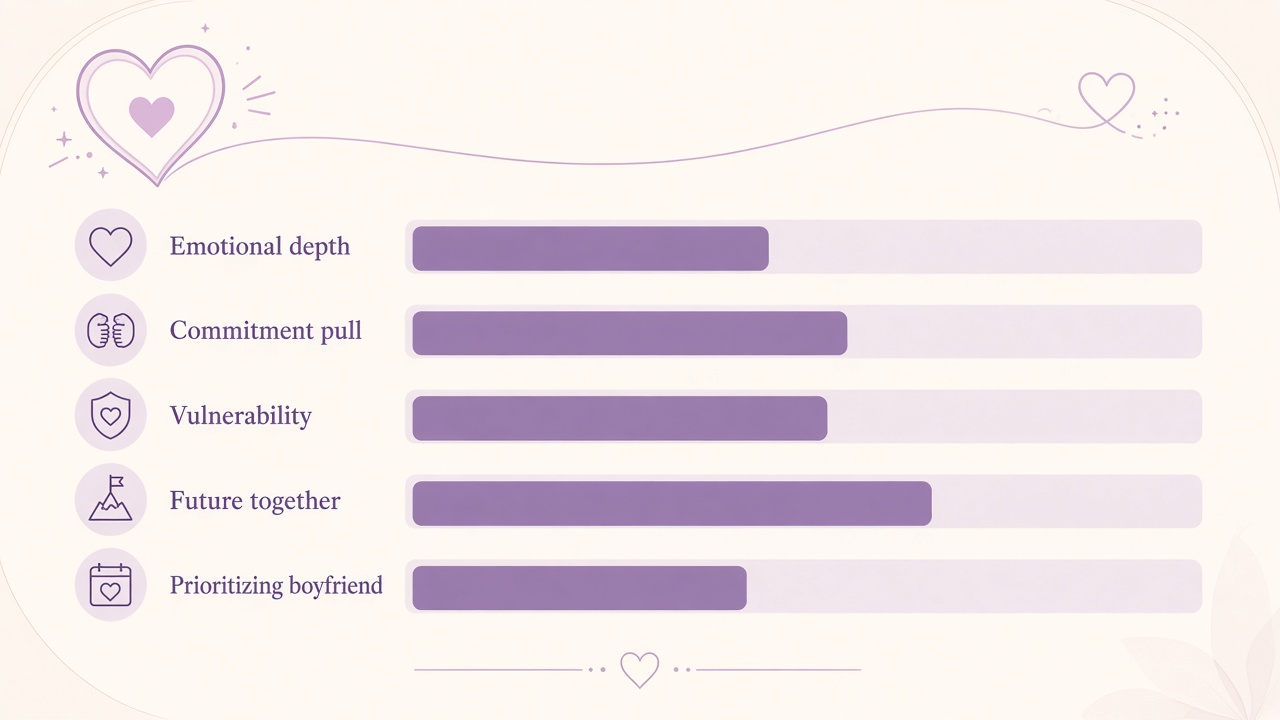
Emotional depth, commitment, vulnerability, future, and prioritizing your boyfriend
The diagram below shows how domain scores appear in your results. High commitment pull with moderate vulnerability toward your boyfriend, for example, can still land you in Real love signals if your overall average sits between bands.
What this quiz can and cannot tell you
Can tell you
- Whether your self-reported feelings toward your boyfriend lean toward growing feelings, real love signals, or deep attachment on this screener
- A love signal index and five domain scores for depth, commitment, vulnerability, future, and prioritizing your boyfriend
- Which domain bar scores highest and may deserve honest reflection first
- A starting point before you decide whether to express love or gather more information in your relationship
Cannot tell you
- Whether you truly love your boyfriend, should commit, or will stay in love long term
- Whether he loves you back or whether the relationship would work
- Whether your feelings are healthy, obsessive, or worth acting on without your own context
- Attachment style, compatibility, or love language scores (see sibling tests below)
Boyfriend love signals, attachment research, and honest self-reflection
Psychologist Robert Sternberg proposed that love blends intimacy, passion, and commitment. His triangular theory, published in the Psychological Review, helps explain why boyfriend-crush excitement alone differs from the deeper pull toward vulnerability and shared future that many people associate with loving a partner.
The Quiz Hub built this do I love my boyfriend quiz for people who already call him their boyfriend and want relationship-specific wording. Twenty-three original items ask about emotional depth, commitment pull, vulnerability, future vision, and prioritizing your boyfriend from your point of view. For generic "him" wording without the boyfriend label, try our do I love him quiz. To compare your inner signals with his behavior, try our does my boyfriend love me quiz. For a broader love lens beyond one partner, try our am I in love quiz.
| The Quiz Hub test | What it adds |
|---|---|
| Do I love him quiz | Generic love signals toward one man: depth, commitment, vulnerability, future, prioritizing him |
| Does my boyfriend love me quiz | His observable behavior: everyday care, reliability, affection, inclusion, future talk, support |
| Am I in love quiz | Broader love reflection across emotional intensity, attachment pull, and relationship readiness |
| Do I like him quiz | Crush level before love depth: attraction, emotional pull, and desire for connection |
| This do I love my boyfriend quiz | 23 boyfriend-framed feeling items with growing feelings, real love signals, and deep attachment bands plus five domain bars |
Sample item: rating Often on feeling drawn toward calling your boyfriend your partner raises your commitment pull bar. Rating Almost always on preferring to keep the relationship undefined lowers your score through a reverse-scored item. Past heartbreak, long distance, and limited time together can temporarily lower scores without meaning you do not love your boyfriend. Read how we review quizzes in our editorial policy or browse more tests on our relationships and dating hub.
Do I love my boyfriend quiz FAQ
What does this do I love my boyfriend quiz measure?
This am I in love with my boyfriend quiz measures how often you notice love-style signals in yourself toward your boyfriend. Twenty-three items cover emotional depth, commitment pull, vulnerability, future together, and prioritizing him in your relationship. Results show a reflective love band and five domain scores. It cannot decide your feelings for you.
Can a quiz tell me if I really love my boyfriend?
No. No online quiz can know your heart with certainty. This screener reflects your self-reported depth, commitment orientation, vulnerability willingness, future vision, and prioritizing behavior toward your boyfriend on specific items. Honest reflection and time spent in the relationship are more reliable than any score.
How is this different from the do I love him quiz?
The do I love him quiz uses generic "him" wording for any man you have feelings for. This quiz uses "your boyfriend" framing and relationship-status language such as partner labels, loyalty in a defined relationship, and prioritizing him as your boyfriend. Both measure similar love domains but this one fits people who already call him their boyfriend.
What if my result shows growing feelings?
Growing feelings means your answers suggest affection and care toward your boyfriend that may still be forming rather than a full love pattern on these deeper items. That can mean you like him strongly but are not sure it is love yet, you are protecting yourself, or the relationship is still early. It is a snapshot, not a permanent label.
Should I take the does my boyfriend love me quiz too?
Yes, if you want to compare your inner signals with his observable behavior. The does my boyfriend love me quiz focuses on his everyday care, reliability, affection, inclusion, future talk, and support. Pairing both can clarify whether your concern is about your own feelings or his actions.
Who reviewed this content?
Dr. Priya Sharma, PhD, reviewed the test framing and result explanations. See our editorial policy for review standards.
Reviewed by